Pages

Tuesday, August 14, 2012

Dawn: Aquilia Crater

Image Credit: NASA/ JPL-Caltech/ UCLA/ MPS/ DLR/ IDA

The engineers of NASA's Dawn mission are working away, studying the recent issue with the spacecraft's reaction control wheels. We plan to have more information for you shortly on Dawn's reaction control system, how it works, and what the options are. But in the mean time, let's catch up on some of the high-altitude / low-altitude image comparisons from the mission's time at Asteroid 4 Vesta.

The above Dawn framing camera (FC) images of Vesta show Aquilia crater at both HAMO (high-altitude mapping orbit) and LAMO (low-altitude mapping orbit) resolutions. The left image is the HAMO image and the right image is the LAMO image. Aquilia is the large crater that does not fit completely into the LAMO image. The LAMO image has approximately 3 times better spatial resolution than the HAMO image. In images with higher spatial resolutions, smaller objects can be better distinguished. In the HAMO image, Aquilia crater appears to be a large crater that has structures in its center and around its rim that are probably due to the gravitational movement of the regolith that covers the crater. These structures, gullies along the crater’s rim and ridges and grooves further down towards its center, are more clearly visible in the LAMO image. Tiny craters can also be distinguished on the base of Aquilia crater in the LAMO image.

Aquilia is located in Vesta’s Pinaria quadrangle, in Vesta’s southern hemisphere. Dawn obtained the left image with its framing camera on October 16, 2011. This image was taken through the camera’s clear filter. The distance to the surface of Vesta is 700 kilometers (435 miles) and the image has a resolution of about 68 meters (223 feet) per pixel. This image was acquired during the HAMO (high-altitude mapping orbit) phase of the mission. The spacecraft obtained the right image with its framing camera on December 22, 2011. This image was taken through the camera’s clear filter. The distance to the surface of Vesta is 272 kilometers (169 miles) and the image has a resolution of about 22 meters (72 feet) per pixel. This image was acquired during the LAMO (low-altitude mapping orbit) phase of the mission.

And now, the mission particulars...

The Dawn mission to Vesta and Ceres is managed by NASA’s Jet Propulsion Laboratory (JPL), a division of the California Institute of Technology in Pasadena (Caltech), for NASA’s Science Mission Directorate, Washington D.C. UCLA is responsible for overall Dawn mission science. The Dawn framing cameras have been developed and built under the leadership of the Max Planck Institute for Solar System Research, Katlenburg-Lindau, Germany, with significant contributions by DLR German Aerospace Center, Institute of Planetary Research, Berlin, and in coordination with the Institute of Computer and Communication Network Engineering, Braunschweig. The framing camera project is funded by the Max Planck Society, DLR, and NASA/JPL.

To learn more about the Dawn mission, visit: http://www.nasa.gov/dawn and http://dawn.jpl.nasa.gov .
-

Dawn: Assessing Reaction Wheel


Above are Dawn framing camera images of Vesta, showing Aelia crater at both HAMO (high-altitude mapping orbit) and LAMO (low-altitude mapping orbit) resolutions. The left image is the HAMO image and the right image is the LAMO image. Image Credit: NASA/JPL-Caltech

NASA's Dawn mission engineers are assessing the status of a spacecraft reaction wheel, part of a system that helps the spacecraft point precisely. Back on August 8th, onboard software had powered-off the wheel. Dawn is now using its thrusters to point at Earth for communications. The rest of the spacecraft is otherwise healthy. Dawn's mission is to study the geology and geochemistry of the giant asteroid Vesta and dwarf planet Ceres, the two most massive objects in the main asteroid belt.

During a planned communications pass on August 9th, the team learned that the reaction wheel had been powered off. Telemetry data from the spacecraft suggest the wheel developed excessive friction, similar to the experience with another Dawn reaction wheel in June 2010. The Dawn team demonstrated during the cruise to Vesta in 2011 that, if necessary, they could complete the cruise to Ceres without the use of reaction wheels.

The spacecraft has been orbiting Vesta since July 15, 2011. Dawn concluded its primary science observations of Vesta on July 25, 2012, and has been spiraling slowly away from the giant asteroid using its ion propulsion system. Ion thrusting was halted to accommodate the reaction wheel investigation, which may briefly delay the escape from Vesta. NASA officials note that even with the technical challenges of the mission, they are thrilled by the success of the Vesta study and they look forward to the study of dwarf planet Ceres, beginning in 2015.

And now, the mission parriculars...

NASA's Jet Propulsion Laboratory, Pasadena, California (JPL) manages the Dawn mission for NASA's Science Mission Directorate in Washington. Dawn is a project of the directorate's Discovery Program, managed by NASA's Marshall Space Flight Center in Huntsville, Alabama. The University of California at Los Angeles (UCLA) is responsible for overall Dawn mission science. Orbital Sciences Corp. in Dulles, Virginia, designed and built the spacecraft. The German Aerospace Center, the Max Planck Institute for Solar System Research, the Italian Space Agency and the Italian National Astrophysical Institute are international partners on the mission team. To learn more about the Dawn mission, visit: http://www.nasa.gov/dawn and http://dawn.jpl.nasa.gov .

-

MSL/Curiosity and the Kevin Bacon Game

The above image is a 360-degree, full-resolution panorama from NASA's Curiosity rover, showing the area all around the rover within Gale Crater on Mars. The rover's deck is to the left and far right. The rover's "head" or mast, where the Navigation cameras that took this picture are located, casts a shadow seen near the center. The rim of Gale Crater is to the left, and the base of Mount Sharp is to the center-right. The summit of Mount Sharp will be imaged at a later time. North is at zero degrees, to the left, and the south-southwest is to the middle-right at 193 degrees. The shadow of Curiosity's mast can be seen in the center of the image. Image Credit: NASA/JPL-Caltech

I recently learned that and Curiosity and I are tight. Well, not exactly tight. We're close, sort of. I mean, we know people who know people. It all has to do with the Kevin Bacon game. Please allow me to backup and explain...

Aboard NASA's Mars Science Laboratory / Curiosity rover, which launched November 2011 and landed August 10th, are three very cool instruments made by Dunedin, Florida-based company Ocean Optics. The instruments are three model HR2000 high-resolution miniature fiber optic spectrometers and they are used to study soil composition as part of the ChemCam instrument, which sits atop Curiosity's mast.

These three spectrometers will study Martian rock and soil composition using Laser Induced Breakdown Spectroscopy (LIBS). Each spectrometer is configured to detect elemental signatures over a different wavelength of light: 240-336 nm, 380-470 nm, and 470-850 nm. The use of the three spectrometers simplifies the design and creates redundancy, as many elements under study have spectral lines in more than one of the spectral ranges covered by the three units.

ChemCam will use laser pulses to vaporize thin layers of material from Martian rocks or soil targets up to 9 meters (30 feet) away. It will use the HR2000 spectrometers to identify the types of atoms excited by the beam, and use a built-in telescope to capture detailed images of the area illuminated by the beam. ChemCam will help researchers determine which objects in the area of Curiosity make the best targets to approach and examine in greater detail with the other Curiosity instruments. Roger Wiens of Los Alamos National Laboratory, Los Alamos, New Mexico, is the principal investigator for the ChemCam instrument.

NASA researchers have previously used Ocean Optics equipment for missions on Earth and in space. A custom Ocean Optics spectrometer named ALICE was instrumental in detecting the presence of water ice on the moon during the LCROSS mission (www.nasa.gov/lcross, lcross.arc.nasa.gov/mission.htm). And the company's Jaz spectrometer scaled Mount Everest with a team that included NASA astronaut Scott Parazynski to measure solar irradiance at extreme altitude (www.nasa.gov/astronauts/everest_expedition.html).

But now, as they say, back to me. I was speaking with a friend of mine named Craig MacDougal. Craig has been an amateur astronomer since his early teens and he is an Assistant Coordinator for the Jupiter Section of the Association of Lunar and Planetary Observers (www.alpo-astronomy.org). In a recent conversation, Craig mentioned that he knows two individuals who worked at Ocean Optics. And while these people did not work on the HR2000 spectrometers themselves, they knew the people who did.

That conversation got me thinking about the Six Degrees of Kevin Bacon, a trivia game based on the concept of the small world phenomenon and rests on the assumption that any individual involved in the Hollywood, California film industry can be linked through his or her film roles to actor Kevin Bacon within six steps. The name of the game is a play on the "six degrees of separation" concept and requires a group of players to try to connect any individual to Kevin Bacon as quickly as possible and in as few links as possible. Six steps would be the maximum to qualify in the game. All of this being understood, I decided to play the game as it applies to me and the Curiosity rover, now on Mars. Here is what I determined.

Degree 1: There is my association to my friend Craig.

Degree 2: There is Craig's association to his two friends who work at Ocean Optics.

Degree 3: There is his friends' associations to coworkers who worked on the three HR2000 spectrometers which were then rugged-ized for the MSL mission.

Degree 4: The three HR2000 spectrometers were installed on NASA's Mars Science Laboratory / Curiosity rover.

Now, if I reason correctly, there are four degrees of separation between me and Curiosity. And, for that matter, five degrees between me and the rest of the MSL mission team. Exciting to think about? You bet! Of any real, material significance? Well, let's just say that this new knowledge, when combined with a dollar, will probably buy me a soft drink refill at my local convenience store. But even so, I think it's pretty darn fun!

To learn more about Ocean Optics, visit www.oceanoptics.com .

The Mars Science Laboratory / Curiosity rover mission is managed for NASA’s Science Mission Directorate, Washington, D.C., by the Jet Propulsion Laboratory (JPL), a division of the California Institute of Technology in Pasadena (Caltech). More information about Curiosity is online at www.nasa.gov/msl and mars.jpl.nasa.gov/msl . You can follow the mission on Facebook at: www.facebook.com/marscuriosity and on Twitter at: www.twitter.com/marscuriosity .

-

August 13th, AR 1543's C2 Flare and CME!


The above image is a collection of ten frames taken by the Atmospheric Imaging Assembly (AIA), at 131 Angstroms, aboard the Solar Dynamics Observatory (SDO). The center of each image is Active Region 1543 (AR 1543). The images were taken one minute apart on August 13th and range from 12:34 UTC through 12:43 UTC. They begin on the top row and progress from left to right, and then move to the bottom row and continue from left to right. The images feature the C2-class solar flare and the apparent expelling of a plasma cloud, or coronal mass ejection (CME). Image Credit: SDO/AIA

On the Earth-facing portion of the Sun, the greatest activity in the past 24 hours was a C2-class solar flare produced on August 13th at 12:40 UTC by Active Region 1543 (AR 1543). The flare appears to have produced a cloud of plasma, or coronal mass ejection (CME), but there is no information as of yet on whether this cloud will have any affect on Earth's geomagnetic field. Aside from this, the solar activity is expected to be low with a slight chance for an isolated M-class flare.

Back at Earth, the geomagnetic field was quiet to unsettled. In the forecast, the geomagnetic field is expected to be quiet to unsettled with a slight chance for activity on August 4th due to a high speed stream from a coronal hole. August 15th and 16th are expected to be predominately quiet. Stay tuned...

To monitor solar flare activity minute by minute, visit the "Today's Space Weather" page of NOAA's Space Weather Prediction Center, URL: www.swpc.noaa.gov .

To learn more about the Sun and to stay current on solar activity, visit the mission home pages of the Solar Dynamics Observatory (SDO), sdo.gsfc.nasa.gov and the Solar and Heliospheric Observatory (SOHO), sohowww.nascom.nasa.gov .

-

Monday, August 13, 2012

MSL/Curiosity: Game Show Fun!

Last Saturday, August 11th, team members from NASA's Mars Science Laboratory / Curiosity mission were featured on National Public Radio's game show, "Wait Wait... Don't Tell Me!" The guests were Curiosity flight engineers Adam Steltzner ("Elvis Hair Guy") and Bobak Ferdowski ("Mohawk Guy").

CLICK HERE to read the game transcript and link to the audio.

The episode was broadcast August 11th and recorded at the Chase Auditorium in Chicago, Illinois. In addition to show host Peter Sagal and judge/scorekeeper Carl Kassell, the panelist were Tom Bodett, Amy Dickinson, and Roy Blount Jr.

Steltzner and Bobak were invited to play a game called "Try landing on this Mars!" In contrast to the Curiosity flight team's recent achievement of landing the rover on the Martian surface, Bobak and Steltzner were asked three questions about the Mars candy company. The questions and answers were fun and entertaining. And somewhere along the way, they actually got around to playing the game! As of this writing the pages are still available online for reading and listening. So please go check them out, and enjoy.

The Mars Science Laboratory / Curiosity rover mission is managed for NASA’s Science Mission Directorate, Washington, D.C., by the Jet Propulsion Laboratory (JPL), a division of the California Institute of Technology in Pasadena (Caltech). More information about Curiosity is online at www.nasa.gov/msl and mars.jpl.nasa.gov/msl . You can follow the mission on Facebook at: www.facebook.com/marscuriosity and on Twitter at: www.twitter.com/marscuriosity .

-

I Guess That Really Was the Perseid Maximum...

The above chart shows the number of Perseid fireballs recorded through August 13th by the eight cameras of NASA's All Sky Fireball Network (fireballs.ndc.nasa.gov). Image Credit: James M. Thomas

A look at the Perseid fireball count for August 13th UTC confirms that the maximum for the 2012 Perseid meteor shower has come and gone. NASA's All Sky Fireball Network (fireballs.ndc.nasa.gov) determined that 41 of the fireballs it recorded during the dark hours of August 13th UTC were from the Perseid meteor shower. This is in great contrast to the 148 recorded August 12th and the 19 recorded August 11th.

The Network currently uses eight video cameras to observe, with two in New Mexico and the rest spread over Alabama, Georgia and South Carolina. For these Network observations, a fireball is defined as any meteor with a brightness equal to Venus or brighter.

But even though the maximum is in the rear view mirror, there are still plenty of Perseids to see. The shower runs from July 23rd through August 20th. You are sure to see at least a few Perseids if you observe from a reasonably dark sky.

Perseids enter the atmosphere at about 59 kilometers/second (37 miles/second) and are yellow in color. The Perseid shower occurs each year when Earth passes through the debris trail of Periodic Comet 109P/Swift-Tuttle, also called Comet 1862 III, discovered on July 16, 1862 by American astronomer Lewis A. Swift and then independently discovered three days later by American astronomer Horace Parnell Tuttle. Perseid meteors appear to radiate from a point in the constellation of Perseus (Right Ascension 03hrs 04min, Declination +58°). For 2012, around the maximum, the zenithal hourly rate (from a single location) is expected to reach 60.

To learn more about meteors, comets, and asteroids, check out these URLs.

NASA's All Fireball Network (fireballs.ndc.nasa.gov), part of NASA's Meteoroid Environment Office, www.nasa.gov/offices/meo .

Asteroids, Comets, Meteorites (a NASA Asteroid Watch article): www.jpl.nasa.gov/asteroidwatch/asteroids-comets.cfm

NASA's Near-Earth Object (NEO) Program coordinates NASA-sponsored efforts to detect, track and characterize potentially hazardous asteroids and comets that could approach the Earth. To learn more, visit the home page of NASA's Near-Earth Object Program: neo.jpl.nasa.gov .

-

Can't Check Back Daily? Get Emails!


We realize you probably don't have time to drop by our site each day to catch the latest articles, but you still probably want to stay current. Not a problem! We've recently configured Roaming Astronomer to be published as an RSS feed through Google FeedBurner. To subscribe, go to the "Get Daily Email Updates!" section in the upper-left margin of the blog, enter your email address and click the "Subscribe" button. You will then receive daily, absolutely free, the Roaming Astronomer articles for the previous 24 hours. Thanks for your feedback and we hope you enjoy our emails!

-

August 9th Morpheus Prototype Crash

The above image shows the August 9th launch of the prototype of the Morpheus Lander craft lander. Image Credit: NASA

Around 12:40 PM EDT on August 9th at NASA's Kennedy Space Center (KSC) in Florida, a prototype of the Morpheus Lander craft crashed and burned during a trial run. The vehicle rose 10 feet into the air, turned over, fell to the ground and burst into flames. The Morpheus tests were being conducted at the north end of the former Space Shuttle Landing Facility. No one was injured in the crash and explosions.

CLICK HERE to watch launch, crash and burn. Image Credit: NASA

The 14-minute 33-second video of the event is very thorough, covering the launch (at time index 00:04), crash and puncturing of 2 of the 4 propellant tanks (at 00:11), explosion of the third tank (at 01:57), explosion of the fourth tank (at 06:23), and the dowsing of the wreck by the KSC Fire Department (beginning at 08:52).

NASA's Project Morpheus lander is an experimental vehicle designed with a view toward future US space missions beyond Earth's orbit. The project is named for the Greek god of dreams. To date, NASA has invested about $7 million in the relatively low-budget project over the past two-and-a-half years. The prototype vehicle was worth about $500,000.

The lander measured 10 feet in diameter and weighed 2,300 pounds without fuel. The vehicle burned a mixture of liquid oxygen and liquid methane, a technology NASA thinks will benefit future landing or in-space propulsion systems.

The prototype had undergone nearly a year of testing at the Johnson Space Center (JSC) in Houston. Two weeks prior to the August 9th test and crash, Morpheus had arrived at KSC to begin what was expected to be more than a dozen flights over several months. These flights would have included use of a hazard field of rugged terrain, similar to the surface of the Moon, complete with an array of boulders, rocks, slopes and craters.

Beginning August 3rd, the vehicle had operated successfully in several tethered flights. In those flights the vehicle was fastened to a harness and suspended from a crane.

On Tuesday, August 7th, the Morpheus team attempted its first free flight. But the vehicle had barely lifted off when a sensor failure caused an engine cutoff and safe abort of the flight. 

As NASA described the August 9th test, the craft experienced a hardware component failure, which prevented Morpheus from maintaining stable flight. The Morpheus crash came hours before the picture-perfect entry, descent and landing of NASA's Mars Science Laboratory / Curiosity lander on Mars. 

NASA engineers are looking into test data to determine the exact cause of the August 9th accident, details are not available as of yet. NASA has acknowledged that failures were anticipated and are part of the development process for any complex spaceflight hardware.

NASA officials acknowledged the crash was a disappointment, but said the Morpheus program could continue testing with a new lander in a matter of months. A second prototype was already under construction at JSC. Once the cause of the crash is identified, the corrections can be applied to the next prototype and testing can resume, possibly with two or three months, pending the outcome of the investigation.

To learn more, visit the Project Morpheus homepage at NASA's Johnson Space Center, morpheuslander.jsc.nasa.gov .

-

U.S. Pres. Calling MSL/Curiosity Team at 8 PT/11 ET

Today, August 13th, at 8:00 AM PDT / 11:00 AM EDT, U.S. President Barack Obama will call and congratulate team members of NASA's Mars Science Laboratory / Curiosity rover mission. The audio and video of the mission team's portion of the call will be carried live on NASA Television and the agency's website. It will also be streamed live to www.ustream.tv/nasajpl . Shortly after the event, a recording of the event should be available at the same URL.

President Obama's call comes a week after Curiosity landed on the Red Planet. Curiosity carries the most advanced science payload ever used on Mars' surface. During the next two years, it will use its 10 instruments to investigate whether conditions have been favorable for microbial life and for preserving clues in the rocks about possible past life.

Curiosity was designed, developed and assembled at the Jet Propulsion Laboratory (JPL) in Pasadena, California, which is also the location of Curiosity mission control.

For NASA TV downlink information, schedules and links to streaming video, visit: www.nasa.gov/ntv .

To learn more about the Curiosity mission, visit: www.nasa.gov/mars and marsprogram.jpl.nasa.gov/msl .

-

Happy 340th, Mars' South Polar Cap!

The above image shows three sketches of Mars made by Christiaan Huygens in 1659. Image Credit: International Planetary Cartography Database

With respect to the work of Galileo Galilei and Francisco Fontana, it is arguable that Dutch astronomer Christiaan Huygens (1629-1695) was the first observer to make a serious telescopic study of Mars. He began in 1659 and his first informative sketch of the planet was done over a number of weeks. The sketch showed a triangular feature which is still recognizable today as Syrtis Major. Huygens' results were so reliable that he used the regular reappearance of this feature to measure the rotational period of Mars. His resulting time was 24 hours, about 39 minutes short of the value recognized today.

On August 13, 1672, Huygens was able to crudely sketch the southern pole of the planet. Although he did not identify it as such at the time, Huygens recorded the feature which we recognize today as the Martian south polar ice cap.

To learn more about NASA's ongoing Mars Exploration Program, visit www.nasa.gov/mars and mars.jpl.nasa.gov .

To learn more about the latest mission to land on Mars, NASA's Mars Science Laboratory / Curiosity rover mission, visit www.nasa.gov/msl and mars.jpl.nasa.gov/msl . You can follow the mission on Facebook at: www.facebook.com/marscuriosity and on Twitter at: www.twitter.com/marscuriosity .

-

More on August 11th M1-Class Flare!

First, we have a 2-minute 3-second video containing images of the August 11th M1-class solar flare. The collection of images were made by the Solar Dynamics Observatory (SDO), organized by www.solarmonitor.org and www.helioviewer.org, and posted to YouTube by contributor "galaxy387."

CLICK HERE to see the video.

Second, we have more information on the flare. the M1-class flare, produced by Active Region 1540 (AR 1540), began at 11:55 UTC, peaked 12:20, and ended at 12:57 UTC. The flare produced a faint coronal mass ejection (CME). But because AR 1540 has moved sufficiently passed the direction of Earth, the plasma cloud will probably not affect Earth.

Finally, an update on the Sun-Earth forecast: The solar activity is expected to be low. But there is a slight chance for an M-class flare.

Earth's geomagnetic field is expected to be quiet to unsettled, with a slight chance for an active period, for August 13th-14th before becoming mostly quiet on August 15th. The increased activity on the 13th and 14th is expected from the influence of a weak high speed stream. Stay tuned...

To monitor solar flare activity minute by minute, visit the "Today's Space Weather" page of NOAA's Space Weather Prediction Center, URL: www.swpc.noaa.gov .

To learn more about the Sun and to stay current on solar activity, visit the mission home pages of the Solar Dynamics Observatory (SDO), sdo.gsfc.nasa.gov and the Solar and Heliospheric Observatory (SOHO), sohowww.nascom.nasa.gov .

-

Sunday, August 12, 2012

Wow! Aug 12th Perseid Fireball Update!

The above chart shows the number of Perseid fireballs recorded through August 12th by the eight cameras of NASA's All Sky Fireball Network (fireballs.ndc.nasa.gov). Image Credit: James M. Thomas

148! I kid you not. NASA's All Sky Fireball Network (fireballs.ndc.nasa.gov) managed to determine that 148 of the fireballs it recorded during the dark hours of August 12th UTC were, in fact, from the Perseid meteor shower. What a jump from the counts recorded in the mid- and upper-teens on the two previous evenings. I guess there can be little doubt that Earth has experienced, and possibly still is experiencing, the maximum of this annual shower. Of course, we should note that these observations were gathered from multiple locations. The Network currently has eight video cameras, with two in New Mexico and the rest spread over Alabama, Georgia and South Carolina. For these Network observations, a fireball is defined as any meteor with a brightness equal to Venus or brighter.

But even with the maximum possibly waning, there is still time to see some Perseids. The shower runs from July 23rd through August 20th. Whether fireball or run-of-the-mill meteor, you are sure to see at least a few Perseids if you observe from a reasonably dark sky.

Perseids enter the atmosphere at about 59 km/second (37 miles/second) and are yellow in color. The Perseid shower occurs each year when Earth passes through the debris trail of Periodic Comet 109P/Swift-Tuttle, also called Comet 1862 III, discovered on July 16, 1862 by American astronomer Lewis A. Swift and then independently discovered three days later by American astronomer Horace Parnell Tuttle. Perseid meteors appear to radiate from a point in the constellation of Perseus (Right Ascension 03hrs 04min, Declination +58°). This year, the zenithal hourly rate (from a single location) is expected to reach 60.

To learn more about meteors, comets, and asteroids, check out these URLs.

NASA's All Fireball Network (fireballs.ndc.nasa.gov), part of NASA's Meteoroid Environment Office, www.nasa.gov/offices/meo .

Asteroids, Comets, Meteorites (a NASA Asteroid Watch article): www.jpl.nasa.gov/asteroidwatch/asteroids-comets.cfm

NASA's Near-Earth Object (NEO) Program coordinates NASA-sponsored efforts to detect, track and characterize potentially hazardous asteroids and comets that could approach the Earth. To learn more, visit the home page of NASA's Near-Earth Object Program: neo.jpl.nasa.gov .

-

Happy 35th, HEAO 1!

The above image shows the High Energy Astronomy Observatory 1 (HEAO 1), prior to launch. Image Credit: NASA

August 12th marks the 35th anniversary of the launch of the High Energy Astronomy Observatory 1 (HEAO 1) aboard an Atlas rocket with a Centaur upper stage. Known prior to launch as HEAO A, the HEAO 1 satellite was the first of three in the HEAO series. During its roughly 17 months of operation, HEAO 1 scanned the sky in the X-ray band almost three times. The satellite provided nearly constant monitoring of X-ray sources near the ecliptic poles, as well as more detailed studies of a number of objects through pointed observations.

HEAO included four large X-ray and gamma-ray astronomy instruments, known as A1 (the Large-Area Sky Survey instrument), A2 (the Cosmic X-ray Experiment), A3 (the Modulation Collimator instrument), and A4 (the Hard X-ray / Low-Energy Gamma-ray experiment). The orbital inclination was about 22.7 degrees. HEAO 1 operated until January 9, 1979 and then re-entered the Earth's atmosphere on March 15, 1979.

To learn more about HEAO 1, visit the mission page, hosted by NASA's Goddard Space Flight Center
heasarc.nasa.gov/docs/heao1/heao1.html , and the information page maintained by NASA's National Space Science Database, nssdc.gsfc.nasa.gov/nmc/spacecraftDisplay.do?id=1977-075A .

To learn about NASA's latest X-ray mission (launched June 13th), the Nuclear Spectroscopic Telescope Array (NuSTAR), visit www.nasa.gov/nustar and www.nustar.caltech.edu .

-

Happy 50th, Vostok 4!

The above image shows Soviet cosmonaut Pavel Popovich, pilot of the Vostok 4, sitting in the spacecraft. Image Credit: National Aeronautics and Space Administration (NASA)

August 12th marks the 50th anniversary of the launch of the fourth successful mission in Soviet spaceflight, Vostok 4 (August 12, 1962). The mission launched one day after Vostok 3. Cosmonaut Pavel Popovich piloted Vostock 4. The flight marked the first time that more than one manned spacecraft were in Earth orbit at the same time. The two Vostok spacecraft came within 6.5 km (4.0 mi) of each other and ship-to-ship radio contact was established.

While the spacecraft were relatively close, a true rendezvous was not attempted. At one point the spacecraft came within a few kilometers of each other and Popovich later reported at a news conference that he saw Vostok 3 from orbit. Popovich is quoted as saying, "I saw it at once," referring to seeing Vostok 3 in orbit. "It looked like a very small moon in the distance."

The mission went largely as planned, despite a malfunction with the spacecraft's life-support systems which resulted in the cabin temperature dropping down to 10 °C (50 °F). The flight was actually terminated earlier than planned. At one point, the ground control misunderstood a communication from Popovich, believing he had given them a code word asking to be brought back ahead of schedule. Both the Vostok 3 and 4 spacecraft landed about 200 km apart, south of Karaganda, Kazakhstan.

The Vostok 4 re-entry capsule is now on display at the NPO Zvezda Museum in Moscow, but it has been modified to represent the Voskhod 2 capsule.

To learn more about the Soviet Vostok 4 spacecraft, visit the information page provided by NASA's National Space Science Data Center (NSSDC), Goddard Space Flight Center, nssdc.gsfc.nasa.gov/nmc/spacecraftDisplay.do?id=1962-037A .

-

AR 1540's M1-Class Flare August 11th!


The above image was taken August 11th at 12:21 UTC by the Atmospheric Imaging Assembly (AIA), at 131 Angstroms, aboard the Solar Dynamics Observatory (SDO). The bright area at lower right is Active Region 1540 (AR 1540), source of the M1-class solar flare. Image Credit: SDO/AIA

On August 11th at 12:21 UTC, the Sun's Active Region 1540 (AR 1540) produced an M1-class solar flare. In the above image we see the view in high-infrared from the point of view of the Solar Dynamics Observatory (SDO). The flare spiked and subsided relatively quickly and there is no indication as of this writing that a coronal mass ejection (CME) was produced. Elsewhere on the Sun, the activity is expected to be low, but with a slight chance for an M-class flare over August 12th through 14th.

Back at Earth, geomagnetic field is expected to be at quiet to unsettled levels, with a chance for isolated active periods, for August 12th through 14th. The elevated activity is associated with the arrival of a recurrent coronal hole high speed stream. Stay tuned...

To monitor solar flare activity minute by minute, visit the "Today's Space Weather" page of NOAA's Space Weather Prediction Center, URL: www.swpc.noaa.gov .

To learn more about the Sun and to stay current on solar activity, visit the mission home pages of the Solar Dynamics Observatory (SDO), sdo.gsfc.nasa.gov and the Solar and Heliospheric Observatory (SOHO), sohowww.nascom.nasa.gov .

-

Watch the Perseids with NASA!


The Perseids are popping! And over this night (August 11th-12th), NASA astronomer Bill Cooke and his team from the Meteoroid Environment Office at NASA's Marshall Space Flight Center will answer your questions about the 2012 Perseid meteor shower via an "Up All Night" live chat. To join the chat, go to the URL below and log in. The chat experts will be available to answer questions between the hours of 11 PM and 3 AM EDT.

Join the chat at URL: www.nasa.gov/connect/chat/perseids_2012.html .

-

Saturday, August 11, 2012

MSL/Curiosity: First Hi-Res Color Mosaic!

Image credit: NASA/JPL-Caltech/MSSS

The above image does not do justice to the original, but maybe it will tempt you sufficiently to check out the original on the mission site of NASA's Mars Science Laboratory (MSL) / Curiosity rover. This is the first high-resolution color mosaic from Curiosity, showing the geological environment around the rover's landing site in Gale Crater on Mars. The images show a landscape that closely resembles portions of the southwestern United States in its morphology, adding to the impression gained from the lower-resolution thumbnail mosaic released early in the week.

The colors in the main image are unmodified from those returned by the camera. It it is difficult to say whether this is what a human eye would see, but it is what a cell phone or camcorder would record since the Mastcam takes color pictures in the exact same manner of consumer cameras. In addition, the image page on the mission website links to a version that is modified for viewing as if the scene were on Earth and illuminated by terrestrial sunlight. That process, called "white balancing," is useful for scientists to be able to recognize and distinguish rocks by color in more familiar lighting.

This 79-image mosaic was acquired by the 34-millimeter Mastcam over about an hour of time on August 8, 2012 PDT (August 9, 2012 EDT). The full mosaic consists of 130 1,200 by 1,200 pixel full-color images, but this version includes all the images that have been returned to Earth so far. The black areas indicate images not yet returned by the rover. To see the actual mosaic, and variations thereof, visit www.nasa.gov/mission_pages/msl/multimedia/pia16051.html .

The Mars Science Laboratory / Curiosity rover mission is managed for NASA’s Science Mission Directorate, Washington, D.C., by the Jet Propulsion Laboratory (JPL), a division of the California Institute of Technology in Pasadena (Caltech). More information about Curiosity is online at www.nasa.gov/msl and mars.jpl.nasa.gov/msl . You can follow the mission on Facebook at: www.facebook.com/marscuriosity and on Twitter at: www.twitter.com/marscuriosity .

-

August 11th, Perseid Fireball Update!


The above chart shows the number of Perseid fireballs recorded through August 11th by the eight cameras of NASA's All Sky Fireball Network (fireballs.ndc.nasa.gov). Image Credit: James M. Thomas

The Perseid meteor shower is well underway! The shower runs from July 23rd through August 20th and the maximum this year is over August 11th/12th. We are trying to put the shower in perspective by referencing the data gathered from NASA's All Sky Fireball Network, which is part of NASA's Meteoroid Environment Office.

I've said this before and I'll say it again. Please remember that the Network currently has only eight video cameras, with two in New Mexico and the rest spread over Alabama, Georgia and South Carolina. But that being said, the data is very interesting. From July 26th through August 11th, the average number of nightly Perseid fireballs recorded is 5.12. And, with the exception of no Perseid fireballs recorded on August 5th (which might have been the result of technical issues), there has been at least one Perseid fireball recorded each night. And wow! Look at the rise as we approach the August 13th maximum. The 10th saw 13 fireballs and the 11th saw 15. We look forward to see what the maximum has in store for us. For these Network observations, a fireball is defined as any meteor with a brightness equal to Venus or brighter.

Perseids enter the atmosphere at about 59 km/second (37 miles/second) and are yellow in color. The Perseid shower occurs each year when Earth passes through the debris trail of Periodic Comet 109P/Swift-Tuttle, also called Comet 1862 III, discovered on July 16, 1862 by American astronomer Lewis A. Swift and then independently discovered three days later by American astronomer Horace Parnell Tuttle. Perseid meteors appear to radiate from a point in the constellation of Perseus (Right Ascension 03hrs 04min, Declination +58°). This year, the zenithal hourly rate is expected to reach 60.

To learn more about meteors, comets, and asteroids, check out these URLs.

NASA's All Fireball Network (fireballs.ndc.nasa.gov), part of NASA's Meteoroid Environment Office, www.nasa.gov/offices/meo .

Asteroids, Comets, Meteorites (a NASA Asteroid Watch article): www.jpl.nasa.gov/asteroidwatch/asteroids-comets.cfm

NASA's Near-Earth Object (NEO) Program coordinates NASA-sponsored efforts to detect, track and characterize potentially hazardous asteroids and comets that could approach the Earth. To learn more, visit the home page of NASA's Near-Earth Object Program: neo.jpl.nasa.gov .

-

Happy 50th, Vostok 3!

The above image shows Soviet cosmonaut Adrian Nikolaiev, pilot of the Vostok 3. Image Credit: The image was provided by Wikipedia contributor "MachoCarioca" and is in the Public Domain

August 11th marks the 50th anniversary of the launch of the third successful mission in Soviet spaceflight, Vostok 3. The mission launched from Gagarin's Start at Baikonur Cosmodrome at on August 11, 1962 at 08:24 UTC atop a Vostok 8K72K rocket.

The Vostok 3 flight was intended to determine the ability of the human body to function in conditions of weightlessness and test the endurance of the Vostok 3KA spacecraft over longer flights. Cosmonaut Andrian Nikolayev orbited the Earth 64 times over nearly four days in space, August 11 to 15, 1962. His feat would not be matched by NASA until the Gemini program (1965–1966).

Not known at the time, Gherman Titov had suffered space sickness during his record-breaking one-day mission aboard Vostok 2. This led Soviet scientists to devote efforts to study the effect of spaceflight on the human body. This goal was added to an already-planned spacecraft rendezvous mission.

Vostok 3 and Vostok 4 were launched a day apart on trajectories that brought the spacecraft within approximately 6.5 km (4.0 mi) of one another. The cosmonauts aboard the two capsules also communicated with each other via radio, the first ship-to-ship communications in space. These missions marked the first time that more than one manned spacecraft was in orbit at the same time, giving Soviet mission controllers the opportunity to learn to manage this scenario.

To learn more about the Soviet Vostok 3 spacecraft, visit the page provided by NASA's National Space Science Data Center (NSSDC), Goddard Space Flight Center, nssdc.gsfc.nasa.gov/nmc/spacecraftDisplay.do?id=1962-036A

-

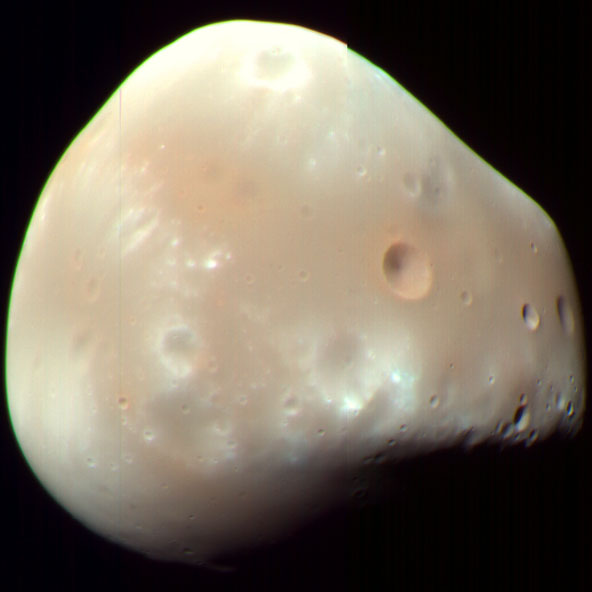
Happy, 135th, Deimos!


The above image is a close-up of the Martian satellite Deimos, taken March 9, 2009 by the HiRISE instrument aboard NASA's Mars Reconnaissance Orbiter. Image Credit: NASA/JPL-Caltech/University of Arizona

August 11th marks the 135th anniversary of the discovery of Martian satellite Deimos by American astronomer Asaph Hall, Sr (August 11, 1877).

Hall discovered Deimos from the United States Naval Observatory in Washington, D.C. Based upon the recording method of the time, the day of discovery was August 11th. But based upon today's conventions, Hall made his discovery on August 12, 1877 at about 07:48 UTC. You see, Hall originally recorded "August 11 14:40" Washington mean time. In that era, the astronomical convention was to mark the beginning of the of the day at noon rather than midnight. So by adjusting for the 12 hours difference between noon and midnight, and then the 5 hours difference between Eastern Time and Greenwich Mean Time (GMT), and then the few minutes difference between local time and Eastern Time, we arrive at 07:48 UTC on August 12, 1877.

Hall would go on to discover Mars' other satellite a few days later. But that's another anniversary...

The Martian satellite names were originally spelled Phobus and Deimus. The names were suggested by Henry Madan (1838–1901), Science Master of Eton, from Book XV of the Iliad, where Ares (the Roman god Mars) summons Dread (Deimos) and Fear (Phobos).

In addition to his discovery of the Martian satellites, Hall determined the orbits of satellites of other planets and of double stars, the rotation of Saturn, and the mass of Mars.

To learn more about Deimos and NASA's ongoing Mars Exploration Program, visit www.nasa.gov/mars and mars.jpl.nasa.gov .

-