Pages

Sunday, June 17, 2012

Voyager 1 Going Interstellar Soon?

The above image is an artist concept of the the general locations of NASA's Voyager 1 and Voyager 2 spacecraft. The two are shown passing through the heliosheath, the last area of our solar system before reaching interstellar space. Image Credit: NASA/JPL-Caltech

Voyager 1 may soon be "out of here," as far as our solar system is concerned. NASA engineers report that data from the spacecraft indicate this venerable deep-space explorer has encountered a region in space where the intensity of charged particles from beyond our solar system has markedly increased. Voyager scientists looking at this rapid rise draw closer to an inevitable but historic conclusion: humanity's first emissary to interstellar space is on the edge of our solar system.
Mission team members knew Voyager would someday become the first human-made interstellar spacecraft, but they were not certain when that would happen. Now, they think the latest data indicate they are in a new region where things are changing more quickly and this could be it.

The data making the 16-hour-38 minute, 11.1-billion-mile (17.8-billion-kilometer), journey from Voyager 1 to antennas of NASA's Deep Space Network on Earth detail the number of charged particles measured by the two High Energy telescopes aboard the 34-year-old spacecraft. These energetic particles were generated when stars in our cosmic neighborhood went supernova.

From January 2009 to January 2012, Voyager 1 received a gradual increase in galactic cosmic rays of about. More recently, that rate has been climbing Beginning on May 7, the rate increased five percent in one week and nine percent in one month.

This marked increase is one of a triad of data sets which need to make significant swings of the needle to indicate a new era in space exploration. The second important measure from the spacecraft's two telescopes is the intensity of energetic particles generated inside the heliosphere, the bubble of charged particles our sun blows around itself. While there has been a slow decline in the measurements of these energetic particles, they have not dropped off precipitously, which could be expected when Voyager breaks through the solar boundary.

The final data set that Voyager scientists believe will reveal a major change is the measurement in the direction of the magnetic field lines surrounding the spacecraft. While Voyager is still within the heliosphere, these field lines run east-west. When it passes into interstellar space, the team expects Voyager will find that the magnetic field lines orient in a more north-south direction. Such analysis will take weeks, and the Voyager team is currently crunching the numbers of its latest data set.

Launched in 1977, Voyager 1 and 2 are in good health. Voyager 2 is more than 9.1 billion miles (14.7 billion kilometers) away from the sun. Both are operating as part of the Voyager Interstellar Mission, an extended mission to explore the solar system outside the neighborhood of the outer planets and beyond. NASA's Voyagers are the two most distant active representatives of humanity and its desire to explore.

And now, the mission particulars...

The Voyager spacecraft were built by NASA's Jet Propulsion Laboratory in Pasadena, California, which continues to operate both. JPL is a division of the California Institute of Technology. The Voyager missions are a part of the NASA Heliophysics System Observatory, sponsored by the Heliophysics Division of the Science Mission Directorate in Washington. For more information about the Voyager spacecraft, visit: http://www.nasa.gov/voyager .

Like what you see? Let me know! Email: RoamingAstroInput@gmail.com

-

Saturday, June 16, 2012

AR 1504 Update for June 16th


Sunspot 1504 has developed a delta-class magnetic field that poses a threat for Earth-directed X-flares. Credit: SDO/HMI

Over June 13th and 14th, two solar flares and two coronal mass ejections (CMEs) erupted from the sun's Active Region 1504 (AE 1504). Today, June 16th, around 0900 UT (5:00 AM EDT), the combined groupings of particles reached Earth in the form of a "double CME." The impact was reported as "weak." The solar wind speed in the wake of the CME barely climbed to 400 km/s (about 1 million miles per hour). This rate is about the average for solar wind. The impact did not even trigger a geomagnetic storm.

But AR 1504 is not done yet. The region has developed a 'beta-gamma-delta' magnetic field that harbors energy for strong solar flares — and the region's huge sunspot (Sunspot 1504) is directly facing Earth.
Forecasters for the Narional Oceanic and Atmospheric Administration (NOAA) estimate a 65% chance of M-flares and a 5% chance of X-flares from AR 1504 during the next 24 hours. To visit NOAA online, follow this link, www.noaa.gov/ . Please stay tuned...

To learn more about the sun and to stay current on solar activity, visit the mission home page of Solar Dynamics Observatory (SDO), sdo.gsfc.nasa.gov/ .

Like what you see? Let me know! Email: RoamingAstroInput@gmail.com

-

Tropical Lakes...On Titan?

In the above image, Saturn's rings lie in the distance as the Cassini spacecraft looks toward Titan and its dark region called Shangri-La, east of the landing site of the Huygens Probe. Image Credit: NASA/JPL-Caltech/Space Science Institute

To be clear, Saturn's largest moon is colder than Earth. It has an average temperature of 93.7 K (−179.5 °C). The atmosphere is mostly nitrogen with some methane mixed in, a little more methane at the surface than in the upper layers.The surface pressure of Titan is 146.7 kPa, or about 1.45 times that of sea-level on Earth. At those pressures and temperatures, the methane can behave like water on Earth, evaporating in warmer regions, raining from the sky in colder ones, and pooling in depressions to form methane lakes. Within that understanding of Titan's ecosystem, let's press on...

NASA's Cassini spacecraft continues to see shallow, standing lakes of methane on the surface of Titan in the "tropics" — the latitudes immediately north and south of Titan's equator. One of the tropical lakes appears to be about half the size of Utah's Great Salt Lake, with a depth of at least 3 feet (1 meter).

The result, which is a new analysis of Cassini data, is unexpected because models had assumed the long-standing bodies of liquid would only exist at the poles. The findings appear in this week's issue of the journal Nature.

Where could the liquid for these lakes come from? The mission team suggests that an one likely supplier is an underground aquifer. Basically, Titan could have oases.

Understanding how lakes or wetlands form on Titan helps scientists learn about the moon's weather. Like Earth's hydrological cycle, Titan has a "methane" cycle, with methane rather than water circulating. In Titan's atmosphere, ultraviolet light breaks apart methane, initiating a chain of complicated organic chemical reactions. But existing models haven't been able to account for the abundant supply of methane.

An aquifer could explain one of the puzzling questions about the existence of methane, which is continually depleted. Methane is a progenitor of Titan's organic chemistry, which likely produces interesting molecules like amino acids, the building blocks of life.

Global circulation models of Titan have theorized that liquid methane in the moon's equatorial region evaporates and is carried by wind to the north and south poles, where cooler temperatures cause methane to condense. When it falls to the surface, it forms the polar lakes. On Earth, water is similarly transported by the circulation, yet the oceans also transport water, thereby countering the atmospheric effects.

The latest results come from Cassini's visual and infrared mapping spectrometer, which detected the dark areas in the tropical region known as Shangri-La, near the spot where the European Space Agency's Huygens probe landed in 2005. When Huygens landed, the heat of the probe's lamp vaporized some methane from the ground, indicating it had landed in a damp area.

Areas appear dark to the visual and infrared mapping spectrometer when liquid ethane or methane are present. Some regions could be shallow, ankle-deep puddles. Cassini's radar mapper has seen lakes in the polar region, but hasn't detected any lakes at low latitudes.

The tropical lakes detected by the visual and infrared mapping spectrometer have remained since 2004. Only once has rain been detected falling and evaporating in the equatorial regions, and only during the recent expected rainy season. Scientists therefore deduce the lakes could not be substantively replenished by rain.

Mission team scientists had thought Titan's system was more simple, with extensive dunes at the equator and lakes at the poles. Now they see that Titan is more complex. Going forward, they will pay closer attention to the Cassini spacecraft's passing of Titan in order to see how the details are filled in.

And now, the mission particulars...

The Cassini-Huygens mission is a cooperative project of NASA, the European Space Agency and the Italian Space Agency. The Jet Propulsion Laboratory, a division of the California Institute of Technology in Pasadena, manages the mission for NASA's Science Mission Directorate, Washington. The Cassini orbiter and its two onboard cameras were designed, developed and assembled at JPL. The imaging team is based at the Space Science Institute, Boulder, Colorado. The visual and infrared mapping spectrometer team is based at the University of Arizona, Tucson.

For more information, visit www.nasa.gov/cassini and saturn.jpl.nasa.gov .

Like what you see? Let me know! Email: RoamingAstroInput@gmail.com
-

Friday, June 15, 2012

Two AR 1504 CMEs Incoming!

The above image of the sun shows the very  Active Region 1504, which has been so since rotating into view June 10th. Image Credit: SDO/HMI

Since it came around the left limb of the sun on June 10, Active Region 1504 (AR 1504) has been just that.  An now it has produced two M-class solar flares and two coronal mass ejections (CMEs). But before we proceed, lets make sure everyone is comfortable with some terminology.

Solar Flare Primer

To review, a solar flare is an explosion on the sun that occurs when the energy stored in twisted magnetic fields (usually above sunspots) is suddenly released. Flares produce a burst of radiation across the electromagnetic spectrum, from radio waves to X-rays and gamma-rays.

Solar flares are classified, from lowest to highest, as A, B, C, M and X according to the peak flux (in watts per square meter, W/m^2) of 100 to 800 picometer X-rays near Earth, as measured on the GOES spacecraft. The five categories break down as follows.

A-class: Peak flux of less than 10^-7 Watts/square meter. A-class flares produce no noticeable consequences on Earth.

B-class: Peak flux ranges from 10^-7 to 10^-6 Watts/square meter. B-class flares produce no noticeable consequences on Earth.

C-class: Peak flux ranges from 10^-6 to 10^-5 Watts/square meter. C-class flares produce few noticeable consequences
on Earth.

M-class: Peak flux ranges from 10^-5 to 10^-4 Watts/square meter. M-class flares  can cause brief radio blackouts that affect Earth's polar regions. Minor radiation storms sometimes follow an M-class flare.

X-class: Peak flux is greater than 10^-4 Watts/square meter. X-class flare are major events that can trigger planet-wide radio blackouts and long-lasting radiation storms.

Within each category are nine subdivisions of strength. For example, C1 to C9, M1 to M9, and so on. On July 14, 2000, the sun produced a X6 flare which triggered a major radiation storm around Earth and was nicknamed the Bastille Day event.

Coronal Mass Ejection Primer

A coronal mass ejection (CME) is a massive burst of solar wind, plasma, and magnetic fields rising above the solar corona or being released into space.

CMEs are often associated with other forms of solar activity, most notably solar flares, but a causal relationship between the two has not been established. Most CMEs originate from active regions on Sun's surface, such as groupings of sunspots associated with frequent flares. Near a solar maximum — the period of greatest activity in a solar cycle — the sun produces about three CMEs every day, whereas near a solar minimum — the period of least activity in a solar cycle — there is about one CME every five days.

Now, Where Were We?...

Oh, yes. The region AR 1504 fired off two M-class flares and two CMEs on June 13th and June 14th. The first flare lasted for a relatively long three hours, peaking on June 13th at 9:17 AM EDT. The associated CME traveled at approximately 375 miles per second and is directed toward Earth, though due to its slow speed, the effect on Earth is expected to be minimal.

The second M-class flare was also a long-duration flare, and it peaked on June 14th at 10:08 AM EDT. The CME associated with this flare is traveling much faster – preliminary analysis at Goddard's Space Weather Center indicates it is traveling at speeds of approximately 800 miles per second. It is traveling toward Earth, and could also impact Mars and the Spitzer spacecraft.

Current models estimate that both CMEs will arrive on June 16th. Please stay tuned for more details as we learn them.

To learn more about the sun and to stay current on solar activity, visit the mission home page of Solar Dynamics Observatory (SDO), sdo.gsfc.nasa.gov/ .

-

Thursday, June 14, 2012

WISE Watching for Brown Dwarfs


The above image shows our local solar neighborhood, from a vantage point about 30 light-years away from the sun. The image highlights the population of brown dwarfs recently discovered by NASA's Wide-field Infrared Survey Explorer, or WISE (red circles). The image simulates actual positions of stars. Image Credit: NASA/JPL-Caltech

The neighborhood watch is on patrol...for brown dwarfs, that is. Our sun resides within a spiral arm of our Milky Way galaxy about two-thirds of the way out from the center. This area is fairly calm and suburban-like, with an average number of stars. Recently, NASA's Wide-field Infrared Survey Explorer (WISE) has been turning up a new crowd of stars close to home: the coldest of the brown dwarf family.

To refresh your memory, brown dwarfs are sub-stellar objects which are too low in mass to sustain hydrogen-1 fusion reactions in their cores, which is characteristic of stars on the main sequence. Brown dwarfs occupy the mass range between that of large gas giant planets and the lowest-mass stars; this upper limit is between 75 and 80 Jupiter masses. Currently there is some debate concerning what criterion to use for defining the separation between a brown dwarf and a giant planet at very low brown dwarf masses (~13), and whether brown dwarfs are required to have experienced fusion at some point in their history. In any event, brown dwarfs heavier than 13 Jupiter masses do fuse deuterium and those above about 65 Jupiter masses also fuse lithium. Some planets are known to orbit brown dwarfs (2M1207b, MOA-2007-BLG-192Lb, and 2MASS J044144b). Enough of the refresh. Let's push on...

The interesting thing is that WISE found there are far fewer brown dwarfs in our stellar neighborhood than astronomers had predicted. Previous estimates were as many brown dwarfs as typical stars, but the initial tally from WISE shows just one brown dwarf for every six stars, or 1:6. It's the cosmic equivalent to finally being able to see into a mysterious gated community and finding only a few homes.

Nonetheless, the observations are providing crucial information about how these exotic worlds form, and hinting at what their population densities might be like in our galaxy and beyond. Astronomers think these brown dwarfs formed by several different mechanisms, including having their growth stunted by a variety of factors that prevent them from becoming full-blown stars. Even so, they are not exactly certain of the process.

WISE was launched in 2009 and surveyed the entire sky in infrared light in 2010. One of the mission's main science goals was to survey the sky for the elusive brown dwarfs. These small bodies start their lives like stars, but lack the bulk required to burn nuclear fuel. With time, they cool and fade, making them difficult to find.

Improvements in WISE's infrared vision over past missions have allowed it to pick up the faint glow of many of these hidden objects. In August 2011, the mission announced the discovery of the coolest brown dwarfs spotted yet, a new class of stars called Y dwarfs. One of the Y dwarfs is less than 80 degrees Fahrenheit (25 degrees Celsius), or about room temperature, making it the coldest star-like body known. Since then, the WISE science team has surveyed the entire landscape around our sun and discovered 200 brown dwarfs, including 13 Y dwarfs.

Determining the distances to these objects is a key factor in knowing their population density in our solar neighborhood. After carefully measuring the distance to several of the coldest brown dwarfs via a method called parallax, the scientists were able to estimate the distances to all the newfound brown dwarfs. They concluded that about 33 brown dwarfs reside within 26 light-years of sun. There are 211 stars within this same volume of space, so that means there are about six stars for every brown dwarf.

Mission team members emphasize that the WISE survey results are still preliminary. The suggest it is highly likely that WISE will discover additional Y dwarfs, but not in vast numbers, and probably not closer than the closest known star, Proxima Centauri. Those discoveries could bring the ratio of brown dwarfs to stars up a bit, to about 1:5 or 1:4, but not to the 1:1 level previously anticipated.

The new observations still allow the possibility of free-floating planets up to a few times the mass of Jupiter beyond a few light-years from the sun, which other surveys have predicted might exist. Those bodies would be too faint for WISE to see in the processed data in hand.

The new results are due to appear in the July 10 issue of The Astrophysical Journal. The Journal issues may be read online here: http://iopscience.iop.org/0004-637X .

And now, the mission particulars...

JPL manages, and operated, WISE for NASA's Science Mission Directorate. The spacecraft was put into hibernation mode after it scanned the entire sky twice, completing its main objectives. Edward Wright is the principal investigator and is at UCLA. The mission was selected competitively under NASA's Explorers Program managed by the agency's Goddard Space Flight Center in Greenbelt, Maryland. The science instrument was built by the Space Dynamics Laboratory in Logan, Utah. The spacecraft was built by Ball Aerospace & Technologies Corp. in Boulder, Colorado. Science operations and data processing take place at the Infrared Processing and Analysis Center at the California Institute of Technology in Pasadena. Caltech manages JPL for NASA.

More information is online at www.nasa.gov/wise and wise.astro.ucla.edu and jpl.nasa.gov/wise .

The Two-Micron All-Sky Survey (2MASS) mission was a joint effort between Caltech, the University of Massachusetts and NASA/JPL. Data are archived at the Infrared Processing and Analysis Center at Caltech: www.ipac.caltech.edu/ .

Like what you see? Let me know! Email: RoamingAstroInput@gmail.com

-

Wednesday, June 13, 2012

NuSTAR Flying Free

The above series of images show NASA's NuSTAR spacecraft, along with OSC's Pegasus XL rocket, dropping from OSC's Stargazer aircraft. Image Credit: Orbital Sciences Corporation (OSC)

It's up! NASA's Nuclear Spectroscopic Telescope Array (NuSTAR) launched into the morning skies over the central Pacific Ocean at noon EDT (9 AM PDT) today (Wednesday).

The observatory began its journey aboard a Lockheed L-1011 aircraft named Stargazer, owned and operated by Orbital Sciences Corporation (OSC), Dulles, Virginia. NuSTAR was perched atop OSC's three-stage Pegasus XL rocket, both of which were strapped to the belly of Stargazer. The aircraft left Kwajalein Atoll in the central Pacific Ocean one hour before launch. At 12:00:35 PM EDT (9:00:35 AM PDT), the rocket dropped, free-falling for five seconds before firing its first-stage motor.

About 13 minutes after the drop, NuSTAR separated from the third stage, reaching its final low-Earth orbit. The first signal from the spacecraft was received at 12:14 PM EDT (9:14 AM PDT) via NASA's Tracking and Data Relay Satellite System. NuSTAR then spread its solar panels to charge the spacecraft battery and confirmed with ground control that all was well.

The NuSTAR mission's unique telescope design includes a 33-foot (10-meter) mast, which was folded up in a small canister prior to launch. In about seven days, engineers will command the mast to extend, enabling the telescope to focus properly. About 23 days later, science operations are scheduled to begin.

Once science operations commence, NuSTAR will be the first space telescope to create sharp images of X-rays with high energies. It will conduct a census for black holes, map radioactive material in young supernovae remnants, and study the origins of cosmic rays and extreme physics around collapsed stars. In addition, NuSTAR will study our sun's fiery atmosphere, looking for clues as to how it is heated. NuSTAR will provide complementary data to NASA's larger observatory missions, including Fermi, Chandra, Hubble and Spitzer.

And now, the mission particulars...

NuSTAR is a Small Explorer mission led by the California Institute of Technology in Pasadena and managed by NASA's Jet Propulsion Laboratory, also in Pasadena, for NASA's Science Mission Directorate in Washington. The spacecraft was built by Orbital Sciences Corporation, Dulles, Virginia. Its instrument was built by a consortium including Caltech; JPL; the University of California, Berkeley (UC Berkley); Columbia University, New York; NASA's Goddard Space Flight Center, Greenbelt, Maryland; the Danish Technical University in Denmark; Lawrence Livermore National Laboratory, Livermore, California; and ATK Aerospace Systems, Goleta, California. NuSTAR will be operated by UC Berkeley, with the Italian Space Agency providing its equatorial ground station located at Malindi, Kenya. The mission's outreach program is based at Sonoma State University, Rohnert Park, California. NASA's Explorer Program is managed by Goddard. JPL is managed by Caltech for NASA.

The launch management and government oversight for the mission is the responsibility of NASA's Launch Services Program at the Kennedy Space Center in Florida. For more information on the NuSTAR mission, visit www.nasa.gov/nustar and www.nustar.caltech.edu/ .

Like what you see? Let me know! Email: RoamingAstroInput@gmail.com

-

NuSTAR Launching Today

The above image shows the three-stage Orbital Sciences Corporation (OSC) Pegasus XL rocket with the NuSTAR spacecraft (hidden) strapped to the nose. The Pegasus XL is mounted to the belly of the OSC's Lockheed L-1011 Stargazer launch aircraft. This image was taken before the Stargazer departed Vandenberg Air Force Base for Kwajalein Atoll in the central Pacific Ocean . Photo Credit: NASA/Randy Beaudoin, VAFB

This is the day, folks! NASA's Nuclear Spectroscopic Telescope Array (NuSTAR) is scheduled to launch into low-Earth orbit.

This morning, no earlier than 11:30 AM EDT (8:30 AM PDT), NuSTAR will be launched above Kwajalein Atoll in the central Pacific Ocean. NuSTAR will be the first space telescope to create sharp images of X-rays with high energies, similar to those used by doctors and dentists. It will conduct a census for black holes, map radioactive material in young supernovae remnants, and study the origins of cosmic rays and extreme physics around collapsed stars.

Currently, NuSTAR is strapped to an Orbital Science Corporation (OSC) Pegasus XL rocket. This, in turn, is mounted to the belly of OSC's Lockheed L-1011 Stargazer launch aircraft. Why? So NuSTAR can be flown to a high altitude by Stargazer and then carried by the Pegasus XL the rest of the way to orbit. Plane-assisted launches are less expensive than those that take place from the ground. Less fuel is needed to boost cargo away from the pull of Earth's gravity. This profile of launch works well for NASA's Small Explorer program, which develops focused science missions at relatively low costs. And NuSTAR is part of the Small Explorer program.

Live Coverage of Launch

Beginning at 10 AM EDT (7 AM PDT), live commentary and coverage will be broadcast online at www.nasa.gov/nustar and at www.ustream.tv/nasajpl2 .

NuSTAR has a four-hour launch window. If everything goes well for a launch at the opening of the window (pun intended), here is a breakdown of the possible timeline.

T - 1 hour: Takeoff - The Stargazer carrier aircraft, with the three-stage Pegasus XL and NuSTAR spacecraft strapped to its belly, will take off from Kwajalein's Bucholz Auxiliary Airfield and climb to an altitude of about 39,000 feet (11,900 meters). This should occur around 10:30 AM EDT (7:30 AM PDT).

T - 0 seconds: Drop Launch - The Stargazer will release the Pegasus XL rocket at 11:30 AM EDT (8:30 AM PDT). The rocket will free-fall for about five seconds before igniting.

T + 5 seconds: First Stage Ignition - At about 11:30 AM EDT (8:30 AM PDT), the Pegasus XL will ignite. Its first-stage motor will burn for 70 seconds and then drop away.

T + 1 minute 16 seconds: First Stage Burnout

T + 1 minute 32.05 seconds: Second Stage Ignition - the second-stage motor will burn for about a minute-and-a-half.

T + 2 minutes 8.3 seconds: Payload Fairing Separation - While the second stage is burning, pyrotechnic devices will be fired to release the nose cone, or fairing, that encapsulates the observatory. NuSTAR will then be exposed to space for the first time.

T + 2 minutes 44.8 seconds: Second Stage Burnout

T + 9 minutes 6 seconds: Third Stage Ignition

T + 10 minutes 14 seconds: Third Stage Burnout and Orbital Insertion

T + 13 minutes: Separating From the Rocket / Phoning Home - At about 8:43 a.m. PDT (11:43 a.m. EDT), NuSTAR will separate from the third stage. At this point, NuSTAR will be in its final orbit — a low-Earth equatorial orbit at an altitude of approximately 340 miles (600 kilometers) and an inclination of six degrees. At this point, NuSTAR's system that controls its orientation in space, or "attitude," will begin to stabilize it, and the spacecraft solar arrays will be deployed. Around this time, its first signal will be received on the ground via NASA's Tracking and Data Relay Satellite System. Over the following week, NuSTAR personnel will perform a series of checkouts to ensure that all spacecraft subsystems are operating nominally.

T + approximately 7 days: Deploying the Boom - Roughly one week after launch, engineers will command NuSTAR to deploy its lengthy 33-foot (10-meter) boom, allowing the telescope to focus X-ray light into crisp images. Unlike visible-light telescopes, X-ray telescopes require a long distance between the mirrors and detectors to focus the light. It's a bit like wearing glasses a few feet away from your face.

T + approximately 30 days: Beginning Science Operations - Science operations are expected to begin about 30 days after launch.

A video showing a previous Pegasus launch is online at www.nasa.gov/multimedia/videogallery/index.html?media_id=128352201 .

And now, the mission particulars...

NuSTAR is a Small Explorer mission led by the California Institute of Technology in Pasadena and managed by NASA's Jet Propulsion Laboratory, also in Pasadena, for NASA's Science Mission Directorate in Washington. The spacecraft was built by Orbital Sciences Corporation, Dulles, Virginia. Its instrument was built by a consortium including Caltech; JPL; the University of California, Berkeley (UC Berkley); Columbia University, New York; NASA's Goddard Space Flight Center, Greenbelt, Maryland; the Danish Technical University in Denmark; Lawrence Livermore National Laboratory, Livermore, California; and ATK Aerospace Systems, Goleta, California. NuSTAR will be operated by UC Berkeley, with the Italian Space Agency providing its equatorial ground station located at Malindi, Kenya. The mission's outreach program is based at Sonoma State University, Rohnert Park, California. NASA's Explorer Program is managed by Goddard. JPL is managed by Caltech for NASA.

The launch management and government oversight for the mission is the responsibility of NASA's Launch Services Program at the Kennedy Space Center in Florida. For more information on the NuSTAR mission, visit www.nasa.gov/nustar and www.nustar.caltech.edu/ .

Like what you see? Let me know! Email: RoamingAstroInput@gmail.com

-

Tuesday, June 12, 2012

Curiosity to Land Closer to Mount Sharp

The above image shows changes in the target landing area for Curiosity, the rover of NASA's Mars Science Laboratory project. The large ellipse represents the original landing area. the smaller ellipse represents the new, smaller landing area. Image Credit: NASA/JPL-Caltech/ESA/DLR/FU Berlin/MSSS 

On Monday, June 11th, members of NASA's Mars Science Laboratory (MSL) mission hosted a teleconference to provide updates on the status of the mission and on changes to the mission profile. And one of these changes, on first review, could cause some mission followers to gasp. 

Here is the deal. The MSL spacecraft is suppose to land the Curiosity rover inside Gale Crater so that the rover, after safely landing, can drive the rest of the way (over several months' time) to the central peak of the crater, called Mount Sharp. There the mission team will use the rover's instruments to investigate whether the area has ever offered an environment favorable for microbial life. 

But now, the mission team thinks they can shorten Curiosity's drive time by narrowing the landing target to a point closer to the foot of Mount Sharp. Specifically, they plan to cut the drive distance by half. The new plan could cut the drive time by months. The problem? Unless the mission team wants to toss out that whole "safely landing" outcome I mentioned earlier, they need to be pretty confident that they and the spacecraft can pull this off. And it seems that they are. 

Apparently, it was possible to adjust the landing plans because of increased confidence in the precision landing technology aboard the MSL spacecraft, which is carrying the Curiosity rover. The mission team report that the spacecraft can now aim closer without hitting Mount Sharp. 

Curiosity is scheduled to land at approximately 1:31 AM EDT, August 6 (10:31 PM PDT, August 5). Following checkout operations, Curiosity will begin a two-year study of whether the landing vicinity ever offered an environment favorable for microbial life. 

The landing target ellipse had been approximately 12 miles wide and 16 miles long (20 kilometers by 25 kilometers). Continuing analysis of the new landing system's capabilities has allowed mission planners to shrink the area to approximately 4 miles wide and 12 miles long (7 kilometers by 20 kilometers), assuming winds and other atmospheric conditions are as predicted. 

Even with the smaller ellipse, the mission team is confident that  Curiosity will be able to touch down at a safe distance from steep slopes at the edge of Mount Sharp. But they do note that landing on Mars always carries risks, so success is not guaranteed. Once on the ground, the team will proceed carefully. They have plenty of time since Curiosity is not as life-limited as the approximate 90-day missions like NASA's Mars Exploration Rovers (Spirit and Opportunity) and the Phoenix lander. 

Since the spacecraft was launched in November 2011, engineers have continued testing and improving its landing software. MSL will use an upgraded version of flight software installed on its computers during the past two weeks. Additional upgrades for Mars surface operations will be sent to the rover about a week after landing. 

Other preparations include upgrades to the rover's software and understanding the effects of debris coming from the drill the rover will use to collect samples from rocks on Mars. Experiments at JPL indicate that Teflon from the drill could mix with the powdered samples. Testing will continue past the landing with duplicates of the drill. The rover will deliver the samples to onboard instruments that can identify mineral and chemical ingredients. Any Teflon from the drill could complicate, but will not prevent analysis of carbon content in rocks by one of the rover's 10 instruments. The team members know there are workarounds. Organic carbon compounds in an environment are one prerequisite for life. Astronomers know meteorites deliver non-biological organic carbon to Mars, but not whether it persists near the surface. The MSL mission team will be checking for that and for other chemical and mineral clues about habitability. 

Curiosity will be in good company as it nears landing. Two NASA Mars orbiters, along with a European Space Agency orbiter, will be in position to listen to radio transmissions as Mars Science Laboratory descends through Mars' atmosphere. 

The mission is managed by JPL for NASA's Science Mission Directorate in Washington. Curiosity was designed, developed and assembled at JPL. Caltech manages JPL for NASA. 

Follow the mission on Facebook and Twitter at www.facebook.com/marscuriosity and www.twitter.com/marscuriosity . 

For more information on the Mars Science Laboratory/Curiosity mission, visit: www.nasa.gov/msl . 

-

Monday, June 11, 2012

MSL/Curiosity Telecon Today


The above image is an artist's concept, depicting the moment that NASA's Mars Science Laboratory (Curiosity rover) touches down onto the Martian surface. Image Credit: NASA/JPL-Caltech

Listen up, friends! If you have been curious about the progress of Curiosity and the Mars Science Laboratory (MSL) mission. This is your lucky day!

Today, June 11th, at noon EDT (9 AM PDT) NASA will host a media teleconference, to provide a status update on the August 5th, landing of MSL, the most advanced rover sent to Mars to-date.

Launched November 26, 2011, NASA's Mars Science Laboratory spacecraft and Curiosity rover are on track for landing the evening of August 5, 2012, PDT (early on August 6, Universal Time and EDT) to begin a two-year prime mission. Researchers plan to use Curiosity to study layers in Gale Crater's central mound, Mount Sharp. The mission will investigate whether the area has ever offered an environment favorable for microbial life. The panelists for today's teleconference include:

— Dave Lavery, MSL program executive, NASA Headquarters, Washington

— Michael Meyer, lead scientist, Mars Exploration Program, NASA Headquarters

— Pete Theisinger, MSL project manager, Jet Propulsion Laboratory, Pasadena, California

— John Grotzinger, MSL project scientist, California Institute of Technology, Pasadena, California

Audio of today's event will be streamed live online at www.nasa.gov/newsaudio .

NASA's Jet Propulsion Laboratory, a division of the California Institute of Technology, Pasadena, manages the mission for NASA's Science Mission Directorate in Washington. More information about Curiosity is online at www.nasa.gov/msl and mars.jpl.nasa.gov/msl . You can follow the mission on Facebook at: www.facebook.com/marscuriosity and on Twitter at: www.twitter.com/marscuriosity .

-

Ice, Dust and Plasma. Go Figure.

Atention, class! Today the subject is plasma, often called the "Fourth State of Matter" (the other states being solid, liquid and gas). Plasma is similar to gas in which a certain portion of the particles are ionized. Heating a gas may ionize its molecules or atoms -- by reducing or increasing the number of electrons they have. The result is a plasma, which contains charged particles: positive ions and negative electrons or ions.

Still with me? Now, ionization can be induced by means other than heat. For example, a strong electromagnetic field. And the ionization is accompanied by the dissociation of molecular bonds, if they are present. The word "plasma" was first used in this way back in the 1920's, by American chemist and physicist Irving Langmuir (1881 - 1957), who worked to understand electric discharges. 

Okay. Now we must touch on dusty plasma, which is plasma containing nanometer (nm) or micrometer-sized particles suspended in it. Dust particles may be charged and the plasma and particles behave as a plasma, following electromagnetic laws for particles up to about 10 nm (or 100 nm if large charges are present). Dust particles may form larger particles resulting in "grain plasmas". Dusty plasmas can be found in industrial processing plasmas and space plasmas.

(cricket, cricket, cricket)

Wake up, people! This stuff is important. You must now apply this newfound knowledge to the icy world of Enceladus, the sixth-largest moon of Saturn. Composition-wise, Enceladus is 91 percent water vapor, 4 percent nitrogen, 3.2 percent carbon dioxide, and 1.7 percent methane.

Back in 2005 NASA’s Cassini mission first noted that Enceladus had geyser-like jets of icy particles rising from the crust. And now, recent findings from Cassini reveal that Enceladus is providing a special laboratory for watching unusual behavior of plasma. In these recent findings, some Cassini scientists think they have observed "dusty plasma," a condition that has been theorized but not previously observed near Enceladus. 

Data also show that the usual "heavy" and "light" species of charged particles in normal plasma are actually reversed near the plume spraying from the moon's south polar region. The findings are discussed in two recent papers in the Journal of Geophysical Research.

Ninety-nine percent of the matter in the universe is thought to exist as plasma, so scientists have been using Saturn as a site other than Earth to observe the behavior of this cloud of ions and electrons directly. Scientists want to study the way the sun sends energy into Saturn's plasma environment, since that jolt of energy drives processes such as weather and the behavior of magnetic field lines. They can use these data to understand how Saturn's plasma environment is similar to and different from that of Earth and other planets.

Enceladus is a major source of ionized material filling the huge magnetic bubble around Saturn. About 200 pounds (about 100 kilograms) of water vapor per second - about as much as an active comet - spray out from long cracks in the south polar region known as "tiger stripes." The ejected matter forms the Enceladus plume - a complex structure of icy grains and neutral gas that is mainly water vapor. The plume gets converted into charged particles interacting with the plasma that fills Saturn's magnetosphere. 

The nature of this unique gas-dust-plasma mixture has been revealed over the course of the mission with data from multiple instruments, including the Cassini plasma spectrometer, magnetometer, magnetospheric imaging instrument, and the radio and plasma wave science instrument. What scientists found most interesting is that the grains range continuously in size from small water clusters (a few water molecules) to thousandths of an inch (100 micrometers). They also saw that a large fraction of these grains trap electrons on their surface. Up to 90 percent of the electrons from the plume appear to be stuck on large, heavy grains. 

In this environment, Cassini has now seen positively charged ions become the small, "light" plasma species and the negatively charged grains become the "heavy" component. This is just the opposite of "normal" plasmas, where the negative electrons are thousands of times lighter than the positive ions.

In a paper published in the December issue of the journal, a team of Swedish and U.S. scientists on the Cassini mission examined radio and plasma wave science instrument observations from four flybys of Enceladus during 2008. They found a high plasma density (both ions and electrons) within the Enceladus plume region, although the electron densities are usually much lower than the ion densities in the plumes and in the E ring. The team concluded that dust particles a hundred millionth to a hundred thousandth of an inch (a nanometer to micrometer) in size are sweeping up the negatively charged electrons.  The mass of the observed "nanograins" ranges from a few hundred to a few tens of thousands of atomic mass units (proton masses), and must therefore contain tens to thousands of water molecules bound together. At least half of the negatively charged electrons are attached to the dust, and their interaction with the positively charged particles causes the ions to be decelerated. Because the dust is charged and behaves as part of the plasma cloud, this paper distinguishes this state of matter from dust that just happens to be in plasma.

In a dusty plasma, conditions are just right for the dust to also participate in the plasma's collective behavior. This increases the complexity of the plasma, changes its properties and produces totally new collective behavior. Dusty plasma are thought to exist in comet tails and dust rings around the sun, but scientists rarely have the opportunity to fly through the dusty plasma and directly measure its characteristics in place. And a separate analysis, based on data obtained by the Cassini plasma spectrometer, revealed the presence of nanograins having an electric charge corresponding to a single excess electron.

The nature of the Enceladus plume has been revealed over time due to the synergistic nature of the fields and particles instruments on Cassini, which has been orbiting in Saturn's magnetosphere since 2004. Following the original detection of the plume based on magnetometer measurements, team members found that the observed perturbation of Saturn's magnetic field required the presence of negatively charged dust grains in the plume. These findings were reported in the April and October 2011 issues of Journal of Geophysical Research Space Physics.  Previous data obtained by the ion and neutral mass spectrometer revealed the complex composition of the plume gas, and the cosmic dust analyzer revealed that the plume grains were rich in sodium salts. Because this scenario can only arise if the plume originated from liquid water, it provides compelling evidence for a subsurface ocean. 

Cassini will continue to study the complex nature of the plume region in the three planned additional flybys of Enceladus.  The Cassini-Huygens mission is a cooperative project of NASA, the European Space Agency and the Italian Space Agency. The Jet Propulsion Laboratory, a division of the California Institute of Technology in Pasadena, manages the mission for NASA's Science Mission Directorate, Washington. More Cassini information is at www.nasa.gov/cassini and saturn.jpl.nasa.gov .

You may visit the Journal of Geophysical Research at this URL: www.agu.org/journals/jgr/


You may visit the Journal of Geophysical Research Space Physics at this URL: www.agu.org/journals/ja/

-

Sunday, June 10, 2012

The Colorful Pinwheel

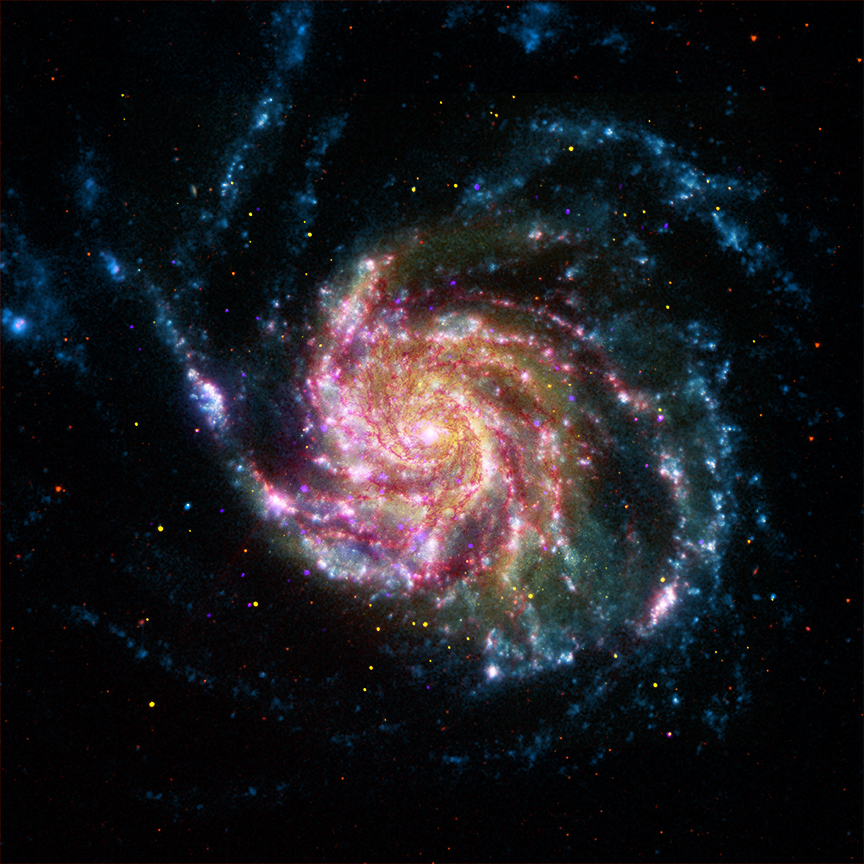
The above image of the Pinwheel Galaxy (M101), combines data from for NASA space-based telescopes. The image combines observation data for X-ray (Purple); Infrared (Red); Optical (Yellow); Ultraviolet (Blue). Image Credit: X-ray: NASA/CXC/SAO; IR & UV: NASA/JPL-Caltech; Optical: NASA/STScI

The image above is a wonderful example of the benefits of data gathered across multiple observatory missions. The image shows the Pinwheel Galaxy, also known as M101 (Messier 101). The image combines data in the infrared, visible, ultraviolet and X-rays. The data types were gathered from four different NASA space-based telescopes. This multi-spectral view shows that both young and old stars are evenly distributed along M101's tightly-wound spiral arms. Such composite images allow astronomers to see how features in one part of the spectrum match up with those seen in other parts. It is like seeing with a regular camera, an ultraviolet camera, night-vision goggles and X-ray vision, all at the same time.


The Pinwheel Galaxy is in the constellation of Ursa Major (also known as the Big Dipper). The Pinwheel is about 70 percent larger than our own Milky Way Galaxy, with a diameter of about 170,000 light years, and sits at a distance of 21 million light years from Earth. This means that the light we're seeing in this image left the Pinwheel Galaxy about 21 million years ago.


The hottest and most energetic areas in this composite image are shown in purple, where the Chandra X-ray Observatory observed the X-ray emission from exploded stars, million-degree gas, and material colliding around black holes.


The red colors in the image show infrared light, as seen by the Spitzer Space Telescope. These areas show the heat emitted by dusty lanes in the galaxy, where stars are forming.


The yellow component is visible light, observed by the Hubble Space Telescope. Most of this light comes from stars, and they trace the same spiral structure as the dust lanes seen in the infrared.


The blue areas are ultraviolet light, given out by hot, young stars that formed about one million years ago, captured by the Galaxy Evolution Explorer (GALEX).

Here are some quick facts about the subject:


- Object: NGC 5457,  M101 / Messier 101, The Pinwheel Galaxy

- Coordinates (J2000): Right Ascention 14h 03m 12.59s, Declination +54° 20' 56.70''


- Distance Estimate: About 21 million light years


- Observation Dates: From 03/26/2000 through 01/01/2005 with 26 pointings


- Observation Time: A total of 274 hours (11 days 10 hours)


- Color Code: X-ray (Purple); Infrared (Red); Optical (Yellow); Ultraviolet (Blue)

And now, the mission particulars...

The Contributing Visible-Light Mission: The Hubble Space Telescope (HST) is a space telescope that was carried into orbit by the Space Shuttle Discovery in April 1990. HST is a 2.4-meter (7.9 ft) aperture telescope in low Earth orbit, Hubble's four main instruments observe in the near ultraviolet, visible, and near infrared. The telescope is named after the astronomer Edwin Hubble. HST was built by NASA, with contributions from the European Space Agency (ESA), and is operated by the Space Telescope Science Institute. The HST is one of NASA's Great Observatories, along with the Compton Gamma Ray Observatory, the Chandra X-ray Observatory, and the Spitzer Space Telescope. The HST mission websites are: hubble.nasa.gov/ and asd.gsfc.nasa.gov/archive/hubble/ and hubblesite.org/

The Contributing X-ray Mission: The Chandra X-ray Observatory is a satellite launched July 1999 by Space Shuttle Columbia. Chandra is named in honor of Indian physicist Subrahmanyan Chandrasekhar who is known for determining the maximum mass for white dwarfs. "Chandra" also means "moon" or "luminous" in Sanskrit. Prior to launch, Chandra was known as AXAF, the Advanced X-ray Astrophysics Facility. Chandra was assembled and tested by TRW (now Northrop Grumman Aerospace Systems) in Redondo Beach, California. Chandra is sensitive to X-ray sources 100 times fainter than any previous X-ray telescope, due primarily to the high angular resolution of the Chandra mirrors. The mission website is: chandra.harvard.edu/

The Contributing Infrared Mission: The Spitzer Space Telescope (SST) was launched August 2003 aboard a Delta II rocket. Spitzer is an infrared space observatory, the fourth and final of the NASA Great Observatories program. The observatory was renamed in honor of Lyman Spitzer, one of the 20th century's great scientists. The mission website is: www.spitzer.caltech.edu/

The Contributing Ultraviolet Mission: NASA's Galaxy Evolution Explorer (GALEX) is an orbiting ultraviolet space telescope launched on April 28, 2003. A Pegasus rocket placed the craft into a nearly circular orbit at an altitude of 697 kilometres (433 mi) and an inclination to the Earth's equator of 29 degrees. In February 2011 NASA stopped missions operation funding because of budget priorities. In May 2012, GALEX operations were transferred to the California Institute of Technology (Caltech). The mission website is: www.galex.caltech.edu/

-

Saturday, June 09, 2012

Is Spitzer Seeing the First Objects of the Universe?


The two above panels show the same piece of sky in the constellation Bootes. The top panel shows the initial infrared view, foreground stars and unresolved galaxies included. The bottom panel is the same image, but with the stars and galaxies masked out (the gray patches). The remaining background glow has been smoothed and enhanced. The process reveals structure too faint to be seen in the original image. The top infrared image was taken by NASA's Spitzer Space Telescope. Image Credit: NASA/JPL-Caltech

Astronomers using NASA's Spitzer Space Telescope think they may have detected the faint, lumpy glow given off by the very first objects in the universe. The objects might be extremely massive stars or they might even be very hungry black holes. They are too far away to be seen individually, but Spitzer has captured new, convincing evidence of what appears to be the collective pattern of their infrared light.


The Spitzer observations help to confirm that the first objects were numerous and burned furiously. While astronomers cannot directly rule out the possibility that the light is coming from relatively nearby, they note that it seems more and more likely they are getting a glimpse of an ancient epoch.


The full details are in a new paper appearing in The Astrophysical Journal. The lead author is Alexander "Sasha" Kashlinsky of NASA's Goddard Space Flight Center in Greenbelt, Maryland. Other authors are Richard Arendt of Goddard and the University of Maryland in Baltimore County; Matt Ashby and Giovanni Fazio of the Harvard-Smithsonian Center for Astrophysics in Cambridge, Massachusetts; and John Mather and Harvey Moseley of Goddard. Fazio led the initial observations of these sky fields.


Spitzer first got hints of this remote pattern of light — the cosmic infrared background — in 2005. It saw the pattern with more precision in 2007. Now, Spitzer is in the extended phase of its mission, during which it performs more in-depth studies on specific patches of the sky. Kashlinsky and his colleagues used Spitzer to look at two patches of sky for more than 400 hours each.


The team then carefully subtracted all the known stars and galaxies in the images. Rather than being left with a black, empty patch of sky, they found faint patterns of light with several telltale characteristics of the cosmic infrared background. The lumps in the pattern observed are consistent with the way the very distant objects are thought to be clustered together.


Kashlinsky compares the observations being in Los Angeles and looking for Fourth of July fireworks in New York City. The observer would need to remove all the foreground lights between the two cities, as well as the blazing lights of New York City itself. Ultimately, the viewer would be left with a fuzzy map of how the fireworks are distributed, but they would still be too distant to make out individually.


Astronomers currently estimate that the universe formed roughly 13.7 billion years ago in a bright and rapid expansion, often described as the Big Bang. With time, it cooled and, by around 500 million years later, the first stars, galaxies and black holes began to form. Astronomers think that "first light" might have traveled billions of years to be picked up by Spitzer. The light would have originated at visible or even ultraviolet wavelengths and then, because of the expansion of the universe, stretched out to the longer, infrared wavelengths observed by Spitzer.


The new study improves on previous observations by measuring this cosmic infrared background out to scales equivalent to two full moons — significantly larger than what was detected before. Imagine trying to find a pattern in the noise in an old-fashioned television set by looking at just a small piece of the screen. It would be hard to know for certain if a suspected pattern was real. By observing a larger section of the screen, you would be able to resolve both small- and large-scale patterns, further confirming your initial suspicion.


In the same way, astronomers using Spitzer have increased the amount of sky examined to obtain more definitive evidence of the cosmic infrared background. The researchers plan to explore more patches of sky in the future to gather more clues hidden in the light of this ancient era.

There's much more to read in the paper, published online: "Reconstructing the Near-infrared Background Fluctuations from Known Galaxy Populations Using Multiband Measurements of Luminosity Functions." Kari Helgason, Massimo Ricotti, and Alexander Kashlinsky. 2012. The Astrophysical Journal, Volume 752, Number 2: iopscience.iop.org/0004-637X/752/2/113/

And now, the mission particulars...

Launched August 2003 aboard a Delta II rocket, the Spitzer Space Telescope was formerly the Space Infrared Telescope Facility (SIRTF). It is an infrared space observatory, the fourth and final of the NASA Great Observatories program. The observatory was renamed in honor of Lyman Spitzer, one of the 20th century's great scientists. NASA's Jet Propulsion Laboratory, Pasadena, California, manages the Spitzer mission for the agency's Science Mission Directorate in Washington. Science operations are conducted at the Spitzer Science Center at the California Institute of Technology (Caltech) in Pasadena. Data are archived at the Infrared Science Archive housed at the Infrared Processing and Analysis Center at Caltech. Caltech manages JPL for NASA. Spitzer's extended operations are expected to run through the U.S. government Fiscal year 2014 and be closed out in Fiscal year 2015. For more information about Spitzer, visit: www.nasa.gov/spitzer and http://www.spitzer.caltech.edu/ .


-

Friday, June 08, 2012

NuSTAR's June 13th Launch Quickly Approaching


The above image shows the L-100 Stargazer aircraft landing June 6th on Kwajalein Atoll in the Pacific Ocean. NuSTAR can be seen mounted to the belly of Stargazer and strapped to a Pegasus XL rocket. On June 13th, NuSTAR will be launched into Earth orbit. Image Credit: Orbital Sciences Corporation

Preparations are moving along for the launch of NASA's Nuclear Spectroscopic Telescope Array (NuSTAR). On 4th, NuSTAR was perched atop its Orbital Sciences Corporation (OSC) Pegasus XL rocket and strapped to OSC's L-1011 Stargazer launch aircraft. On June 5th, Stargazer departed Vandenberg Air Force Base in central California and, on June 6th, reached the launch point of Kwajalein Atoll in the central Pacific Ocean.

NuSTAR will be the first space telescope to create sharp images of X-rays with high energies, similar to those used by doctors and dentists. It will conduct a census for black holes, map radioactive material in young supernovae remnants, and study the origins of cosmic rays and extreme physics around collapsed stars.

On Monday, June 11th at 3 PM EDT (noon PDT), NASA will host a news teleconference to discuss the June 13th launch. The panelists include:

— Omar Baez, NASA launch director, Kennedy Space Center, Florida

— Fiona Harrison, NuSTAR principal investigator, California Institute of Technology, Pasadena, California

— William Craig, NuSTAR instrument manager, University of California at Berkeley (UC Berkeley)

— Grace Baird, NuSTAR bus chief engineer, Orbital Sciences Corporation, Dulles, Virginia

The news teleconference will take place at the Space Sciences Laboratory at UC Berkeley. Graphics presented during the teleconference will be online shortly before the event begins, at 1.usa.gov/nustar . Live audio of the teleconference will be available at www.nasa.gov/newsaudio .

On June 13th, about an hour before launch, Stargazer will lift off from the island and ascend to launch altitude. Stargazer will then drop NuSTAR and its Pegasus XL rocket over the Pacific. The Pegasus XL will ignite, carrying NuSTAR to its final orbit above Earth's equator. Launch coverage and commentary will be broadcast online, beginning 90 minutes before launch, at www.nasa.gov/nustar .

And now, the mission particulars...

NuSTAR is a Small Explorer mission led by the California Institute of Technology in Pasadena and managed by NASA's Jet Propulsion Laboratory, also in Pasadena, for NASA's Science Mission Directorate in Washington. The spacecraft was built by Orbital Sciences Corporation, Dulles, Virginia. Its instrument was built by a consortium including Caltech; JPL; the University of California, Berkeley (UC Berkley); Columbia University, New York; NASA's Goddard Space Flight Center, Greenbelt, Maryland; the Danish Technical University in Denmark; Lawrence Livermore National Laboratory, Livermore, California; and ATK Aerospace Systems, Goleta, California. NuSTAR will be operated by UC Berkeley, with the Italian Space Agency providing its equatorial ground station located at Malindi, Kenya. The mission's outreach program is based at Sonoma State University, Rohnert Park, California. NASA's Explorer Program is managed by Goddard. JPL is managed by Caltech for NASA.

The launch management and government oversight for the mission is the responsibility of NASA's Launch Services Program at the Kennedy Space Center in Florida. For more information on the NuSTAR mission, visit www.nasa.gov/nustar and www.nustar.caltech.edu/ .

-

Thursday, June 07, 2012

Colorful Vesta Video Released June 6

When you have a moment, be sure to check out this NASA-provided link: t.co/XKaez5wG

The link will take you to YouTube and present a 1-minute 27-second video which was just released by NASA Jet Propulsion Laboratory, Pasadena, California. The video is entitled, "Asteroid Vesta's Coat of Many Colors." The animation was created by the Planetary Science Institute and is based on data obtained by Dawn's framing camera from September and October 2011. Image Credit: NASA / JPL-Caltech / MPS / DLR / IDA / PSI

The video animation is based on data from NASA's Dawn spacecraft. It starts with high-resolution black and white images of asteroid Vesta, which is wrapped onto a 3-D shape model and rotated. The image then transitions to false-color images of the surface. The surface colors were chosen to highlight differences in surface composition that are too subtle for the human eye to see.

Scientists are still analyzing what some of the colors mean for the composition of the surface. But they are confident that the orange material thrown out from some of the impact craters is different from the other surface material. Also, they note that the green coloration indicates a relative abundance of iron. For example, you may note that parts of the huge Rheasilvia impact basin, in Vesta's southern hemisphere, have less iron than nearby areas.

As noted, the images were obtained using Dawn's framining camera. While some areas in the north were in shadow at the time the images were taken, the Dawn team expects to improve this coverage with additional observations. Dawn's viewing geometry also prevented mapping of a portion of the moutain of the south pole.

The Dawn spacecraft is currently spiraling up from its lowest-altitude orbit into its final science orbit, where its average altitude will be about 420 miles (680 kilometers). Dawn is scheduled to leave asteroid Vesta around August 26 (my birthday) and head toward dwarf planet Ceres.

And now, the mission particulars...

The Dawn mission is managed by NASA's Jet Propulsion Laboratory in Pasadena, California, for the agency's Science Mission Directorate in Washington. Dawn is a project of the directorate's Discovery Program, managed by NASA's Marshall Space Flight Center in Huntsville, Alabama. UCLA is responsible for overall Dawn mission science. Orbital Sciences Corp. of Dulles, Va., designed and built the Dawn spacecraft. The framing cameras were developed and built under the leadership of the Max Planck Institute for Solar System Research in Katlenburg-Lindau, Germany. The German Aerospace Center (DLR) Institute of Planetary Research in Berlin made significant contributions in coordination with the Institute of Computer and Communication Network Engineering in Braunschweig. The framing camera project is funded by the Max Planck Society, DLR and NASA. JPL is a division of the California Institute of Technology in Pasadena.

For more information about the Dawn mission, visit: www.nasa.gov/dawn and dawn.jpl.nasa.gov .

-

Wednesday, June 06, 2012

NASA/JPL Tweetup for MSL Curiosity Landing

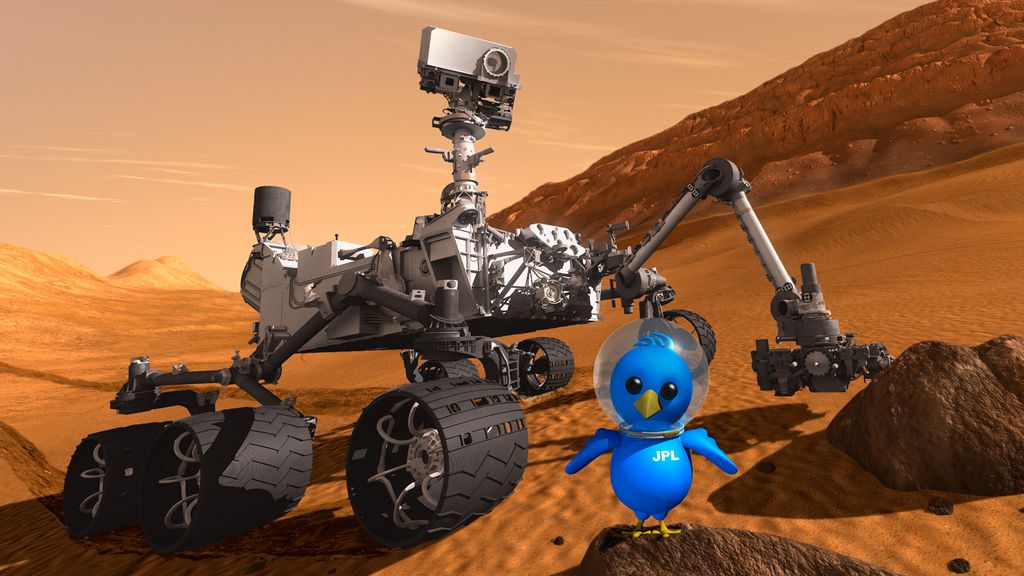
This artist concept features NASA's Mars Science Laboratory Curiosity rover along with an illustrated astronaut bird. Image Credit: NASA/JPL-Caltech

NASA has embraced social media in big way over the last few years. A now, they are using that new frontier as a means to go social old-school.

Beginning August 3rd, a three-day NASA Social will be held at the NASA Jet Propulsion Laboratory (JPL) in Pasadena, California. And the guests-of-honor will be 25 of NASA's social media followers.

The NASA Social is scheduled to culminate in the landing of the Mars Science Laboratory's Curiosity rover at Mars' Gale crater. The landing is currently estimated to occur on August 6 at 1:31 AM EDT (August 5 at 10:31 PM PDT).

The event will offer people who engage with NASA through Twitter, Facebook, Google+ and other social networks the opportunity to tour JPL, speak with scientists and engineers, participate in news conferences and, if all goes as planned, be at the media site when the first signal of the rover's landing is detected by JPL mission control. The event also will provide participants the opportunity to interact with fellow tweeps, space enthusiasts and members of NASA's social media team.

During the two-year prime mission, Curiosity will investigate whether the selected area of Mars offered environmental conditions favorable for microbial life or if evidence of it existed.

JPL has 23 spacecraft and 10 instruments conducting active missions of exploration of Earth, the solar system and the universe beyond. These ventures, including Voyager, Cassini and the Opportunity Mars rover, are enabled by NASA's Deep Space Network (DSN). Managed by JPL, the DSN is an international network of antenna complexes for communications between spacecraft and Earth-based teams that guide them. NASA Social guests will meet team members from some of these missions and tour DSN mission control.

NASA Social registration opens at noon EDT (9 AM PDT) Wednesday, June 6 and closes noon EDT (9 AM PDT)  Friday, June 8. NASA will randomly select 25 participants from online registrations.

For more information and rules pertaining to NASA Social registration, visit: www.nasa.gov/social

For information about connecting and collaborating with NASA, visit: www.nasa.gov/connect

For more information about JPL, visit: www.jpl.nasa.gov

To follow the Mars Science Laboratory/Curiosity mission via Facebook and Twitter, visit: www.facebook.com/MarsCuriosity www.twitter.com/MarsCuriosity

-

Tuesday, June 05, 2012

No Sun? No Problem!

If you are in a part of the world where no portion of the transit of Venus may be seen, or if you are clouded out, do not fret! You may still watch the event online. NASA EDGE is hosting live video from Mauna Kea, Hawaii. Just go to the link below.

http://venustransit.nasa.gov/webcasts/nasaedge/

To learn more about the transit of Venus, visit these links.

2012 Transit of Venus, NASA/Goddard Space Flight Center: eclipse.gsfc.nasa.gov/OH/transit12.html

Transit of Venus, Sun-Earth Day 2012, NASA: sunearthday.nasa.gov/transitofvenus/

-

Transit of Venus 2012 Is Here!

Above are three close-up images from a transit of the planet Venus across the face of the sun. The top image shows Venus on the eastern limb of the Sun. The faint ring around the planet comes from the scattering of its atmosphere, which allows some sunlight to show around the edge of the otherwise dark planetary disk. The faint glow on the disk is an effect of the TRACE telescope. The bottom left image is in the ultraviolet, and the bottom right image is in the extreme ultraviolet. The three images were captured by NASA's Sun-observing TRACE spacecraft. Image Credit: NASA/LMSAL

It's here! It's here! The transit of Venus is occurring later today over June 5 and 6, depending on where you are viewing in the world.

If you're in the western Pacific, eastern Asia and eastern Australia, you'll get a great view of the entire event. North and Central America, and northern South America get the beginning of the transit on June 5, but the sun will set before the event ends. Conversely, Europeans, as well as those watching in western and central Asia, eastern Africa and western Australia will get a glimpse at the tail end.

BUT REMEMBER: You should never, never look at the sun directly, even with binoculars or a telescope, because you could severely damage your eyes or even go blind. There are special filtering materials that, when used correctly, allow you to view the sun safely. If you do not have these, or you are not certain how to use them, do not take chances. Instead, view the sun using a projection method.

Viewing a Tranist

There are officially approved solar filtering materials that, when used properly, will allow you to view the sun. But if you don't have these, or you are not completely comfortable in using them. PLEASE DO NOT TAKE CHANCES! You can still view the transit in other ways.

If you have binoculars or a telescope, you may use them to project an image onto a card or other flat surface for viewing. If you do not have a telescope or binoculars, no worries! You can still enjoy the event using a pinhole camera that you can make yourself, cheaply and easily. JPL Education has created a wonderful page, compete with pictures, that walks you through the entire project.

"How to Make a Pinhole Camera." JPL Education, NASA/JPL-Caltech: www.jpl.nasa.gov/education/index.cfm?page=341

Transits of Venus are the rarest of all predictable astronomical phenomena and currently occur in a pattern that repeats every 243 years, with pairs of transits eight years apart separated by long gaps of 121.5 years and 105.5 years. Before 2004, the last pair of transits of Venus were in December 1874 and December 1882. The first of the latest pair of transits occurred on June 8, 2004. After this one, the next pair of Venus transits will not occur until December 2117 and December 2125. If you have the opportunity, you should definitely have a look for yourself. To learn more about the transit of Venus, visit these links.

2012 Transit of Venus, NASA/Goddard Space Flight Center: eclipse.gsfc.nasa.gov/OH/transit12.html

Transit of Venus, Sun-Earth Day 2012, NASA: sunearthday.nasa.gov/transitofvenus/

-

Sunday, June 03, 2012

Wanted: Exoplanet Hunters

Are you a researcher in the field of extrasolar planets (exoplanets)? Are you currently looking for a job? Here for your consideration are two hiring notices posted this week.


Geneva University


The Astronomy Department of the Geneva University is seeking applications for a tenured position as MaƮtre d'Enseignement et de Recherche (MER, corresponding to Senior Lecturer) to work in the Exoplanet team with Professors Stephane Udry, Didier Queloz and Francesco Pepe, on theoretical and observational aspects of exoplanet detection and characterization.


The successful candidate should have an outstanding research record in the field. A focus on the characterization of exoplanet atmospheres through high-resolution spectroscopy or direct imaging, or on the dynamical modeling of multi-planet systems and their characterization through the combination of observational and theoretical constraints, would be of particular interest. She/he is expected to contribute to the various research activities of the Geneva exoplanet group, to participate actively in the teaching of astrophysics courses at both the undergraduate and graduate levels, and to attract external funding. The expected starting date is this September 1st (or upon agreement).


The University of Geneva particularly encourages women to apply for this position.


Applications (in English) including a curriculum vitae, a list of publications, and an outline of current and planned future research should be uploaded to the Geneva University dedicated web site, jobs.icams.unige.ch/ . The deadline for submission is June 11th, so get going!


The official announcement is available here: www.unige.ch/sciences/astro/fr/Emploi/index.html


Cardiff University


The School of Physics and Astronomy at Cardiff University has immediate
vacancies for two permanent faculty appointments in Astrophysics. We are
seeking experts in observational and theoretical studies of star-formation
and/or extra-solar planetary systems to conduct world-class research and
research-led teaching at undergraduate and postgraduate level. The
appointments will be at any level from Lecturer to Professor depending on
the experience of the candidates; we expect at least one of the
appointments to be at a junior level.


Physics and Astronomy at Cardiff University has undergone substantial
expansion in the past few years, and has very strong research groups in
star-formation, extragalactic astronomy and cosmology, gravitational-wave
physics, astronomical instrumentation, and condensed matter physics. There
are presently 18 academic staff involved in astrophysics and relativity,
with 15 postdoctoral researchers and 22 PhD students.


The deadline for applications is Jun 30th, so hurry!


More information about this post may be obtained by contacting the Head of
School , Professor Walter Gear at  gear@astro.cf.ac.uk.  However please
note that all applicants are required to complete the on-line application
process at www.cardiff.ac.uk/jobs/  before the deadline  in order
to be considered for appointment.

-

Saturday, June 02, 2012

The Fastenation of Venus

The above image is an artist's concept of lightning on Venus. Image Credit: European Space Agency (ESA)

Regular readers may be tired of being reminded, but because of the rarity of this event, we will do so, again. The next transit of Venus will occur over June 5-6. The transit (passing) of the planet Venus across the face of the sun is a relatively rare event — occurring in pairs with more than a century separating each pair. There have been all of 53 transits of Venus across the sun between 2000 B.C. and the last one occurred in 2004. On Tuesday, June 5 (Wednesday, June 6 in the Eastern Hemisphere), Earth gets another shot at it. The next pair will not be until December 2117 and December 2125. But beyond this, why has Venus been an object worthy of study for hundreds of centuries?

Venus is a planet of extremes. The surface is hot enough to melt lead due to its runaway greenhouse atmosphere. Yet in many respects, Venus is Earth's twin in general size, gravity and bulk composition.

Venus is the closest planet to Earth of all in the solar system. Its proximity to Earth, combined with its dense and highly reflective clouds, contributed in making it the third brightest object in the sky (the sun and moon are one and two, respectively).

The ancient Babylonians noted the wanderings of Venus in texts as far back as 1600 BC. The Greek mathematician Pythagoras studied the movements of heavenly bodies and eventually became the first to determine that the "morning star" and "evening star" of Greek and Egyptian cultures were in fact one object — Venus.

But for all of the deductions of these ancient astronomers and their medieval contemporaries (including the Aztecs back in the 1500s), no human had seen Venus as more than a bright dot in the sky until Galileo Galilei, who in 1610 was the first human to actually see Venus in various kinds of light. With his telescope, Galileo made several Venetian discoveries, including the fact that Venus changed its illumination phase just like the moon which circled Earth. Galileo's telescope provided strong evidence that Venus moved around the sun, and not Earth, as most of his contemporaries believed.

After Galileo, Venus came under even more intense scrutiny, both scientific and fanciful. More than one astronomer (and science fiction author) theorized it was home to some type of life form. The thick, impenetrable clouds allowed them to imagine tropical climates with steady rainfall and lush vegetation.

With the dawn of robotic space probes, America's Mariner 2, built by JPL, became history's first interplanetary traveler when it flew past Venus on December 14, 1962. All told, Venus 45 missions have been launched by the United States, Russia (and former Soviet Union), and Japan. All this probing by astronomers and robotic explorers has found Venus to be replete with 900-degree-Fahrenheit (500-degree-Celsius) temperatures in a carbon-dioxide-rich atmosphere with pressures equivalent to being half a mile below the ocean surface. It is not a particularly hospitable environment. Even so, Venus holds many lessons for us about the climate and interior of Earth and Earth-like planets in other solar systems.

If you're in the western Pacific, eastern Asia and eastern Australia, you'll get a great view of the entire event. North and Central America, and northern South America get the beginning of the transit on June 5, but the sun will set before the event ends. Conversely, Europeans, as well as those watching in western and central Asia, eastern Africa and western Australia will get a glimpse at the tail end. If you want to know more, check out these URLs.

NASA's web page for all things Venus transit: venustransit.nasa.gov/transitofvenus/ .

2012 Transit of Venus, NASA/Goddard Space Flight Center: eclipse.gsfc.nasa.gov/OH/transit12.html

-

Friday, June 01, 2012

Predicted Andromeda-Milky Way Collision Confirmed


The above image is an artist’s depiction of night sky just before the predicted merger, about 3.75 million years from now, between our Milky Way galaxy and the neighboring Andromeda galaxy (Messier 31 / NGC 224). Andromeda's disk fills the field of view and its gravity begins to create tidal distortions in the Milky Way. The view is inspired by dynamical computer modeling of the future collision between the two galaxies. Image Credit: NASA, ESA, Z. Levay and R. van der Marel (STScI), and A. Mellinger

On Thursday, May 31, NASA astronomers announced they had confirmed the prediction that the Andromeda galaxy (Messier 31 / NGC 224) would indeed collide with our Milky Way galaxy in about 4 billion years. Astronomers predict that the sun will be flung into a new region of our galaxy, but Earth and our solar system will not be destroyed.

The confirmation came through painstaking NASA Hubble Space Telescope measurements of the motion of Andromeda. The galaxy is now 2.5 million light-years away, but it is falling toward the Milky Way under the mutual pull of gravity.

Computer simulations derived from Hubble's data show that it will take an additional two billion years after the encounter for the interacting galaxies to completely merge under the tug of gravity and reshape into a single elliptical galaxy similar to the kind commonly seen in the local universe.

Although the galaxies will plow into each other, stars inside each galaxy are so far apart that they will not collide with other stars during the encounter. However, the stars will be thrown into different orbits around the new galactic center. Simulations show that our solar system will probably be tossed much farther from the galactic core than it is today.

To complicate things even more, Andromeda’s small companion, the Triangulum galaxy, Messier 33, will join in the collision and perhaps later merge with the Andromeda/Milky Way pair. There is a small chance that Triangulum will hit the Milky Way first.

The universe is expanding and accelerating, and collisions between galaxies in close proximity to each other still happen because they are bound by the gravity of the dark matter surrounding them. The Hubble Space Telescope's deep views of the universe show such encounters between galaxies were more common in the past when the universe was smaller.

Tell me a story, Daddy…

A century ago astronomers did not realize that Messier 31 was a separate galaxy far beyond the stars of the Milky Way. Edwin Hubble measured its vast distance by uncovering a variable star that served as a "milepost marker." Hubble went on to discover the expanding universe in which galaxies are rushing away from us, but it has long been known that Messier 31 is moving toward the Milky Way at about 250,000 miles per hour, fast enough to travel from here to the Moon in one hour. The measurement was made using the Doppler Effect, which is a change in frequency and wavelength of waves produced by a moving source relative to an observer, to measure how starlight in the galaxy has been compressed by Andromeda's motion toward us.

The study team members are: R. van der Marel, S.T. Sohn, J. Anderson, and T. Brown (STScI), M. Fardal (University of Massachusetts, Amherst), G. Besla (Columbia University), R. Beaton (University of Virginia), P. Guhathakurta (UCO/Lick Observatory/UCSC), and T.J. Cox (Carnegie Observatories). You may learn much, much more about the study by reviewing the following three PDF-formatted papers, online at the Space Telescope Science Institute website.

ApJ Science Paper I by: S.T. Sohn et al.
hubblesite.org/pubinfo/pdf/2012/20/pdf1.pdf

ApJ Science Paper II by: R.P. van der Marel et al.
hubblesite.org/pubinfo/pdf/2012/20/pdf2.pdf

ApJ Science Paper III by: R.P. van der Marel et al.
hubblesite.org/pubinfo/pdf/2012/20/pdf3.pdf

And now, the mission particulars...

The Hubble Space Telescope (HST) was carried into orbit by the Space Shuttle Discovery in April 1990. HST is a 2.4-meter (7.9 ft) aperture telescope in low Earth orbit, Hubble's four main instruments observe in the near ultraviolet, visible, and near infrared. The telescope is named after the astronomer Edwin Hubble. HST was built by NASA, with contributions from the European Space Agency (ESA), and is operated by the Space Telescope Science Institute. The HST is one of NASA's Great Observatories, along with the Compton Gamma Ray Observatory, the Chandra X-ray Observatory, and the Spitzer Space Telescope. The HST mission websites are: hubble.nasa.gov/ and asd.gsfc.nasa.gov/archive/hubble/ and hubblesite.org/

-