Pages

Friday, July 13, 2012

July 12th X1.4 Flare & Incoming CME from AR 1520

The above image was taken Thursday, July 12th, at 12:45 PM EDT by the Solar Dynamics Observatory (SDO). The image shows an X1.4 solar flare in progress. It was captured in the 304 Angstrom wavelength and it is colorized here in red. Image Credit: NASA/SDO/AIA

It appears we have more incoming, and this time from the big Active Region 1520 (AR 1520), which first rotated into view on July 6th. On Thursday, July 12th, the sun released a class X1.4 solar flare which began at 16:39 UTC (12:39 EDT), peaked at 16:42 UTC (12:42 EDT) and then suddenly dropped off. During the flare, the region produced a coronal mass ejection (CME) which appears to be heading in the direction of Earth.

According to a forecast track prepared by analysts at the Goddard Space Weather Lab, the CME will hit Earth on July 14th around 10:20 UT, give or take 7 hours (06:20 EDT, give or take...). The impact could spark strong geomagnetic storms. Sky watchers should be alert for auroras this weekend.

The explosion also strobed Earth with a pulse of extreme UV radiation. The UV pulse partially ionized Earth's upper atmosphere, disturbing the normal propagation of radio signals around the planet. Monitoring stations in Norway, Ireland and Italy recorded the sudden ionospheric disturbance.

Solar protons accelerated by the blast are swarming around Earth. The radiation storm, in progress, ranks "S1" on NOAA space weather scales, which means it poses no serious threat to satellites or astronauts. This could change if the storm continues to intensify. Stay tuned...

To see other July 12th images as well as a SDO video of the flare, visit the NASA news release here, www.nasa.gov/mission_pages/sunearth/news/News071212-X1.4flare.html

To monitor solar flare activity minute by minute, visit the "Today's Space Weather" page of NOAA's Space Weather Prediction Center, URL: www.swpc.noaa.gov/today.html .

To learn more about the sun and to stay current on solar activity, visit the mission home page of Solar Dynamics Observatory (SDO), sdo.gsfc.nasa.gov .

-

Thursday, July 12, 2012

Happy 95th, NASA Langley Research Center!


The above image shows the Variable Density Tunnel which was put into operation at Langley Memorial Aeronautical Laboratory in 1922. This was the first pressurized wind tunnel in the world, able to achieve more realistic effects than any previous wind tunnel in predicting how actual aircraft would perform under flight conditions. Image Credit: NASA


Langley Field was founded in 1916. But on July 13, 1917, the National Advisory Committee for Aeronautics (NACA), established Langley Memorial Aeronautical Laboratory on Langley Field. Both the Field and the Laboratory are named for aviation pioneer Samuel Pierpont Langley. The Aviation Section, U.S. Signal Corps had established a base there earlier that same year. The first research facilities were in place and aeronautical research was started by 1920. Initially the laboratory included four researchers and 11 technicians.


NASA Langley Research Center is the oldest of NASA's field centers, located in Hampton, Virginia. It directly borders Poquoson, Virginia and Langley Air Force Base. Langley focuses primarily on aeronautical research, though the Apollo lunar lander was flight-tested at the facility and a number of high-profile space missions have been planned and designed on-site.


Exhibits and scheduled facility tours are regularly available to the public. To find out more, visit NASA Langley’s home online, http://www.larc.nasa.gov/ .

To catch postings for all my blogs, subscribe on Twitter to twitter.com/RoamingAstro . Like what you see? Let me know! Email: RoamingAstroInput@gmail.com .

-

July 11th HI-C Flight a Success

The above graphic is an overview of the stages of the July 11th flight of the High Resolution Coronal Imager (HI-C). Image Credit: Apogee Imaging Systems

NASA reported a successful flight on Wednesday, July 11th, of the High Resolution Coronal Imager (HI-C) from White Sands Missile Range, New Mexico. Preliminary results show that good data was taken during the ten-minute sub-orbital flight. We await more details from NASA as they become available.

HI-C is the highest resolution solar telescope ever to observe the solar corona, the million degree outer solar atmosphere. The solar telescope flew atop a Black Brant sounding rocket. Of the 602-second flight, actual data collection was expected to last for 381 seconds while HI-C was above Earth's atmosphere.

The spatial resolution on HI-C is about five times more detailed than the Atmospheric Imaging Assembly (AIA) instrument on the Solar Dynamics Observatory (SDO), that can resolve structures down to 600 miles and currently sends back some of our most stunning and scientifically useful images of the sun. AIA can see the entire sun at this resolution, but HI-C focused on an area just one-sixth the width of the sun or 135,000 miles across. Also, AIA observes the sun in ten different wavelengths, while HI-C observes just one: 193 Angstroms. This wavelength of UV light corresponds to material in the sun at temperatures of 1.5 million Kelvin and that wavelength is typically used to observe material in the corona.

In addition to seeing the finest structures yet seen in the sun’s corona, HI-C serves as a test bed for this high-resolution telescope. Often one improves telescope resolution simply by building bigger mirrors, but this is not possible when constraining a telescope to the size of a sounding rocket, or even a long-term satellite. So HI-C's mirror is only about nine and a half inches across, no bigger than that of AIA. The HI-C mirrors are made by a team at NASA's Marshall Space Flight Center.

And now, the mission particulars...

NASA's Marshall Space Flight Center is leading the international effort for Hi-C. Key partners include the University of Alabama at Huntsville, Smithsonian Astrophysical Observatory, University of Central Lancashire in Lancashire, England, and the Lebedev Physical Institute of the Russian Academy of Sciences.

To read more about HI-C, visit these URLs:

Apogee Imaging Systems, makers of the imaging system for the High Resolution Coronal Imager (HI-C), www.ccd.com/nasa_hic.html

NASA News, 10/21/2011 - "Marshall Scientist Dr. Jonathan Cirtain Receives Presidential Early Career Award." NASA Marshall Space Flight Center. www.nasa.gov/centers/marshall/news/news/releases/2011/11-125.html

NASA News, 06/21/2012 - "Hi-C to Investigate Activity in Solar Atmosphere." NASA Marshall Space Flight Center. www.nasa.gov/centers/marshall/news/news/releases/2012/12-064.html

NASA News, 07/05/2012 - "HI-C Sounding Rocket Mission Has Finest Mirrors Ever Made." Wallops Flight Facility, NASA Goddard Space Flight Center. www.nasa.gov/centers/wallops/news/HI-C.html


-

Pluto Has Four Moons? Make That Five!


The above image of the Pluto system is one of several taken by the Hubble Space Telescope, using Wide Field Camera 3, in order to confirm the discovery of a fifth moon for Pluto. In the above image the new moon is labeled "P5." Image Credit: NASA, ESA, and M. Showalter (SETI Institute)  

The Pluto system just got bigger!  A team of astronomers using NASA's Hubble Space Telescope have reported the discovery of yet another moon orbiting the icy dwarf planet.

The newly-found moon is estimated to be irregular in shape and 6 to 15 miles across. It follows a 58,000-mile-diameter circular orbit around Pluto that is assumed to be in the same plane as the other satellites in the system.

The Pluto team is fascinated that such a small planet can have such a complex collection of satellites. The new discovery provides additional clues for unraveling how the Pluto system formed and evolved. The most popular theory is that all the moons are relics of a collision between Pluto and another large Kuiper belt object billions of years ago.

The new detection will help scientists navigate NASA's New Horizons spacecraft through the Pluto system in 2015, when it makes an historic and long-awaited high-speed flyby of the distant world. The team is using Hubble's powerful vision to scour the Pluto system to uncover potential hazards to the New Horizons spacecraft. Moving past the dwarf planet at a speed of 30,000 miles per hour, New Horizons could be destroyed in a collision with even a BB-shot-size piece of orbital debris. The team feels confident that the more they find now, the safer their spacecraft will be when it passes by.

Pluto's largest moon, Charon, was discovered in 1978 in observations made at the United States Naval Observatory in Washington, D.C. Hubble observations in 2006 uncovered two additional small moons, Nix and Hydra. In 2011 another moon, P4, was found in Hubble data and is yet to be named.

Provisionally designated S/2012 (134340) 1, the latest moon was detected in nine separate sets of images taken by Hubble's Wide Field Camera 3 on June 26th, 27th, and 29th and July 7th and 9th of 2012.

In the years following the New Horizons Pluto flyby, astronomers plan to use the infrared vision of Hubble's planned successor, NASA's James Webb Space Telescope, for follow-up observations. The Webb telescope will be able to measure the surface chemistry of Pluto, its moons, and many other bodies that lie in the distant Kuiper Belt along with Pluto.

To learn more about Pluto and other members of our solar family, visit NASA’s Solar System Exploration site, solarsystem.nasa.gov .

To learn more about the New Horizons mission to Pluto and the Kuiper Belt, visit the mission site, pluto.jhuapl.edu .

To learn more about this and the other discoveries of the Hubble Space Telescope, visit these Hubble sites: hubblesite.org and stsci.edu .

To catch postings for all my blogs, subscribe on Twitter to twitter.com/RoamingAstro . Like what you see? Let me know! Email: RoamingAstroInput@gmail.com .    

-

Wednesday, July 11, 2012

Hi-C is Go for Launch!

The above image shows the sounding rocket (in foreground) containing NASA's High Resolution Coronal Imager (HI-C). It's sub-orbital flight is set for launch today (July 11th) at 12:50 PM MDT (2:50 PM EDT) from White Sands Missile Range, New Mexico. Image Credit: NASA

Today, July 11th, NASA will launch the highest resolution solar telescope ever to observe the solar corona, the million degree outer solar atmosphere. The solar telescope, called the High Resolution Coronal Imager (HI-C), will fly atop a Black Brant sounding rocket, launched from the White Sands Missile Range in New Mexico. The launch is scheduled for 12:50 PM MDT (2:50 PM EDT). This mission is a sub-orbital flight, lasting just 620. For about half of that time (381 seconds) HI-C will be high enough so that Earth's atmosphere will not block ultraviolet rays from the sun. By looking at a specific range of UV light, HI-C mission scientists hope to observe fundamental structures on the sun, as narrow as 100 miles across.

Mission scientists note that other instruments currently flying cannot resolve objects to this detail, but they do suggest – after detailed computer analysis of the amount of light in any given pixel – that structures in the sun's atmosphere – the chromosphere and the corona – are about 100 miles across. The scientists also have theories about the shapes of these structures. The mission team is excited because HI-C will have the first chance to see them.

The spatial resolution on HI-C is about five times more detailed than the Atmospheric Imaging Assembly (AIA) instrument on the Solar Dynamics Observatory (SDO), that can resolve structures down to 600 miles and currently sends back some of our most stunning and scientifically useful images of the sun. Of course, AIA can see the entire sun at this resolution, while HI-C will focus on an area just one-sixth the width of the sun or 135,000 miles across. Also, AIA observes the sun in ten different wavelengths, while HI-C will observe just one: 193 Angstroms. This wavelength of UV light corresponds to material in the sun at temperatures of 1.5 million Kelvin and that wavelength is typically used to observe material in the corona.

During its ten-minute journey, HI-C will focus on the center of the sun, where sunspot activity was predicted to be – a prediction based on what the sun looked like 27 days previously, since it takes 27 days for the sun to complete a full rotation. Of course, we now know this prediction worked very well, since the center of the disc currently features three active regions: AR 1520, AR 1521 and AR 1519.

HI-C will start acquiring data at 69 seconds after launch, at a rate of roughly an image a second. But the flight will not just be an automated one. Scientists will be able to look through a secondary H-alpha telescope on the instrument in real time and re-point the main telescope as needed.

In addition to seeing the finest structures yet seen in the sun’s corona, the launch of HI-C will serve as a test bed for this high-resolution telescope. Often one improves telescope resolution simply by building bigger mirrors, but this is not possible when constraining a telescope to the size of a sounding rocket, or even a long-term satellite. So HI-C's mirror is only about nine and a half inches across, no bigger than that of AIA. However, the HI-C mirrors, made by a team at NASA's Marshall Space Flight Center, are some of the finest ever made. If one could see the mirror surface at an atomic level, it would show no greater valleys or peaks than two atoms in either direction.

In addition, the team created the instrument to have a longer focal length – that is, they increased the distance the light travels from its primary mirror to its secondary mirror, another trick to improve resolution – by creating a precise inner maze for the light to travel from mirror to mirror, rather than a simple, shorter straight line.

And now, the mission particulars...

NASA's Marshall Space Flight Center is leading the international effort for Hi-C. Key partners include the University of Alabama at Huntsville, Smithsonian Astrophysical Observatory, University of Central Lancashire in Lancashire, England, and the Lebedev Physical Institute of the Russian Academy of Sciences.

To read more about this flight, visit these URLs:

Apogee Imaging Systems, makers of the imaging system for the High Resolution Coronal Imager (HI-C), www.ccd.com/nasa_hic.html


NASA News, 10/21/2011 - "Marshall Scientist Dr. Jonathan Cirtain Receives Presidential Early Career Award." NASA Marshall Space Flight Center. www.nasa.gov/centers/marshall/news/news/releases/2011/11-125.html

NASA News, 06/21/2012 - "Hi-C to Investigate Activity in Solar Atmosphere." NASA Marshall Space Flight Center. www.nasa.gov/centers/marshall/news/news/releases/2012/12-064.html

NASA News, 07/05/2012 - "HI-C Sounding Rocket Mission Has Finest Mirrors Ever Made." Wallops Flight Facility, NASA Goddard Space Flight Center. www.nasa.gov/centers/wallops/news/HI-C.html


-

Vortex Equals Titan Winter?


The above true-color image was captured June 27, 2012 by NASA's Cassini spacecraft before a distant flyby of Saturn's moon Titan. It shows a south polar vortex, or a swirling mass of gas around the pole in the atmosphere of the moon. Image Credit: NASA/JPL-Caltech/Space Science Institute   

Does a swirling polar weather system automatically signal the coming of the winter season? This June 27th Cassini image of Titan shows a south polar vortex — a swirling mass of gas around the pole — in the atmosphere of the moon. The south pole of Titan, 3,200 miles (5,150 kilometers) across is near the center of the view.

Since Cassini arrived in the Saturn system in 2004, Titan has had a visible "hood" high above the north pole. It was northern winter when Cassini arrived, and much of the high northern latitudes were in darkness. But the hood — an area of denser, high altitude haze compared to the rest of the moon's atmosphere — was high enough to be still illuminated by sunlight. The seasons have been changing since Saturn's August 2009 equinox signaled the beginning of spring in the northern hemisphere and fall in the southern hemisphere for the planet and its many moons. Now the high southern latitudes are moving into darkness. The formation of the vortex at Titan's south pole may be related to the coming southern winter and the start of what will be a south polar hood.

See Titan's South Polar Vortex in Motion for a movie captured with a similar view and showing the polar vortex in motion: saturn.jpl.nasa.gov/multimedia/videos/movies/PIA14920_full_movie.gif .

These new, more detailed images are only possible because of Cassini's newly inclined orbits, which are the next phase of Cassini Solstice Mission. Previously, Cassini was orbiting in the equatorial plane of the planet, and the imaging team's images of the polar vortex between late March and mid-May were taken from over Titan's equator. At that time, images showed a brightening or yellowing of the detached haze layer on the limb, or edge of the visible disk of the moon, over the south polar region.

Scientists think these new images show open cell convection. In open cells, air sinks in the center of the cell and rises at the edge, forming clouds at cell edges. However, because the scientists can't see the layer underneath the layer visible in these new images, they don't know what mechanisms may be at work. Note in the individual frames of the black-and-white movie that any cosmic ray hits on the camera detectors will appear as bright dots.

Images taken using red, green and blue spectral filters were combined to create the natural color view in the above image. The images were obtained with the Cassini spacecraft narrow-angle camera late on June 26, 2012 at a distance of approximately 301,000 miles (484,000 kilometers) from Titan. Image scale is 2 miles (3 kilometers) per pixel.

And now, the mission particulars...

The Cassini-Huygens mission is a cooperative project of NASA, the European Space Agency and the Italian Space Agency. The Jet Propulsion Laboratory (JPL), a division of the California Institute of Technology in Pasadena, manages the mission for NASA's Science Mission Directorate, Washington, D.C. The Cassini orbiter and its two onboard cameras were designed, developed and assembled at JPL. The imaging operations center is based at the Space Science Institute in Boulder, Colorado. For more information about the Cassini-Huygens mission visit saturn.jpl.nasa.gov .

To catch postings for all my blogs, subscribe on Twitter to twitter.com/RoamingAstro . Like what you see? Let me know! Email: RoamingAstroInput@gmail.com .   


-

Tuesday, July 10, 2012

Happy 20th, Giotto and Grigg-Skjellerup!


The above image is an artist's concept of the European Space Agency spacecraft Giotto approaching a comet. Image Credit: Andrzej Mirecki

Tuesday, July 10th, marks the 20th anniversary (July 10, 1992) of the European Space Agency's (ESA's) Giotto spacecraft with Comet Grigg-Skjellerup. Launched and manged by ESA, the Giotto mission was originally intended to fly by and study Halley's Comet. On March 13, 1986, Giotto succeeded in approaching Halley's nucleus at a distance of 596 kilometers. Following the flyby, on March 15th, Giotto was adjusted to an Earth flyby trajectory and its science instruments were turned off.

On July 2, 1990, when Giotto flew by Earth, it was commanded to wake up and walked through sling-shot maneuvers in order to investigate another comet. Specifically, Comet Grigg-Skjellerup.

On July 10, 1992, Giotto flew by Comet Grigg-Skjellerup at a distance of about 200 km. After the encounter, on July 23rd, Giotto was again turned off.

In 1999 Giotto made another Earth flyby, but was not reactivated. The Giotto mission was named after Italian painter and architect Giotto di Bondone (1266/7 - 1337). Better known simply as Giotto, he is generally considered the first in a line of great artists who contributed to the Italian Renaissance. In 1301 Giotto observed Hally's Comet and was inspired by his experience to depict Comet Halley as the star of Bethlehem in his painting painting Adoration of the Magi.

To learn more about Comet Grigg-Skjellerup, visit this ESA science page, sci.esa.int/science-e/www/object/index.cfm?fobjectid=31877 .

To learn more about the Giotto mission, visit this ESA summary page, sci.esa.int/science-e/www/area/index.cfm?fareaid=15 .

To catch postings for all my blogs, subscribe on Twitter to twitter.com/RoamingAstro . Like what you see? Let me know! Email: RoamingAstroInput@gmail.com .

-

Rings and... Propellers?


The above composite of three images, taken by the Cassini spacecraft, show a propeller-shaped structure created by an unseen moon in Saturn's A ring. Scientists are seeing these propellers and other details of Saturn's rings for the first time in two years. Cassini's orbit took the spacecraft out of Saturn's equatorial plane in the spring of 2012, making face-on views of the rings possible again. Image Credit: NASA/JPL-Caltech/SSI/Cornell  

For years scientists have tracked within Saturn's A ring a propeller-shaped structure created by an unseen moon. This propeller, marked with red arrows of these Cassini images. These are part of a growing catalogue of "propeller" moons that, despite being too small to be seen, enhance their visibility by creating larger disturbances in the surrounding fabric of Saturn's rings.

This particular propeller is nicknamed "Sikorsky," after Russian-American aviator Igor Sikorsky. It is about 30 miles (50 kilometers) long. To learn more about propellers, see these three images:

photojournal.jpl.nasa.gov/catalog/PIA12790

photojournal.jpl.nasa.gov/catalog/PIA12792

photojournal.jpl.nasa.gov/catalog/PIA11672

In this most recent image composite, scientists knew they were observing a propeller they had seen before because Sikorsky was found close to the location predicted by a simple model of its motion. But its actual location did trail the predicted location by 6 degrees of longitude (8,000 miles, or 13,000 kilometers), underlining some of the changes known to occur in the orbits of propeller moons. These changes may occur because of interactions between the rings and the propeller moons. Scientists are eager to understand these interactions in Saturn's rings, as they may hold a key to similar systems such as solar systems forming from disks of matter.

In this most recent image, Sikorsky was found to trail its predicted position by 6 degrees of longitude (8,000 miles, or 13,000 kilometers), a discrepancy that underlines the changes that are known to occur in the orbits of propeller moons, possibly due to interactions between the rings and the embedded moons. Scientists are eager to understand these interactions in Saturn's rings, as they may hold a key to similar systems such as solar systems forming from disks of matter.

The Encke Gap of Saturn's A ring is on the right in the images. The A ring is the outermost of Saturn's main rings. This view looks toward the northern, sunlit side of the rings from about 12 degrees above the ringplane.

These images have not been cleaned of the effects of cosmic rays that struck the camera's sensor during exposure. These cosmic ray hits appear as small white specks or streaks on the images. These specks are not features in Saturn's rings. The image has been enhanced to aid visibility of compact objects like the propeller. The enhancement makes the edge of the Encke Gap appear dashed.

The images were taken in visible light with the Cassini spacecraft narrow-angle camera on June 5, 2012. The view was obtained at a distance of approximately 236,000 miles (380,000 kilometers) from Saturn and at a sun-Saturn-spacecraft, or phase, angle of 24 degrees. The image scale is 1 mile (2 kilometers) per pixel.

And now, the mission details...

The Cassini-Huygens mission is a cooperative project of NASA, the European Space Agency and the Italian Space Agency. The Jet Propulsion Laboratory (JPL), a division of the California Institute of Technology in Pasadena, manages the mission for NASA's Science Mission Directorate, Washington, D.C. The Cassini orbiter and its two onboard cameras were designed, developed and assembled at JPL. The imaging operations center is based at the Space Science Institute in Boulder, Colorado.
For more information about the Cassini-Huygens mission visit www.nasa.gov/cassini and saturn.jpl.nasa.gov .

To catch postings for all my blogs, subscribe on Twitter to twitter.com/RoamingAstro . Like what you see? Let me know! Email: RoamingAstroInput@gmail.com .

-

Monday, July 09, 2012

Happy 50th, Telstar 1!


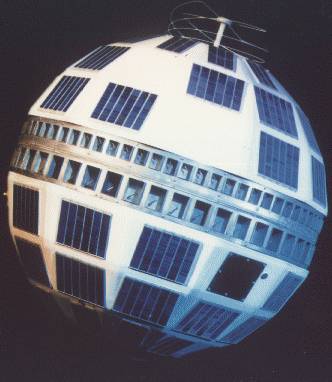
The above image shows Telstar 1. Image Credit: NASA

Tuesday, July 10th, marks the 50th anniversary (July 10, 1962) of the launch of communication satellite Telstar 1 aboard a Thor-Delta rocket. Telstar 1 successfully relayed the first television pictures, telephone calls, fax images, and provided the first trans-Atlantic television feed. Telstar 1 was soon follower by a sister satellite, Telstar 2, launched May 7, 1963.

Belonging to American Telephone & Telegraph (AT&T), Telstar 1 was part of a multi-national agreement between AT&T, Bell Telephone Laboratories, NASA, the British General Post Office, and the French National PTT (Post, Telegraph & Telecom Office) to develop experimental satellite communications over the Atlantic Ocean. The US ground station was Andover Earth Station in Andover, Maine, built by Bell Labs.

The satellite was built by a team at Bell Telephone Laboratories. Telstar 1 is roughly spherical, measures 34.5 inches (876.30 mm) in length, and weighs about 170 pounds (77 kg). Its dimensions were limited by what would fit on one of NASA's Delta rockets. Telstar was spin-stabilized, and its outer surface was covered with solar cells to generate electrical power. The power produced was a tiny 14 watts.

The original Telstar had one innovative transponder to relay data, which was a television channel or multiplexed telephone circuits. An omnidirectional array of small antenna elements around the satellite's "equator" received 6 GHz microwave signals to be relayed. The transponder converted the frequency to 4 GHz, amplified the signals in a traveling-wave tube, and retransmitted them omnidirectionally via the adjacent array of larger box-shaped cavities. The prominent helical antenna was for telecommands from a ground station.

Telstar 1 was the first privately-sponsored space launch. A medium-altitude satellite, it was placed in an elliptical orbit completed once every 2 hours and 37 minutes, inclined at an angle of approximately 45 degrees to the equator, with perigee about 952 km from Earth and apogee about 5933 km from Earth. This is in contrast to most of today's communications satellites, which are placed in circular geostationary orbits.

Because of its non-geosynchronous orbit, Telstar's availability for transatlantic signals was limited to the 20 minutes in each 2.5 hour orbit when the satellite passed over the Atlantic Ocean. Ground antennas had to track the satellite with a pointing error of less than 0.06 degrees as it moved across the sky at up to 1.5 degrees per second.

Since the transmitting and receiving radio systems on board Telstar were not nearly as powerful or capable as those of today's satellites, the ground antennas had to be huge. Morimi Iwama and Jan Norton of Bell Laboratories were in charge of designing and building the electrical portions of the system that steered the antennas. The aperture of the antennas was 3,600 square feet (330 m2). The antennas were 177 feet (54 m) long and weighed 380 tons. The antennas were housed in radomes the size of a 14-story office building.

While Telstar 1 ushered in a new age of the benevolent use of technology, it became a victim of technology during the Cold War. The day before Telstar 1 was launched, the United States had tested a high-altitude nuclear bomb (called Starfish Prime) which energized the Earth's Van Allen Belt where Telstar 1 went into orbit. This vast increase in radiation, combined with subsequent high-altitude blasts, including a Soviet test in October, overwhelmed Telstar's fragile transistors. Telstar 1 went out of service in early December 1962, but was restarted by a workaround in early January 1963. After encountering more issues, Telstar 1 went out of service for the last time, on February 21, 1963. As of this writing, Telstar 1 and 2 remain in Earth orbit.

To catch postings for all my blogs, subscribe on Twitter to twitter.com/RoamingAstro . Like what you see? Let me know! Email: RoamingAstroInput@gmail.com .

-

"Webb-Cams" For James Webb


In the above image, three engineers from the European Space Agency (in blue hoods) are investigating the Mid-Infrared Instrument (MIRI) that recently arrived at NASA Goddard Space Flight Center. The MIRI sees light in the mid-infrared region of the electromagnetic spectrum. Image Credit: NASA

Ever wondered what goes on in a NASA spacecraft clean room? Now you can find out! Members of the general public are now able to track the progress of the under-construction James Webb Space Telescope. Your view is of a large clean room inside Building 29 of NASA's Goddard Space Flight Center (Goddard), in Green Belt, Maryland, where the recently delivered Mid-Infrared Instrument (MIRI) will soon be integrated into Webb's science instrument payload.

You are treated online to still views from two web-cameras mounted in the clean room. Their images are updated every minute. Oh. And these two web-cameras have been affectionately dubbed "Webb-cams."

The Webb clean room is generally occupied Monday through Friday from 8:00 AM to 4:30 PM EDT (5:00 AM to 1:30 PM PDT). The Webb-cams can be seen online at: http://jwst.nasa.gov/webcam.html .

Developed by a consortium of 10 European institutions and NASA's Jet Propulsion Laboratory (JPL) in Pasadena, California, and delivered by the European Space Agency (ESA), MIRI is the first Webb telescope instrument to be completed. NASA engineers accepted delivery from the ESA engineers on May 29th.

Of the James Webb Space Telescope's four science instruments, only MIRI can see light in the mid-infrared region of the electromagnetic spectrum. This unique capability will allow the Webb telescope to study physical processes occurring in the cosmos that the other Webb instruments cannot see.

MIRI's sensitive detectors will allow it to make unique observations of many things, including the light of distant galaxies, newly forming stars within our own Milky Way, and the formation of planets around stars other than our own, as well as planets, comets and the outermost debris disk in our own solar system.

And now, the mission particulars....

The Webb Telescope project, managed at Goddard, is the world's next-generation space observatory and successor to NASA's Hubble Space Telescope. It is a joint project of NASA, the European Space Agency and the Canadian Space Agency.

For more information about MIRI and its arrival at NASA Goddard, visit: http://www.jpl.nasa.gov/news/news.cfm?release=2012-174 .

For more information about the James Webb Space Telescope, visit: http://www.jwst.nasa.gov/ .

To catch postings for all my blogs, subscribe on Twitter to twitter.com/RoamingAstro . Like what you see? Let me know! Email: RoamingAstroInput@gmail.com .

-

Sunday, July 08, 2012

Happy 180th, Alvan Graham Clark!


In the above image, taken in 1896, Alvan Graham Clark (left) and his assistant Carl Lundin (right) are laboring over the 40-inch lens of the great Yerkes Observatory refracting telescope. Image Credit: Yerkes Observatory

Tuesday July 10th, marks the 180th birthday (July 10, 1832) of American astronomer and telescope-maker Alvan Graham Clark (1832 - 1897). Born in Fall River, Massachusetts, this Alvan was the son of THE Alvan Clark (1804 - 1887), who founded optics company Alvan Clark & Sons, maker of the largest refracting telescopes of the 19th and early 20th centuries. Father Alvan and son Alvan worked together with Alvan Graham's brother, George Bassett Clark (1827 - 1891).

On January 31, 1862, while testing a new 18½ inch refracting telescope, Alvan Graham made the first observation of the star Sirius B from Cambridge, Massachusetts. This magnitude 8 companion of Sirius was also the first known white dwarf star. That particular telescope is still in regular use, now at the landmark Dearborn Observatory of Northwestern University in Evanston, Illinois.

To catch postings for all my blogs, subscribe on Twitter to twitter.com/RoamingAstro . Like what you see? Let me know! Email: RoamingAstroInput@gmail.com .

-

On July 8th: 20th Anniversary of Shoemaker-Levy 9 Breakup


Above is a Hubble Space Telescope (HST) image of comet Shoemaker-Levy 9, taken on May 17th, 1994, with the Wide Field Planetary Camera 2 (WFPC2) in wide field mode. When observed, the comet's train of 21 icy fragments stretched across 1.1 million km (710 thousand miles) of space, or 3 times the distance between Earth and the Moon. This required 6 WFPC exposures spaced along the comet train to include all the nuclei. The image was taken in red light and has been informally nicknamed the "string of pearls." The comet was approximately 660 million km (410 million miles) from Earth when the picture was taken, on a mid-July collision course with the gas-giant planet Jupiter. Image Credit: NASA, ESA, and H. Weaver and E. Smith (STScI)


Comet Shoemaker–Levy 9 (formally designated D/1993 F2) was discovered by American astronomers Carolyn and Eugene M. Shoemaker and David Levy. Shoemaker–Levy 9 was orbiting Jupiter and at that time was located on the night of March 24th, 1993, in a photograph taken with the 40 centimeter (1 ft 4 in) Schmidt telescope at the Palomar Observatory in California. Named as the nineth jointly discovered by the trio, it was the first comet observed to be orbiting a planet, and had probably been captured by the planet around 20 to 30 years earlier.

On July 8th, 1992, Comet Shoemaker–Levy 9 passed within Jupiter's Roche limit, and Jupiter's tidal forces pulled the comet body apart. The comet was later observed as a series of fragments ranging up to 2 km (1.2 mi) in diameter. These fragments collided with Jupiter's southern hemisphere between July 16th and July 22nd, 1994, at a speed of approximately 60 km/s (37 mi/s) or 21600km/hr (13320m/hr). The prominent scars from the impacts were more easily visible than the Great Red Spot and persisted for many months.

To learn more about the history and the legacy of Comet Shoemaker-Levy 9, visit this URL: www2.jpl.nasa.gov/sl9/

To catch postings for all my blogs, subscribe on Twitter to twitter.com/RoamingAstro . Like what you see? Let me know! Email: RoamingAstroInput@gmail.com .

-

A Celebratory Martian Panorama

This full-circle scene combines 817 images taken by the panoramic camera (Pancam) on NASA's Mars Exploration Rover Opportunity. Image Credit: NASA/JPL-Caltech/Cornell/Arizona State University 

This newly completed view from the panoramic camera (Pancam) on NASA's Mars Exploration Rover Opportunity shows the ruddy terrain around the outcrop where the long-lived explorer spent its most recent Martian winter. Note the rover tracks through the left side of the view.

This scene was recorded from the mast-mounted color camera and includes the rover's own solar arrays and deck in the foreground. The view gives a sense of what it would be like to sit atop Opportunity on the edge of Endeavour Crater and take in the whole scene. NASA released the image just this passed week, coinciding with two milestones: Opportunity completing its 3,000th sol (Martian day) on July 2, and NASA continuing past 15 years of robotic presence at Mars. Mars Pathfinder landed July 4th, 1997. NASA's Mars Global Surveyor orbiter reached the planet while Pathfinder was still active, and Global Surveyor overlapped the active missions of the Mars Odyssey orbiter and Opportunity, both still in service.

NASA makes the new panorama available online at photojournal.jpl.nasa.gov/catalog/PIA15689. It is presented in false color to emphasize differences between materials in the scene. It was assembled from 817 component images taken between Dec. 21st, 2011, and May 8th, 2012, while Opportunity was stationed on an outcrop informally named "Greeley Haven," on a segment of the rim of ancient Endeavour Crater, during its fifth Martian winter.

Opportunity and its twin, Spirit, landed on Mars in January 2004 for missions originally planned to last for three months. NASA's next-generation Mars rover, Curiosity, is on course for landing on Mars next month.
Opportunity's science team chose to call the winter campaign site Greeley Haven in tribute to Ronald Greeley (1939-2011), a team member who taught generations of planetary science students at Arizona State University.

And now, the mission particulars...

NASA's Jet Propulsion Laboratory, a division of the California Institute of Technology in Pasadena, manages the Mars Exploration Rover Project for the NASA Science Mission Directorate, Washington.
More information about Opportunity is online at: www.nasa.gov/rovers and marsrovers.jpl.nasa.gov . You can follow the project on Twitter at twitter.com/MarsRovers and on Facebook at www.facebook.com/mars.rovers .

To catch postings for all my blogs, subscribe on Twitter to twitter.com/RoamingAstro . Like what you see? Let me know! Email: RoamingAstroInput@gmail.com . 

-

Nova in Sagittarius Seen July 7th

A fairly bright nova has been discovered by Japanese observers Koichi Nishiyama (from Kurame) and Fujio Kabashima (Miyaki). The discovery was made on July 7th, 2012, using a 105-mm f/4 camera lens and CCD, describing the nova as magnitude 7.8. The nova is located in the constellation Sagittarius roughly between the "lid" and "spout" of the Teapot stars, coordinates (J2000) R.A. 18h 20.5m, Dec -27d 44m.  A number of other observers in Japan have made confirming sightings.

The discovery was announced from Cambridge Massachusetts by the Central Bureau for Astronomical Telegrams in CBET 3166, issued July 7th. This circular assigns the star the official designations Nova Sagittarii 2012 No. 4 and also PNV J18202726-2744263. View recent CEBTs online here: www.cbat.eps.harvard.edu/cbet/RecentCBETs.html

The American Association of Variable Star Observers (AAVSO) is requesting observations of this nova. The AAVSO collects magnitude determinations by skilled observers to aid in the study of novae and other variable stars, and their site offers guidance on the techniques involved. Their URL is: http://www.aavso.org/ .

-

Saturday, July 07, 2012

July 6th X-Class Flare from AR 1515

Follow this URL to see a YouTube video, compiled by contributor "SolarWatcher," on the X1.1 solar flare produced by AR 1515 late Friday, July 6th.
http://www.youtube.com/watch?v=n144GR6dw7w&feature=colike

After several days of increased activity, and the release of several M-class flares on July 5th, the very Active Region 15115 (AR 1515) finally put out an X-Class solar flare on Friday, July 6th at 23:08 UTC (7:08 PM EDT). To be exact, it was an X1.1 flare. Associated with this blast is a 10cm Radio Burst, Type IV Sweep Frequency Event and a proton event is now in progress.

Along with the flare was corona mass ejection (CME), which appears to be headed to the south, away from Earth. But we might receive a glancing blow on July 8th or 9th.

Back to that proton event. It seems the CME hurled a bunch of energetic protons toward Earth, which were accelerated by the flare and guided by solar magnetic fields. The protons are currently peppering Earth-orbiting satellites, causing "snow" in imaging systems and posing a slim threat for single-event upsets (computer glitches).

This looks like a good time for a refresher on solar flares and CMEs...

Solar Flare Primer

To review, a solar flare is an explosion on the sun that occurs when the energy stored in twisted magnetic fields (usually above sunspots) is suddenly released. Flares produce a burst of radiation across the electromagnetic spectrum, from radio waves to X-rays and gamma-rays.

Solar flares are classified, from lowest to highest, as A, B, C, M and X according to the peak flux (in watts per square meter, W/m^2) of 100 to 800 picometer X-rays near Earth, as measured on the GOES spacecraft. The five categories break down as follows.

A-class: Peak flux of less than 10^-7 Watts/square meter. A-class flares produce no noticeable consequences on Earth.

B-class: Peak flux ranges from 10^-7 to 10^-6 Watts/square meter. B-class flares produce no noticeable consequences on Earth.

C-class: Peak flux ranges from 10^-6 to 10^-5 Watts/square meter. C-class flares produce few noticeable consequences
on Earth.

M-class: Peak flux ranges from 10^-5 to 10^-4 Watts/square meter. M-class flares  can cause brief radio blackouts that affect Earth's polar regions. Minor radiation storms sometimes follow an M-class flare.

X-class: Peak flux is greater than 10^-4 Watts/square meter. X-class flare are major events that can trigger planet-wide radio blackouts and long-lasting radiation storms.

Within each category are nine subdivisions of strength. For example, C1 to C9, M1 to M9, and so on. On July 14, 2000, the sun produced a X6 flare which triggered a major radiation storm around Earth and was nicknamed the Bastille Day event.

Coronal Mass Ejection Primer

A coronal mass ejection (CME) is a massive burst of solar wind, plasma, and magnetic fields rising above the solar corona or being released into space.

CMEs are often associated with other forms of solar activity, most notably solar flares, but a causal relationship between the two has not been established. Most CMEs originate from active regions on Sun's surface, such as groupings of sunspots associated with frequent flares. Near a solar maximum — the period of greatest activity in a solar cycle — the sun produces about three CMEs every day, whereas near a solar minimum — the period of least activity in a solar cycle — there is about one CME every five days.

Now, Where Were We?...

Lots going on, now. As we get more details, we will post them here. Stay turned...

To monitor solar flare activity minute by minute, visit the "Today's Space Weather" page of NOAA's Space Weather Prediction Center, URL: www.swpc.noaa.gov/today.html .

To learn more about the sun and to stay current on solar activity, visit the mission home page of Solar Dynamics Observatory (SDO), sdo.gsfc.nasa.gov .

-

Sorry About That...

We had a miss-fire on a posting draft of solar activity from July 5th. Please disregard. Sorry to trouble you.

-

Hey, TYC 8241 2652! Where's the Dust?


The above image is an artist's concept of a dusty, planet-forming disc like the one that, until very recently, surrounded the star TYC 8241 2652. Image Credit: NASA/JPL-Caltech

That was a good one! Astronomers have witnessed a disappearing act around a young sun-like star called TYC 8241 2652, located about 450 million light-years away. Previously, enormous amounts of dust circled the star. Now, the dust is nowhere to be found.

A new study on the observations appeared July 5th issue of the journal Nature. The study was led by Carl Melis of the University of California, San Diego. The co-author of the study is Ben Zuckerman of UCLA, whose research is funded by NASA. The journal may be visited online at this URL: www..nature.com/nature .

A dusty disk around TYC 8241 2652 was first seen by the NASA Infrared Astronomical Satellite (IRAS) in 1983, and continued to glow brightly for 25 years. The dust was thought to be due to collisions between forming planets, a normal part of planet formation. Like Earth, warm dust absorbs the energy of visible starlight and reradiates that energy as infrared, or heat, radiation.

The first strong indication of the disk's disappearance came from images taken in January 2010 by NASA's Wide-field Infrared Survey Explorer (WISE). An infrared image obtained at the Gemini telescope in Chile on May 1st, 2012, confirmed that the dust has been gone for two-and-a-half years.

A disappearance like this has not been seen previously in the many hundreds of stars that astronomers have studied for dust rings. And they thought the change was remarkably quick. So quick, in fact, that researchers thought their observations must have been wrong.

The astronomers have a few of possible explanations, but they say none are compelling. One possibility is that gas produced in the impact that released the dust helped to quickly drag the dust particles into the star and thus to their doom. In another possibility, collisions of large rocks left over from an original major impact provide a fresh infusion of dust particles into the disk, which caused the dust grains to chip apart into smaller and smaller pieces.

The result is based upon multiple sets of observations of TYC 8241 2652 obtained with the Thermal-Region Camera Spectrograph on the Gemini South telescope in Chile; IRAS; WISE; NASA's Infrared Telescope on Mauna Kea in Hawaii; the European Space Agency's Herschel Space Telescope, in which NASA plays an important role; and the Japanese/European Space Agency AKARI infrared satellite.

Read the Gemini news release at http://www.gemini.edu/node/11836 , and the UCLA release at http://newsroom.ucla.edu/portal/ucla/astronomers-discover-a-houdini-235572.aspx .

And now, the mission particulars...

NASA's Jet Propulsion Laboratory, Pasadena, California, manages, and operated, WISE for NASA's Science Mission Directorate. Edward (Ned) Wright is the mission principal investigator and is at UCLA. The mission was selected competitively under NASA's Explorers Program managed by the agency's Goddard Space Flight Center in Greenbelt, Maryland. The science instrument was built by the Space Dynamics Laboratory in Logan, Utah. The spacecraft was built by Ball Aerospace & Technologies Corp. in Boulder, Colorado Science operations and data processing take place at the Infrared Processing and Analysis Center at the California Institute of Technology in Pasadena. Caltech manages JPL for NASA. You can learn more about WISE mission online at http://www.nasa.gov/wise, http://wise.astro.ucla.edu and http://jpl.nasa.gov/wise .

IRAS was executed jointly by the United States (NASA), the Netherlands and the United Kingdom. The Infrared Telescope is operated and managed for NASA by the University of Hawaii, located in Honolulu. Learn more about IRAS online at irsa.ipac.caltech.edu/IRASdocs/iras.html .


-

Friday, July 06, 2012

On July 6th: 325th Anniversary of Newton's 'Principia'

The above image shows the cover page of the first edition (1687) of Philosophiæ Naturalis Principia Mathematica. Image Credit: The image is in the Public Domain.

Today is the 325th anniversary (July 5th, 1687) of the publication of Philosophiæ Naturalis Principia Mathematica (Mathematical Principles of Natural Philosophy) by Sir Isaac Newton. In the pursuit of brevity we have come to reference the work simply as Newton's Principia. The three-volume work has been described as one of the most important in the history of science. The Principia states Newton's laws of motion, which form the foundation of classical mechanics, also Newton's law of universal gravitation, and a derivation of Kepler's laws of planetary motion.

In a nutshell, Newton's laws of motion are three physical laws that form the basis for classical mechanics. They describe the relationship between the forces acting on a body and its motion due to those forces. They have been expressed in several different ways over nearly three centuries, and can be summarized as follows:

1. First law: Every object continues in its state of rest, or of uniform motion in a straight line, unless compelled to change that state by external forces acted upon it.

2. Second law: The acceleration a of a body is parallel and directly proportional to the net force F acting on the body, is in the direction of the net force, and is inversely proportional to the mass m of the body, i.e., F = ma.

3. Third law: When two bodies interact by exerting force on each other, these action and reaction forces are equal in magnitude, but opposite in direction.

Newton used his laws to explain and investigate the motion of many physical objects and systems. For example, Newton showed that these laws of motion, combined with his law of universal gravitation, explained Kepler's laws of planetary motion.

In honor of Sir Isaac Newton, the European Space Agency (ESA) renamed an Earth-orbiting X-ray observatory mission for him. Specifically, the X-ray Multi-Mirror Mission - Newton (XMM-Newton), which launched December 1999. To learn more about the XMM-Newton, visit these URLs: xmm.esac.esa.int and xmm.sonoma.edu .

Several copies of Newton's Principia are available online for your reading pleasure. Here is one such copy which is available in several file formats at the Internet Archive: rchive.org/details/newtonspmathema00newtrich .

To catch postings for all my blogs, subscribe on Twitter to @RoamingAstro . Like what you see? Let me know! Email: RoamingAstroInput@gmail.com .

-

Titan's Subsurface Ocean?


This artist’s concept shows a possible scenario for the internal structure of Titan, as suggested by data from NASA’s Cassini spacecraft.  


The above image is an artist’s concept, showing a possible scenario for the internal structure of Titan, as suggested by data from NASA’s Cassini spacecraft. Scientists have been trying to determine what is under Titan’s organic-rich atmosphere and icy crust. Data from the radio science experiment make the strongest case yet for a global subsurface ocean, sitting above a subsurface layer of high-pressure ice and a water-infused silicate core. Image Credit: A. Tavani

An ocean? On Titan? Sorry. In Titan? What gives?

Well, it seems that data from NASA's Cassini spacecraft have revealed that Titan, Saturn's largest moon, likely harbors a layer of liquid water under its ice shell.

Researchers saw a large amount of squeezing and stretching as the moon orbited Saturn. They deduced that if Titan were composed entirely of stiff rock, the gravitational attraction of Saturn would cause bulges, or solid "tides," on the moon that were only 3 feet (1 meter) in height. But spacecraft data show that Saturn creates solid tides approximately 30 feet (10 meters) in height, suggesting that Titan is not made entirely of solid rocky material. The finding appeared in the June 28th edition of the journal Science. The lead author of the paper is Luciano Iess, a Cassini team member at the Sapienza University of Rome, Italy. The journal may be viewed online at the URL: http://www.sciencemag.org/ .

Titan takes only 16 days to orbit Saturn, and scientists were able to study the moon's shape at different parts of its orbit. Because Titan is not spherical, but slightly elongated like a football, its long axis grew when it was closer to Saturn. Eight days later, when Titan was farther from Saturn, it became less elongated and more nearly round. Cassini measured the gravitational effect of that squeeze and pull.
Scientists were not sure Cassini would be able to detect the bulges caused by Saturn's pull on Titan. By studying six close flybys of Titan from February 27th, 2006, to February 18th, 2011, researchers were able to determine the moon's internal structure by measuring variations in the gravitational pull of Titan using data returned to NASA's Deep Space Network (DSN).

An ocean layer does not have to be huge or deep to create these tides. A liquid layer between the external, deformable shell and a solid mantle would enable Titan to bulge and compress as it orbits Saturn. Because Titan's surface is mostly made of water ice, which is abundant in moons of the outer solar system, scientists infer Titan's ocean is likely mostly liquid water.

On Earth, tides result from the gravitational attraction of the moon and sun pulling on our surface oceans. In the open oceans, those can be as high as two feet (60 centimeters). While water is easier to move, the gravitational pulling by the sun and moon also causes Earth's crust to bulge in solid tides of about 20 inches (50 centimeters).

The presence of a subsurface layer of liquid water at Titan is not itself an indicator for life. Scientists think life is more likely to arise when liquid water is in contact with rock, and these measurements cannot tell whether the ocean bottom is made up of rock or ice. The results have a bigger implication for the mystery of methane replenishment on Titan.

Researchers want to understand how methane is stored in Titan's interior and how it may outgas to the surface. This is important because everything that is unique about Titan derives from the presence of abundant methane, yet the methane in the atmosphere is unstable and will be destroyed on geologically short timescales.

A liquid water ocean, "salted" with ammonia, could produce buoyant ammonia-water liquids that bubble up through the crust and liberate methane from the ice. Such an ocean could serve also as a deep reservoir for storing methane.

And now, the mission particulars...

The Cassini-Huygens mission is a cooperative project of NASA, the European Space Agency and the Italian Space Agency. The mission is managed by the Jet Propulsion Laboratory (JPL) in Pasadena, California for NASA's Science Mission Directorate in Washington. DSN, also managed by JPL, is an international network of antennas that supports interplanetary spacecraft missions and radio and radar astronomy observations for the exploration of the solar system and the universe. The network also supports selected Earth-orbiting missions. Cassini's radio science team is based at Wellesley College in Massachusetts. JPL is a division of the California Institute of Technology in Pasadena.

For more information about the mission, visit: http://www.nasa.gov/cassini and http://saturn.jpl.nasa.gov/ .

To catch postings for all my blogs, subscribe on Twitter to @RoamingAstro . Like what you see? Let me know! Email: RoamingAstroInput@gmail.com .

-

Thursday, July 05, 2012

Get Your Moon Handouts Here!


Shameless plug time. Just putting out a reminder that you... yes, you! ..can download your VERY OWN copy of a 12-page handout that I prepared for a fun telescope observing event back in May.

This PDF-formatted handout is about Earth's moon, and is quite creatively entitled, "Exploring the Moon." The document includes some facts about our moon, a lunar exploration timeline, online URLs to sites about past, current, and future moon missions. NOW how much would you pay?... Well, just the same that you would have two paragraphs earlier, which is nothing.

To download copy of the handout, just click the following link and please enjoy: http://tiny.cc/JMTSSA002-20120501

-

On July 5th: Earth Reaches Aphelion

This morning, at about 04:00 UTC (12:00 AM EDT), Earth reached aphelion in its orbit, a distance of 1.017 AU from the sun.

Aphelion/Perihelion Primer

Earth's orbit around the sun is not a circle. Instead, it is an ellipse, though very slight. For this reason, the distance between Earth and the sun varies throughout the year.
At the nearest point in Earth's orbit, Earth is 0.984 AU (91,445,000 miles or 147,166,462 km) from the sun. This point in Earth's orbit is known as perihelion and it occurs around January 3.

Earth is farthest away from the sun around July 4, when it is 1.017 AU (94,555,000 miles or 152,171,522 km) from the sun. This point in Earth's orbit is called aphelion.
The slight ellipse in the earth's orbit does have a slight impact on the amount of solar energy being received by the earth. But it is important to note that this 3.3 percent difference distance does not impact Earth as much as the seasonal variations, which occur because of the tilt of Earth's axis relative to the plane of its orbit.

Scientists utilize the average distance from Earth to the sun as the standard for one astronomical unit (1 AU). This average distance is 92,955,807 miles or 149,597,870.691 km.

To catch postings for all my blogs, subscribe on Twitter to @RoamingAstro . Like what you see? Let me know! Email: RoamingAstroInput@gmail.com . 

-

July 4th Celebrations From AR 1515 and AR 1513


The above image, captured by the Solar Dynamics Observatory, shows an M5.3 class solar flare that peaked on July 4th at 09:55 UTC (5:55 AM EDT). The flare is shown in the 131 Angstrom wavelength, a wavelength that is particularly good for capturing the radiation emitted from flares. The wavelength is typically colorized in teal as shown here. Image Credit: NASA/SDO/AIA/Helioviewe

It seems the sun wanted to take part in the Independence Day celebrations. On Wednesday, July 4th, the large sunspot of Active Region 1515 (AR 1515) threw at least four minor coronal mass ejections (CMEs) into space. Of the four, one is headed toward Earth. According to analysts at the Goddard Space Weather lab, the cloud will reach Earth on July 7th around 06:00 UTC. Observers in the high latitudes should be alert for auroras on that day. 

Also on July 4th, AR 1513 erupted, producing an M2-class solar flare. The burst was heard by those monitoring shortwave radios. The noise is caused by beams of electrons that are accelerated by the flare. As the electrons cut through the sun's atmosphere (a combination of the photosphere, chromosphere and corona), they generate a ripple of plasma waves and radio emissions that are detectable on Earth. 92.9 million miles away. 
  
More activity is expected from AR 1515 and AR 1513. Stay tuned... 

To learn more about the sun and to stay current on solar activity, visit the mission home page of Solar Dynamics Observatory (SDO), sdo.gsfc.nasa.gov .


To catch postings for all my blogs, subscribe on Twitter to @RoamingAstro . Like what you see? Let me know! Email: RoamingAstroInput@gmail.com .

-

WISE Keeps the Flame Burning

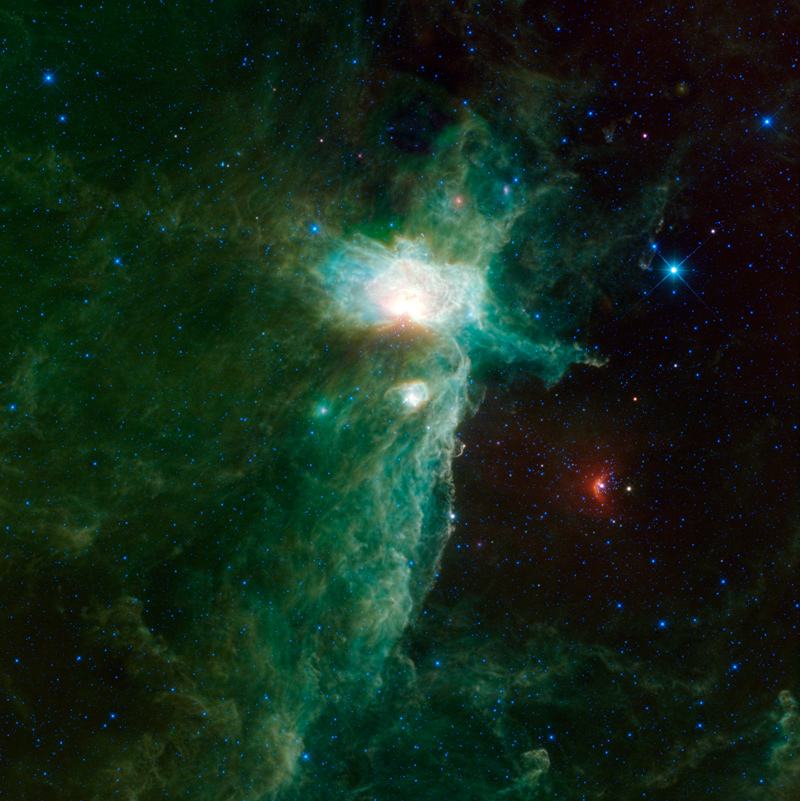
The above image shows the Flame Nebula (NGC 2024 and Sh2-277), which sits on the eastern hip of the constellation Orion, the Hunter. Orion is most easily visible in the northern hemisphere during winter evenings. Image Credit: NASA/JPL-Caltech

Take a look at this! It's a new image from NASA's Wide-field Infrared Survey Explorer (WISE), which shows the candle-like Flame Nebula (NGC 2024 and Sh2-277) lighting up a cavern of dust. The Flame is part of a region known as the Orion complex, a turbulent star-forming area located near the belt of the constellation Orion, the Hunter.

The WISE mission team released this image Monday, July 2nd, along with a new batch of data. Last March, the team released its all-sky catalog and atlas containing infrared images from its first scan and data on more than a half billion objects, including everything from asteroids to stars and galaxies. Now, the mission is offering up additional data from its second scan of the sky. According to WISE principle investigator Edward (Ned) Wright of UCLA, data from the second sky scan are useful for studying stars that vary or move over time, and for improving and checking data from the first scan.

In this WISE view of the Flame, colors are assigned to different channels of infrared light. The resulting image looks like a flaming candle giving off billows of smoke. In fact, the wispy tendrils in the image are part of the larger Orion star-forming complex, a huge dust cloud churning out new stars. In the Flame, massive stars are carving a cavity in this dust. Intense ultraviolet light from a central massive star 20 times heavier than our sun, and buried in the blanketing dust, is causing the cloud to glow in infrared light. This star would be almost as bright to our eyes as the three stars in Orion's belt, but the dust makes the star appear 4 billion times fainter than it really is.

Other features in this view include the reflection nebula NGC 2023, seen as a bright circle in the lower half of the image, and the famous Horsehead Nebula, which is hard to see but located to the right of one of the lower, vertical ridges. The bright red arc at lower right is a bow shock, where material in front of the speeding multiple-star system Sigma Orionis is piling up.

The data released July 2nd cover about one-third of the mission's second full scan of the sky. They were taken from August to September 2010 as the telescope began to deplete its coolant, operating with three of its four infrared detectors. The coolant kept the telescope chilled to prevent its heat, or infrared radiation, from interfering with the observations. As the telescope warmed during this period, one of the four channels on WISE was overwhelmed by the infrared radiation. An introduction and quick guide to accessing the WISE all-sky archive for astronomers is online at: http://wise2.ipac.caltech.edu/docs/release/allsky/ 
.

And now, the WISE mission particulars...

Launched into Earth orbit December 14, 2009, NASA's Wide-field Infrared Survey Explorer (WISE) mission performed an all-sky survey in 3, 5, 12, and 22 µm wavelength range bands, over 10 months. WISE made its observations using its 40 cm (16 in) infrared telescope. The length of the initial mission was limited by the spacecraft's hydrogen coolant. A secondary post-crygenic mission continued for four months. During its time of operation, WISE completed two scans of the sky. On February 17th, 2011, WISE was decommissioned/hibernated when its transmitter was turned off.

NASA's Jet Propulsion Laboratory, Pasadena, California, manages, and operated, WISE for NASA's Science Mission Directorate. Edward (Ned) Wright is the mission principal investigator and is at UCLA. The mission was selected competitively under NASA's Explorers Program managed by the agency's Goddard Space Flight Center in Greenbelt, Maryland. The science instrument was built by the Space Dynamics Laboratory in Logan, Utah. The spacecraft was built by Ball Aerospace & Technologies Corp. in Boulder, Colorado Science operations and data processing take place at the Infrared Processing and Analysis Center at the California Institute of Technology in Pasadena. Caltech manages JPL for NASA. You can learn more about WISE mission online at http://www.nasa.gov/wise, http://wise.astro.ucla.edu and http://jpl.nasa.gov/wise .

To catch postings for all my blogs, subscribe on Twitter to @RoamingAstro . Like what you see? Let me know! Email: RoamingAstroInput@gmail.com .

-

Wednesday, July 04, 2012

15th Anniversary of Pathfinder Landing

The above image is a panoramic view taken by the Pathfinder cameras. At center is the Sojourner rover at its first major target, a big rock nicknamed "Yogi Rock." The rocks found on this mission were named after famous icons and figures. Yogi was the first rock found on Mars to be made of basalt. Image Credit: NASA

Happy anniversary, Mars Pathfinder! On July 4th, 1997, NASA's Mars Pathfinder mission successfully landed on the surface of Mars. The event marked the first successful U.S. landing on the Red Planet since NASA's Project Viking missions of the 1970s. Originally named the Mars Environmental Survey (MESUR) Pathfinder mission, Mars Pathfinder consisted of a lander, later renamed the Carl Sagan Memorial Station, and a lightweight (10.6 kilograms/23 pounds) wheeled robotic rover named Sojourner.

Mars Pathfinder launched on December 4th, 1996 aboard a Delta II booster, one month after the launch of the Mars Global Surveyor (MGS), a Mars orbiter mission. Pathfinder landed on Mars' Ares Vallis, in a region called Chryse Planitia in the Oxia Palus quadrangle. The lander then opened, exposing the rover which conducted many experiments on the Martian surface. Pathfinder was the second project from NASA's Discovery Program, which promotes the use of low-cost spacecraft and frequent launches under the motto "cheaper, faster and better," which was promoted by the then administrator, Daniel Goldin. Mars Pathfinder was directed by the Jet Propulsion Laboratory (JPL), a division of the California Institute of Technology, responsible for NASA's Mars Exploration Program.

In addition to its scientific objectives, Mars Pathfinder was also a "proof-of-concept" for various technologies, such as airbag-mediated touchdown and automated obstacle avoidance, both later exploited by the Mars Exploration Rovers (Spirit and Opportunity). Pathfinder was also remarkable for its extremely low cost relative to other unmanned space missions to Mars.


After the landing, Pathfinder was renamed as the Sagan Memorial Station in honor of astronomer and planetologist Carl Sagan. On Sol 2 (the second Martian day on the surface), the Sojourner rover rolled off the lander. The little rover then made its way to a grouping of rocks, which the scientists named "Barnacle Bill", "Yogi", and "Scooby Doo", after famous cartoon characters. Sojourner made measurements of the elements found in those rocks and in the martian soil, while the lander took pictures of the Sojourner and the surrounding terrain, in addition to making climate observations.

Sojourner had six wheels, was 65 cm long, 48 cm wide, 30 cm tall and weighed 10.5 kg. Its maximum speed reached one centimeter per second. Sojourner traveled approximately 100 meters in total, never more than 12 meters from the Pathfinder station. During its 83 sols of operation, it sent 550 photographs to Earth and analyzed the chemical properties of 16 locations near the lander.


Although the mission was programmed to last from a week to a month, it lasted for almost three months. The final contact with Pathfinder was at 10:23 UTC on September 27th, 1997. Although mission managers tried to restore contact during the five months that followed, the mission was terminated on March 10th, 1998. The mission had exceeded its goals in the first month.

The official name for "the little rover that could" was chosen after a year-long, worldwide competition in which students up to 18 years of age were invited to submit an essay about a heroine of their choosing. First prize went to Valerie Ambroise, age 12, who wrote about Sojourner Truth, a black reformist who lived during the Civil War era. An abolitionist and champion of women's rights, Sojourner Truth, whose legal name was Isabella Van Wagener, made it her mission to "travel up and down the land," advocating the rights of all people to be free and the rights of women to participate fully in society. The name Sojourner means "traveler."

Second prize went to Deepti Rohatgi, age 18, who wrote about Marie Curie, the Polish-born chemist who won the Nobel Prize in 1911 for her discovery of the elements radium and polonium. This name was given to an identical rover which was used in testing on Earth by the mission team. Third prize went to Adam Sheedy, age 16, who wrote about the late NASA astronaut Judith Resnik.

To learn more about the Mars Pathfinder mission, visit the mission archives at this URL: mars.jpl.nasa.gov/MPF . To lean more about the planet Mars and more about NASA's Exploring Mars Program, visit these URLs: marsprogram.jpl.nasa.gov/ and marsrovers.jpl.nasa.gov .

To catch postings for all my blogs, subscribe on Twitter to @RoamingAstro . Like what you see? Let me know! Email: RoamingAstroInput@gmail.com . 

-

Tuesday, July 03, 2012

On July 3rd: Pluto, Spacewatch-Boattini, Asteroids, SAMPEX

Moon Occults Pluto. First shadow, 10:58:05 UTC, last shadow 13:39:00 UTC. Celestial coordinates (J2000) R. A. 18h 34m 33s Dec -19d 20m 29s, in the constellation Sagittarius. Pluto approximate magnitude 14.43. 


Comet P/2011 JB15 (Spacewatch-Boattini) has its closest approach to Earth (4.098 AU). P/2011 JB15 was discovered using the Steward Observatory Telescope on Mount Lemmon, near Tucson, Arizona, by Italian astronomer Andrea Boattini, as part of the Mount Lemmon Survey (part of the Catalina Sky Survey). P/2011 JB15 was discovered on May 8th, 2011 and classified as an asteroid until a coma was first observed on May 28th. On May 31st, 2011 the body was named  Spacewatch-Boattini. Celestial coordinates (J2000) R.A. 18h 49m 02.16s Dec -04d 02m 58.9s. Apparent nuclear magnitude 18.90. 

Asteroid 3367 Alex (1983 CA3) occults HIP 91527 (6.7 Magnitude Star). 3367 Alex is a main-belt asteroid, discovered February 15th, 1983, from Anderson Mesa Station, Flagstaff, Arizona, by American astronomer Norman G. Thomas. 3367 Alex apparent magnitude 15.93. HIP 91527 celestial coordinates (J2000) R.A. 18h 39m 54s Dec -20d 04m 16s. Occulation details - time: 10:33 UTC; duration: 1.4; magnitude change: 9.20.

Asteroid 1855 Korolev (1969 TU1) has its closest approach to Earth (1.264 AU). 1855 Korolev is a main-belt asteroid, discovered October 8th, 1969, from the Crimean Astrophysical Observatory, Ukraine, by Soviet astronomer Lyudmila Chernykh. 1855 Korolev is named after Soviet rocket engineer and spacecraft designer Sergei Korolev. Celestial coordinates (J2000) R.A. 19h 09m 07.34s Dec -16d 54m 47.1s. Apparent magnitude 15.13.

Asteroid 7000 Curie (1939 VD) has its closest approach to Earth (1.328 AU). 7000 Curie is a main-belt asteroid, discovered November 6th, 1939, from Uccle, Belgium, by Belgian astronomer Fernand Rigaux. 7000 Curie is named after French-Polish physicist and chemist, Marie Curie. Celestial coordinates (J2000) R.A. 17h 48m 07.66s Dec -32d 55m 28.3s. Apparent magnitude 15.78.

Asteroid 2843 Yeti (1975 XQ) has its closest approach to Earth (1.465 AU). 2843 Yeti is a main-belt asteroid, discovered December 7th, 1975, from Zimmerwald, Switzerland, by Swiss astronomer Paul Wild. 2843 Yeti is named after the ape-like creature said to inhabit the Himalayan region of Nepal and Tibet. Celestial coordinates (J2000) R.A. 19h 11m 37.65s Dec -17d 57m 09.1s. Apparent magnitude 16.11.

Asteroid 1381 Danubia (1930 QJ) has its closest approach to Earth (1.524 AU). 1381 Danubia is a main-belt asteroid, discovered August 20th, 1930, from Simeiz Observatory, Crimea, Ukraine, by E. Skvortsov. 1381 Danubia is named after the Danube River which runs through Central Europe. Celestial coordinates (J2000) R.A. 18h 10m 22.77s Dec -30d 59m 18.7s. Apparent magnitude 15.63.

The 20th anniversary (July 3rd, 1992) that the Solar Anomalous and Magnetospheric Particle Explorer (SAMPEX) satellite was launched in to low Earth orbit. SAMPEX was originally planned for a three-year science mission. The SAMPEX science mission ended June 30th, 2004.

To catch postings for all my blogs, subscribe on Twitter to @RoamingAstro . Like what you see? Let me know! Email: RoamingAstroInput@gmail.com . 

-

Three Cheers for Opportunity! 3,000 Sols and Counting...

The above image shows the travels of NASA's Mars Exploration Rover Opportunity along the north end of Cape York on the rim of Endeavour Crater. The top-most point represents the current location of the rover. Image Credit: NASA 


On Monday, July 2nd, NASA's Opportunity rover celebrated its 3,000th Sol on the planet Mars. A Sol is mean solar day on the Red Planet, which lasts 24 hours, 39 minutes, and 35.244 seconds. Opportunity is continuing to explore the north end of Cape York on the rim of Endeavour Crater. Specifically, the transition layer between Cape York and Meridiani Planum. 

The data transmission rate from Opportunity to Earth is returning to its normal frequency. Until recently, Opportunity's Ultra High Frequency relay had been limited to just two relay passes per week, using the Mars Reconnaissance Orbiter (MRO). You see, all surface transmissions must be relayed through the satellites in Mars orbit. Opportunity had been limited to MRO because the Mars Odyssey orbiter was out of service for a few weeks. Since Odyssey has been back up and running, Opportunity has had data downlinks on both Sols 2995 and 2996 (June 27th and 28th). 


Opportunity's work may seem tedious and tiresome, but Opportunity was built for it, and does it without complaining. For example, on Sol 2990 (June 21st, 2012), Opportunity began taking in-situ measurements, using the Microscopic Imager (MI) and Alpha Particle X-ray Spectrometer (APXS), on a rock named "Grasberg." On Sol 2992 (June 24th, 2012), Opportunity analyzed a slightly offset target called "Grasberg 2." And finally, on Sol 2995 (June 27th, 2012), the original Grasberg target was brushed by Opportunity using its Rock Abrasion Tool, in preparation for further MI and APXS analysis.

Opportunity's solar array has not had any recent "cleaning events" (translation: wind blows dust off the solar panels to increase electricity generation). Even so, Opportunity continues to do well. But the mission team would not mind a few good breezes to clean off the solar array a bit more. As of June 20th, Opportunity had traveled over 21.43 miles (34,491.99 meters). And so it goes... 

And now, the mission particulars... 

The rover Opportunity and its twin, Spirit, completed their three-month prime missions on Mars in April 2004. Both rovers continued for years of bonus, extended missions. Both have made important discoveries about wet environments on ancient Mars that may have been favorable for supporting microbial life. Spirit stopped communicating in 2010. Since landing in the Meridiani region of Mars in January 2004, Opportunity has driven 21.4 miles (34.4 kilometers). 

NASA's Jet Propulsion Laboratory, a division of the California Institute of Technology, in Pasadena, manages the Mars Exploration Rover Project for NASA's Science Mission Directorate, Washington. 

To lean more about the planet Mars and more about NASA's Exploring Mars Program, visit these URLs:
marsprogram.jpl.nasa.gov/ and marsrovers.jpl.nasa.gov .

To catch postings for all my blogs, subscribe on Twitter to @RoamingAstro . Like what you see? Let me know! Email: RoamingAstroInput@gmail.com . 

-

July 2nd AR 1515 Solar Flare and CME

The YouTube video at the URL below is a collection of views of the AR 1515 solar flare on July 2nd, 2012. The video is provided from various NASA sources. The video was compiled and edited by YouTube contributor "Otherstuffman". http://m.youtube.com/#/watch?v=Fa_1jqPC710

The big sunspot known as Active Region 1515 (AR 1515) erupted on Monday, July 2nd, at 10:52 UTC (6:52 AM EDT). The eruption produced an M5.6-class solar flare that nearly reached X-class strength.

A pulse of x-rays and UV radiation from the flare illuminated Earth's upper atmosphere, producing waves of ionization over Europe. Such waves alter the propagation of low-frequency radio transmissions. The eruption also hurled a coronal mass ejection (CME) into space, but not directly toward Earth. The south-traveling cloud could deliver a glancing blow to our magnetosphere on July 4th or 5th. Stay tuned...

To learn more about the sun and to stay current on solar activity, visit the mission home page of Solar Dynamics Observatory (SDO), sdo.gsfc.nasa.gov/ .

-