Pages

Saturday, May 19, 2012

Safe Viewing With a Pinhole Camera

The above image demonstrates the use of a pinhole camera to safely view the sun. Such a device could be very handy for the May 20 annular eclipse and the transit of Venus over June 5-6. Image Credit: NASA/JPL-Caltech

As you may well know by now, Earth will be treated to an annular solar eclipse this Sunday, May 20th, and a transit of Venus over June 5-6. Because solar safety bears repeating, we will do so now.

ATTENTION! You should never, never look at the sun directly, even with binoculars or a telescope, because you could severely damage your eyes or even go blind! Now that we have that out of the way...

There are special filtering materials that, when used correctly, allow you to view the sun safely. If you do not have these, or you are not certain how to use them, do not take chances. Instead, view the sun using a projection method.

If you have binoculars or a telescope, you may use them to project an image. We discussed this method in a May 18th posting, so just read back.

If you do not have a telescope or binoculars, no worries! You can still enjoy the event using a pinhole camera that you can make yourself, cheaply and easily.

JPL Education has created a wonderful page, compete with pictures, that walks you through the entire project. Please check it out and tell a friend!

"How to Make a Pinhole Camera." JPL Education, NASA/JPL-Caltech: www.jpl.nasa.gov/education/index.cfm?page=341

For more information on eclipses, visit this site: eclipse.gsfc.nasa.gov/eclipse.html

-

SpaceX Will Try, Again, May 22

The Associated Press and ABC News have reported that the May 20 SpaceX ISS re-supply mission aborted on the launch pad at Cape Canaveral Air Force Base, Florida.


Space Exploration Technologies Corporation (SpaceX) was on schedule for a 4:55 AM ET launch to the International Space Station. But seconds before the countdown reached zero, with the ignition sequence already started, the Falcon 9 rocket's on-board computers issued an automatic shutdown order. An engine pressure problem is suspected.


SpaceX is one name on a small-but-growing list of private U.S. companies that hope to take over the job of regularly re-supplying the International Space Station for NASA. SpaceX will work to identify and correct the May 19 problems in time for the next ISS launch window on Tuesday, May 22. For more on SpaceX, visit their home page: www.SpaceX.com


-

SpaceX Goes for ISS Re-Supply


The above image is an artist's depiction of a SpaceX COTS (Commercial Orbital Transportation Services) Dragon spacecraft approaching the International Space Station: Image Credit: SpaceX


This Saturday, May 19th, SpaceX will attempt to become the first private company to dock a capsule with the space station. Since the Space Shuttle Columbia disaster in 2003, the White House has consistently directed NASA to turn the job of transporting cargo and crew to the station over to private firms.


NASA already has $3.5 billion in cargo contracts with two rocket makers – SpaceX and Orbital Sciences Corporation – and has added $270 million in seed money to four companies to develop technologies to transport crews. This summer, NASA expects to provide additional money to help private space companies develop full-scale systems. With SpaceX about to try for the history books, here is a rundown on the company.


Space Exploration Technologies Corporation (SpaceX) was founded in 2002 by Elon Musk, a co-founder of the online payment service, PayPal. Mr. Musk's team has developed rockets aimed at driving down the cost of launching payloads and people into space.


In 2008, after three failures, the company's two-stage Falcon 1 rocket became the first privately financed rocket to reach orbit. It launched its first satellite in 2009.


The company's next model, the Falcon 9, is designed to be the workhorse for space-station resupply missions and for launching commercial satellites. As a resupply ship, it's topped by a capsule (called Dragon) designed to carry cargo and – in the future – space-station crew members. So far, NASA has spent $75 million on the company's efforts to develop the human-transportation portion of its efforts.


Falcon 9 passed its first test launch in June 2010, topped with a dummy capsule. A second launch six months later put the company into the record books as the first privately financed rocket maker to orbit and recovery a capsule.


Liftoff of the Falcon 9 rocket, its Dragon capsule filled with food, supplies and science experiments, is scheduled for 4:55 AM ET from the SpaceX launch site at Cape Canaveral Air Force Station in Florida. Three days later, astronauts will use a robotic arm to attach the Dragon capsule to the station. The cargo will be unloaded, the return cargo loaded in, and the capsule will return to splash down in the Pacific.


As early as the end of this year, SpaceX plans to test its next rocket, the Falcon Heavy, in a launch from Vandenberg Air Force Base in California. It's designed to lift up to 53 metric tons of cargo to low-Earth orbit, more than twice the capacity of the space shuttle. It would be the most powerful rocket in the US stable since NASA's Saturn V first launched astronauts to the moon in 1969.

You can learn more about SpaceX at their website: www.SpaceX.com

-

Friday, May 18, 2012

Transit Trivia: Gregory and Halley


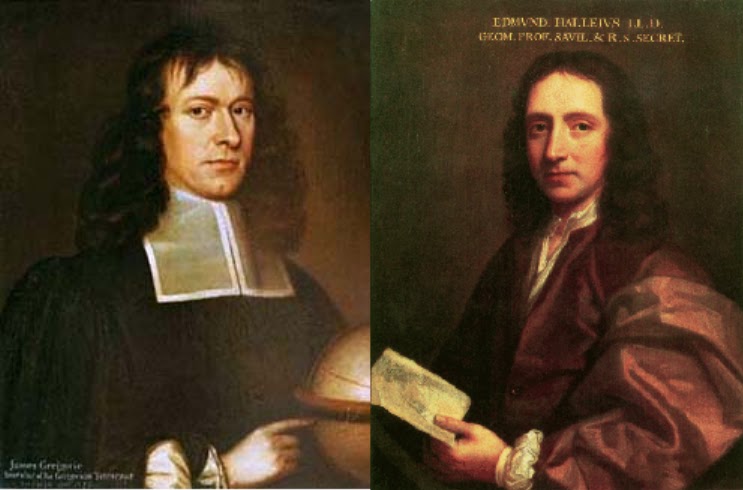
In the above portraits, James Gregory is on the left (artist and date unknown) and Edmund Halley is on the right (1687 by Thomas Murray). Image Credit: The portraits are in the Public Domain.

In 1663, Scottish mathematician and astronomer James Gregory (1638 - 1675) published a work he entitled Optica Promota (The Advance of Optics). In his work, Gregory analyzed the properties of lens and mirrors, substantially developed Johannes Kepler’s theory of the telescope, proposed a new telescope design, and made other observations along the way.

One of the observations Gregory made was that the transits of Mercury and Venus could be used to determine the distance between Earth and the sun. He explained that multiple observations of a specific transit, at widely spaced points on the surface of the earth, could be used to calculate the solar parallax — using triangulation — and from that, determine the distance from Earth to the sun.

Gregory's work came one year after the posthumous publication of Jeremiah Horrocks' observations and calculations from the 1639 transit of Venus. Perhaps Gregory was aware of Horrocks, or perhaps the realization of the usefulness of solar transits was just gaining momentum. Whatever the case, the notion caught the attention of a young Edmund Halley (1656 - 1742).

In 1677, Halley traveled to St. Helena, a volcanic island in the South Atlantic Ocean. From this point, on November 7th, Halley made the first careful observations of the transit of Mercury. But Halley was later disappointed to learn that few others had done the same. In a letter written by John Flamsteed to Johannes Hevelius the following year, Flamsteed reported there were only three observers of the 1677 Mercury transit. In addition to Halley on St. Helena, Richard Towneley observed from Lancashire, England and Jean Charles Gallet observed from Avignon, France. Needless to say, Halley was not satisfied with the resulting calculations.


In 1678, Halley proposed that more accurate measurements could be made using a transit of Venus. Halley pushed for a coordinated international effort that would ensure a large pool of data from which to calculate a more accurate solar parallax, and thus a more accurate distance to the sun. The next transit of Venus was expected in 1761. Sadly, Halley would not participate in the event himself, for he died nineteen years prior.


The next transit of Venus will occur over June 5-6. To learn more, visit these links.


2012 Transit of Venus, NASA/Goddard Space Flight Center: eclipse.gsfc.nasa.gov/OH/transit12.html


Transit of Venus, Sun-Earth Day 2012, NASA: sunearthday.nasa.gov/transitofvenus/


-

May 20th Annular Eclipse from Earth and Space


The above image is an X-ray view from space of the January 6, 2011 solar eclipse. The image was captured by the Hinode spacecraft. Image Credit: Hinode

This Sunday, May 20th, Earth will be treated to an annular solar eclipse. The event will be visible in the U.S. on a path from northwestern Texas through New Mexico, northeastern Arizona, southern Utah, Nevada, northern California and southwestern Oregon late in the day.

As the sun continues its path, the eclipse will then be visible over the North Pacific, in southern Japan and southern China on the morning of May 21.

An annular eclipse is similar to a total solar eclipse in that the moon lines up exactly with the sun. But in this case, the moon is close to apogee — the farthest point from Earth in its elliptical orbit around our planet — so that the moon is a bit too small to cover the solar disk completely. As a result, a ring of bright sunlight (some say a "ring of fire") will still blaze around the moon's circumference. At its peak, the eclipse will block about 94 percent of the sun's light. The event is described as an "annular" eclipse because the word comes from the Latin annulus, meaning "little ring."

Most of North America not in the totality footprint will still see a partial solar eclipse, without being treated to the ring of fire effect. Sadly, the East Coast will miss the event since the sun will have set before it begins. The eclipse will occur in the late afternoon or early evening of May 20 throughout North America, and May 21 for observers in Asia.

WARNING! Never view the sun directly with the naked eye or with any unfiltered optical device, such as binoculars or a telescope! If and when you view the sun, your first concern should always be eye safety. Serious eye damage — partial or total blindness — can result from even a brief glimpse.

One safe way to observe eclipses is to project an image of the sun through a telescope or binoculars onto a white screen — paper plates, walls and sidewalks all work nicely for this. If you're using a telescope, be sure that any small finder telescope is capped. If you're using binoculars, keep the cover on the tube which is not used.

Your projected image will be a circle of light. This is the disc of the sun. Adjust the distance between the screen and the telescope until the disk is about the size of a small paper plate. The image will probably be blurred, so focus your telescope until the circle becomes sharp. Using this method you can see considerable detail.

Pinhole projectors and certain types of solar filters can also provide a safe view of the sun. Pinhole projectors usually produce a small and unsatisfying image, but they are better than nothing if you don't have a telescope or binoculars.

Incidentally, with all of the solar observatories currently flying, you would think that some could take advantage of this rare event for some interesting observing. Well, as it turns out, the orbits for NASA's Solar Dynamics Observatory (SDO), NASA's Solar Terrestrial Relations Observatory (STEREO), and the joint ESA/NASA mission the Solar Heliospheric Observatory (SOHO) will not provide them with a view of the eclipse.

So what solar mission is left? Why, Hinode, of course! Hinode (Japanese, meaning "sunrise") is the joint JAXA/NASA mission to study the sun's magnetic field and better understand the mechanisms that power the solar atmosphere.

Hinode will observe the eclipse and provide images and movies that will be available on the NASA website at www.nasa.gov/sunearth. Due to Hinode's orbit around the Earth, Hinode will actually observe 4 separate partial eclipses." Scientists often use an eclipse to help calibrate the instruments on the telescope by focusing in on the edge of the moon as it crosses the sun and measuring how sharp it appears in the images. And as an added bonus, Hinode's X-ray Telescope will be able to provide images of the peaks and valleys of the lunar

After May 20th, the next solar eclipse will be the total solar eclipse of this November 13th. For more information on eclipses, visit this site: eclipse.gsfc.nasa.gov/eclipse.html

To find information about the time of any eclipse in your location: eclipse.gsfc.nasa.gov/JSEX/JSEX-index.html

-

Thursday, May 17, 2012

Transit Trivia: Jeremiah Horrocks


The above painting is an artist's conception of the first observed transit of the planet Venus, as predicted and observed by Jeremiah Horrocks in 1639. The portrait is held in the collection of Astley Hall Museum and Art Gallery Chorley and the property of Chorley Council. Image Credit: Because of its age, the image is in the Public Domain.

Kepler's Rudophine Tables proved invaluable to many astronomers, not the least of which was Jeremiah Horrocks (1618 – 1641), an English astronomer, the son of a Liverpool farmer, and a clerk at the local St. Michael's Church in Much Hoole, Lancashire. In the tables, Kepler had predicted transits in 1631 and 1761 and a near miss in 1639. But Horrocks found and corrected an error in Kepler's calculation for the orbit of Venus. He then realized that transits of Venus would occur in pairs that were eight years apart, and so predicted the transit in 1639.

On December 4th, 1639 (November 24th under the Julian calendar, which was then in use in England), Horrocks prepared to observe from Carr House in Much Hoole, near Preston in England. Although he was uncertain of the exact time, Horrocks calculated that the transit would begin at approximately 3:00 PM. The day being Sunday, Horrocks spent much of the time attending to his clerk duties at St. Michael's. It was just as well, for clouds obscured the sun for most of the day, but cleared by about 3:15, when Horrocks was finished with his other obligations. He was able to observe a portion of the event for about 30 minutes until the local sunset. Aside from Horrocks, only one other person observed the transit: English astronomer, mathematician, merchant, and friend to Jeremiah Horrocks, William Crabtree (1610 - 1644). Crabtree  observed from his home in Broughton, near Manchester.

Horrocks understood that looking directly at the sun without proper filtering would cause blindness, a tragedy for anyone, but especially bad for an astronomer. Horrocks therefore focused the image of the sun through a simple refractor telescope and onto a piece of card, where the image could be safely observed.

Horrocks' observations allowed him to make a well-informed guess as to the size of Venus, as well as to make an estimate of the distance between the Earth and the sun. He estimated that distance to be 59.4 million miles (0.639 AU) – about two thirds of the actual distance of 93 million miles (149.6 million km) but a more accurate figure than any suggested up to that time.

The life of Jeremiah Horrocks was indeed impressive. This son of a farmer had managed to study at Cambridge University. He had reviewed, found fault, and corrected the works of earlier greats, including those of Kepler. He correctly predicted a transit of Venus, was one of the first two people to observe the event, and he used his observations to calculate a new distance between Earth and the sun which was the most accurate to that time. And for all of this, Horrocks was only about 21 years old.

In addition, Horrocks determined the orbit of Earth's moon and correctly hypothesized that its shape was elliptical rather than circular. He even suggested that Earth and the sun influenced the moon's orbit, anticipating Isaac Newton's theories on gravity. And Horrocks had begun a detailed study of tides in an attempt to explain the lunar causation of tidal movements. Sadly, Horrocks would not complete this or any other work. He died at his home, from unknown causes, at the age of 22. As his friend William Crabtree expressed, "What an incalculable loss!"

About twenty years later, in 1662, the Polish-Lithuanian astronomer Johannes Hevelius (1611 - 1687) published, at his own expense, the transit work of Jeremiah Horrocks. The treatise was entitled Venus in sole visa (Venus in transit across the Sun). The paper caused great excitement when it was presented to members of the Royal Society. It contained much evidence of Horrocks' enthusiastic and romantic nature, including humorous comments and passages of original poetry. When writing on the century which separated his and the next transit of Venus, Horrocks rhapsodized,

"Oh! then farewell, thou beauteous queen!
Thy sway may soften natures yet untamed,
Whose breasts, bereft of the native fury,
Then shall learn the milder virtues.
We, with anxious mind, follow thy latest footsteps here,
And far as thought can carry us;
My labours now bedeck the monument for future times
Which thou at parting left us. Thy return
Posterity shall witness; years must roll away,
But then at length the splendid sight
Again shall greet our distant children's eyes."


At St. Michael's Church in Much Hoole, a stained glass window on the east wall commemorates Horrocks and his achievement in observing the transit. Nearby, at Carr House, a plaque recognizes the location where Horrocks made his observations.

The next transit of Venus will occur over June 5-6. To learn more, visit these links.

2012 Transit of Venus, NASA/Goddard Space Flight Center: eclipse.gsfc.nasa.gov/OH/transit12.html

Transit of Venus, Sun-Earth Day 2012, NASA: sunearthday.nasa.gov/transitofvenus/
 
-

Tiangong-1 Caught by Legault


The above drawing shows the Chinese experimental space station, Tiangong-1 (left), with a Shenzhou spacecraft docked (right). Image Credit: Wikipedia contributor "Craigboy"

On May 11th, French astrophotographer Thierry Legault posted online an image of the sun which included the silhouette of China's experimental space station, Tiangong-1. The spacecraft was passing across the face of the sun near the giant sunspot AR1476.

Tiangong-1 is much smaller than the International Space Station, but it can be seen with the naked eye shining in the night sky as brightly as the stars of the Big Dipper. The image by Legault may be seen online at this URL: legault.perso.sfr.fr/transit_tiangong1_120511.html

Tiangong-1 (meaning “Heavenly Palace 1") is a Chinese space laboratory module which is being used as an experimental test-bed to demonstrate the rendezvous and docking capabilities needed to support a space station complex. The Tiangong-1 spacecraft was launched by a Long March 2F/G rocket on September 29, 2011. Tiangong-1 is part of the Tiangong program, which has the goal of placing a larger, modular station into orbit by 2020. Tiangong-1 will be deorbited in 2013, and replaced over the following decade by the larger Tiangong-2 and Tiangong-3 modules.

Tiangong-1 is expected to be visited by three Shenzhou missions during its two-year operational lifetime. The first of these, the robotic mission Shenzhou 8, successfully docked with the module in November 2011, while the crewed Shenzhou 9 and 10 missions are expected to launch in 2012. Shenzhou 9 is not expected to launch before June.

To learn more about Tiangong-1, visit the following link at NASA’s National Space Science Data Center: nssdc.gsfc.nasa.gov/nmc/masterCatalog.do?sc=2011-053A

-

Wednesday, May 16, 2012

Transit Trivia: Brahe and Kepler


The above image shows a monument dedicated to Tycho Brahe (left) and Johannes Kepler (right). The monument is located in Prague, Czechia. Image Credit: WikiCommons contributor "Mohylek." This image is in the Public Domain.

Danish nobleman and astronomer Tycho Brahe (1546 - 1601) spent much of his life making very careful measurements of the positions of stars and planets. His work yielded data with an accuracy that was not previously possible. Brahe wanted his observations to be the basis of a new and more accurate set of star tables. He trusted this work to his collaborator, whom some considered his competition, the German mathematician, astronomer and astrologer Johannes Kepler (1571 - 1630).

Kepler was able to prepare the new tables using a combination of Brahe's accurate observations, a heliocentric (sun-centered) model of the solar system and Kepler's own discovery that the planets moved in elliptical (not circular) orbits. Following Brahe's death, Kepler faced many obstacles in completing the work. His biggest were Brahe's surviving relatives, who fought Kepler for the publication rights.

In 1623, Kepler at last completed the new tables. However, publication was delayed because of the publishing requirements of Emperor Ferdinand II and because of ongoing negotiations with Brahe's family. In the meantime, religious tension — the root of the ongoing Thirty Years' War — put Kepler and his family in jeopardy. In 1626, Kepler and family moved from Bohemia to Ulm, Upper Austria, where Kepler arranged for the printing of the new tables at his own expense.

Brahe had wanted the tables to be dedicated to his patron, the Bohemian king and Holy Roman emperor Rudolph II. But by the time of their publication in 1627, Rudolf II had died, so instead the tables were dedicated to Emperor Ferdinand II but were still named in honor of Rudolph II.

The Rudolphine Tables (Latin: Tabulae Rudolphinae) included a star catalogue and planetary tables. Most of the calculated positions were accurate to within one minute of arc. In addition, the tables were the first to include corrective factors for atmospheric refraction. In fact, the tables were so accurate that they led to the first observed transits of Mercury (in 1631) and of Venus (in 1639).

The next transit of Venus will occur over June 5-6. To learn more, visit these links.

2012 Transit of Venus, NASA/Goddard Space Flight Center: eclipse.gsfc.nasa.gov/OH/
transit12.html

Transit of Venus, Sun-Earth Day 2012, NASA: sunearthday.nasa.gov/transitofvenus/


-

More on Vesta and HED Meteorites


The above image shows three slices of HED-class meteorites. Image Credit: University of Tennessee


This is a follow-up to the recent paper by the NASA Dawn mission team regarding asteroid Vesta and its parentage of the HED family of meteorites. Back on May 11th, a paper by the mission team was posted in the journal Science. In the paper, the team presented evidence that the family of meteorites known as howardite, eucrite and diogenite (HED) originated on asteroid 4 Vesta, and likely left Vesta as a result of the impact which created the large basin near Vesta's south pole.


Above are three nifty slices of HED-class meteorites. They were viewed through a polarizing microscope, where different minerals appear in different colors. The texture of the rocks reveals that they crystallized at different rates. The image on the left comes from a meteorite named QUE 97053 (Antarctica), which is basaltic eucrite. The image in the middle comes from the Moore County (North Carolina) cumulate eucrite. The image on the right comes from a diogenite meteorite named GRA 98108 (Antarctica).


Launched in 2007, NASA's Dawn spacecraft has been studying Vesta since its arrival in July of 2011. The Dawn spacecraft will depart Vesta on August 26 (my birthday) . At that time it will head for its next study target, the dwarf planet Ceres, arriving in 2015.


And now, the mission particulars...


Dawn's mission to Vesta and Ceres is managed by JPL for NASA's Science Mission Directorate in Washington. Dawn is a project of the directorate's Discovery Program managed by NASA's Marshall Space Flight Center in Huntsville, Ala. UCLA is responsible for overall Dawn mission science. Orbital Sciences Corp. in Dulles, Va., designed and built the spacecraft. The German Aerospace Center, the Max Planck Institute for Solar System Research, the Italian Space Agency and the Italian National Astrophysical Institute are international partners on the mission team. The California Institute of Technology in Pasadena manages JPL for NASA.


For more information about the Dawn mission, visit: www.nasa.gov/dawn and dawn.jpl.nasa.gov .


To read more about the Vesta discoveries, check out the online home page of the journal Science: www.sciencemag.org


-

Tuesday, May 15, 2012

Transit Trivia: Venus and the Ancients


The tablet in the above image is know as the Venus Tablet of Ammisaduqa from the Neo-Assyrian period. The tablet is on display in the British Museum, London. Image Credit: Wikipedia contributor "Fæ"

The celestial body which we now call Venus was known to ancient Indian, Greek, Egyptian, Babylonian and Chinese observers. The early Greeks actually thought they were recording the movements of two different objects — one that appeared in the morning and one that appeared in the evening. Their "evening star" was called Hesperus (in Greek mythology, a son of the dawn goddess Eos) and their "morning star" was called Phosphorus (also a son of Eos and brother to Hesperus) The Greek philosopher and mathematician Pythagoras is credited with realizing these two object were one and the same.

Venus was important to ancient American cultures, in particular for the Maya, who called it Noh Ek, "the Great Star" or Xux Ek, "the Wasp Star"; they embodied Venus in the form of the god Kukulkán (also known as or related to Gukumatz and Quetzalcoatl in other parts of Mexico). In the in the Mayan book which we now call the Dresden Codex, the Maya charted Venus' full cycle.

For their times, these culture made careful records of Venus. But even so, there is no evidence that any of these ancient cultures knew of the transits of Venus across the sun.

The next transit of Venus will occur over June 5-6. To learn more, visit these links.

2012 Transit of Venus, NASA/Goddard Space Flight Center: eclipse.gsfc.nasa.gov/OH/transit12.html

Transit of Venus, Sun-Earth Day 2012, NASA: sunearthday.nasa.gov/transitofvenus/

-

MRO Detects Dune Movement


The above animation present two alternating images of the same area of Martian sand dunes taken three years apart. The animation shows the movement of the dunes. If you have problems seeing the animation, visit this link: http://www.nasa.gov/mission_pages/MRO/news/mro20120509.html Image Credit: NASA/JPL-Caltech/Univ. of Arizona/JHU-APL


Images from NASA's Mars Reconnaissance Orbiter have revealed that movement in sand dune fields on the planet Mars occurs on a surprisingly large scale, about the same as in dune fields on Earth.


The discovery is unexpected for three reasons: (1) the Red Planet has a much thinner atmosphere than Earth, (2) the atmosphere is only about one percent as dense, and (3) the atmosphere's high-speed winds are less frequent and weaker than Earth's.


We know from other Mars missions that the planet has its share of dust storms -- just talk to the Mars Exploration Rover mission team. Even so, researchers have debated for years whether the sand dunes observed on Mars were mostly fossil features related to past climate, or were they were currently active. In the past two years, researchers used the High Resolution Experiment (HiRISE) camera on the Mars Reconnaissance Orbiter (MRO) to detect and report sand dune movement.


The researchers now report that entire dunes as thick as 200 feet (61 meters) are moving as coherent units across the Martian landscape. Their study was published online May 9th by the journal Nature.


Researchers analyzed before-and-after images using a new software tool developed at the California Institute of Technology (Caltech) in Pasadena, California. The tool measured changes in the position of sand ripples, revealing that the ripples move faster the higher up they are on a dune.


The study examined images taken in 2007 and 2010 of the Nili Patera sand dune field located near the Martian equator. By correlating the ripples' movement to their position on the dune, the analysis determined the entire dunes are moving. This allows researchers to estimate the volume, or flux, of moving sand.


The study adds important information about the pace at which blowing sand could be actively eroding rocks on Mars. Using the new information about the volume of sand that is moving, scientists estimate rocks in Nili Patera would be worn away at about the same pace as rocks near sand dunes in Antarctica, where similar sand fluxes occur.


Scientists calculate that if someone stood in the Nili Patera dunes and measured out a one-yard (one-meter) width, they would see more than two cubic yards (1,500 liters) of sand pass by in an Earth year, about as much as in a child's sand box.


Scientists will use the information to understand broader mysteries on Mars, like why so much of the surface appears heavily eroded, how that occurred, and whether it is a current process or it was done in the past. Scientists can now point to sand flux as a mechanism capable of creating significant erosion today on the Red Planet.


And now the instrument particulars...


The HiRISE camera provides unprecedented resolution in studying the Martian landscape. NASA's Jet Propulsion Laboratory, Pasadena, California, a division of Caltech, manages the Mars Reconnaissance Orbiter for NASA's Science Mission Directorate in Washington. Lockheed Martin Space Systems, Denver, built the spacecraft. HiRISE is operated by the University of Arizona and was built by Ball Aerospace & Technologies Corp., Boulder, Colorado.


For related images and more information about Mars Reconnaissance Orbiter, visit the mission home page: www.nasa.gov/mro


To learn more about the study, visit the online home page of the journal Nature: www.nature.com


For more on NASA' Exploring Mars Program, visit the program home page: mars.jpl.nasa.gov


-

Monday, May 14, 2012

Transit Trivia: Predicting Patterns

The duration of a transit of Venus is usually measured in hours (the transits of 2004 and 2012 last about six hours). Before modern astronomy, observations of transits of Venus helped scientists measure the distance between the Sun and the Earth using the method of parallax.


Transits of Venus are the rarest of all predictable astronomical phenomena and currently occur in a pattern that repeats every 243 years, with pairs of transits eight years apart separated by long gaps of 121.5 years and 105.5 years. Before 2004, the last pair of transits of Venus were in December 1874 and December 1882. The first of the latest pair of transits occurred on June 8, 2004 and the other will occur on June 6, 2012.  Following that, the next pair of transits will be in December 2117 and December 2125.


The pattern repeats every 243 years because 243 sidereal orbital periods of the Earth (365.25636 days, which is slightly different from the tropical year) is 88757.3 days, and 395 sidereal orbital periods of Venus (224.701 days) is 88756.9 days. Thus, after this time both Venus and Earth have returned to very nearly the same point in each of their respective orbits. This period of time corresponds to 152 synodic periods of Venus.


The pattern of 105.5, 8, 121.5 and 8 years is not the only pattern that is possible within the 243-year cycle. Prior to 1518, the pattern of transits was 8, 113.5 and 121.5 years, and prior to 546, transits always took place 121.5 years apart. The current pattern will continue until 2846, when it will be replaced by a pattern of 105.5, 129.5 and 8 years. Thus, the 243-year cycle is relatively stable, but the number of transits and their timing within the cycle will vary over time.


The safest way to observe the event in 2012 would be to project the image of the Sun, as seen through a telescope, onto a screen. Nevertheless, the event can also be seen with free eyes using special stained glasses. If observing with Welder’s glasses, a grade of at least 14 should be used. Observing the Sun without filters can cause a temporary or permanent loss of visual function, as it can damage and even destroy retinal cells.


For more on the June 2012 Transit of Venus, visit these links.

2012 Transit of Venus, NASA/Goddard Space Flight Center: eclipse.gsfc.nasa.gov/OH/transit12.html

Transit of Venus, Sun-Earth Day 2012, NASA: sunearthday.nasa.gov/transitofvenus/

-

JunoCam Certifies With the Dipper


Above is an image, taken by NASA's Juno spacecraft of the asterism known in the U.S. as the "Big Dipper." Image Credit: NASA/JPL-Caltech/SWRI/MSSS


The above image is an asterism -- a grouping of stars that is not an official constellation, but is still familiar to observers. The grouping is called different names by different people. For example, it is called the "Big Dipper" (US), the "Plough" (UK), the "Great Cart" (Germany), and "Seven Ploughs" (Malaysia).


Whatever the name, these stars have long been, for northern hemisphere observers, a welcome and familiar introduction to the heavens. Now, these stars are helping the Juno mission team make sure that Juno's camera is ready to do its job.


Launched on August 5, 2011, the solar-powered Juno spacecraft is about 380 million miles (612 million kilometers) into its five-year, 1,905-million-mile (3,065-million-kilometer) journey to Jupiter.  Once there, the spacecraft will orbit the planet's poles 33 times and use its nine instruments to image and probe beneath the gas giant's obscuring cloud cover to learn more about Jupiter's origins, structure, atmosphere and magnetosphere, and look for a potential solid planetary core.


The instrument tasked with taking closeups of Jupiter's atmosphere is the JunoCam. But it would be four-and-a-half years until JunoCam's CCD (charged-coupled device) actually saw Jupiter. So the mission planners needed something on which to certify the instrument and they decided on this familiar grouping of stars. On March 21, JunoCam took the image seen above. The Juno team was thrilled by the result and is confident that the instrument is ready for Jupiter.


You can view the full test image online at: photojournal.jpl.nasa.gov/catalog/PIA15653


Juno's name comes from Greek and Roman mythology. The god Jupiter drew a veil of clouds around himself to hide his mischief, and his wife, the goddess Juno, was able to peer through the clouds and reveal Jupiter's true nature.


And now, the mission particulars...


NASA's Jet Propulsion Laboratory, Pasadena, Calif., manages the Juno mission for the principal investigator, Scott Bolton, of Southwest Research Institute in San Antonio. The Juno mission is part of the New Frontiers Program managed at NASA's Marshall Space Flight Center in Huntsville, Ala. JunoCam was developed and is operated by Malin Space Science Systems in San Diego. Lockheed Martin Space Systems, Denver, built the spacecraft. JPL is a division of the California Institute of Technology in Pasadena.  


Learn more about Juno online at www.nasa.gov/juno and missionjuno.swri.edu .


-

Sunday, May 13, 2012

Transit Trivia: Coming June 5-6

Above are three close-up images from a transit of the planet Venus across the face of the sun. The top image shows Venus on the eastern limb of the Sun. The faint ring around the planet comes from the scattering of its atmosphere, which allows some sunlight to show around the edge of the otherwise dark planetary disk. The faint glow on the disk is an effect of the TRACE telescope. The bottom left image is in the ultraviolet, and the bottom right image is in the extreme ultraviolet. The three images were captured by NASA's Sun-observing TRACE spacecraft. Image Credit: NASA/LMSAL 


The next transit of the Planet of Venus across the face of the sum will occur over Tuesday-Wednesday, June 5-6. In astronomy, a transit occurs when a smaller celestial body passes across the face of a larger celestial body from the point of view of the observer.

From Earth, there are only two regularly occurring transits of celestial bodies across the sun -- one by the planet Mercury and the other by the planet Venus. In truth, a third celestial body crosses the sun, but that is the moon and it completely covers the sun when the alignment is right. But because these events cover so much of the sun, and in some cases all of the sun, these occurrences are more precisely called occultations (coverings) rather than transits (crossings).

For reasons which we will get into later, transits of Venus occur in pairs that are just a few years apart. The last transit occurred June 8, 2004. The second of the pair occurs over June 5/6. After that, the next pair will in December 2117 and December 2125.

For more on the June 2012 Transit of Venus, visit these links.

2012 Transit of Venus, NASA/Goddard Space Flight Center: eclipse.gsfc.nasa.gov/OH/transit12.html

Transit of Venus, Sun-Earth Day 2012, NASA: sunearthday.nasa.gov/transitofvenus/

-

Curiosity Driving School in the Mojave

The above image shows the stripped-down rover used for test-driving in the Mojave Desert. Image Credit: NASA/JPL-Caltech

This passed week, team members of NASA's Mars Science Laboratory mission took a test rover to Dumont Dunes in California's Mojave Desert. No, no. It wasn't for joyriding. Well, it wasn't only for joyriding. They did it on order to improve their knowledge of the best way to operate the actual Curiosity rover, which is en route to Mars and scheduled for an August landing.

The test rover had a full-scale version of Curiosity's mobility system, but it was otherwise stripped down so that it weighed about the same on Earth as Curiosity will weigh in the lesser gravity of Mars.

What the team members learned in their tests on windward and downwind portions of the dunes will be used in making decisions about driving Curiosity on the dunes near a mountain in the center of Gale Crater. Of course, the mission team must first put the Curiosity rover safely on Mars. The landing methods are new and innovative, but much innovation is needed on order to progress toward eventual human missions to the Red Planet.

And now, the mission particulars...

Launched November 26, 2011, NASA's Mars Science Laboratory spacecraft and Curiosity rover are on track for landing the evening of August 5, 2012, PDT (early on August 6, Universal Time and EDT) to begin a two-year prime mission. Researchers plan to use Curiosity to study layers in Gale Crater's central mound, Mount Sharp. The mission will investigate whether the area has ever offered an environment favorable for microbial life.

NASA's Jet Propulsion Laboratory, a division of the California Institute of Technology in Pasadena, manages the mission for the NASA Science Mission Directorate, Washington.

More information about Curiosity is online at www.nasa.gov/msl and mars.jpl.nasa.gov/msl .  You can follow the mission on Facebook at: www.facebook.com/marscuriosity  and on Twitter at: www.twitter.com/marscuriosity .

-

Saturday, May 12, 2012

Venus Transit May Help Exoplanet Studies


The above image, taken by the Hubble Space Telescope, shows the Moon's Crater Tycho. Image Credit: NASA, ESA, and D. Ehrenreich (Institut de Planétologie et d'Astrophysique de Grenoble (IPAG)/CNRS/Université Joseph Fourier)

The mottled landscape surrounding the impact crater Tycho is among the most violent-looking places on our Moon. But astronomers didn't aim NASA's Hubble Space Telescope to study Tycho. The above image was taken in preparation to observe the transit of Venus across the sun's face on June 5-6. What astronomers learn from the transit may help in the search for habitable extra-solar planets (exoplanets).

Hubble has no filtering precautions, so it cannot look directly at the sun. Instead, astronomers are planning to point the telescope at Earth's moon, using it as a mirror to capture reflected sunlight and isolate the small fraction of the light that passes through Venus's atmosphere. Imprinted on that small amount of light are the fingerprints of the planet's atmospheric makeup. These observations will mimic a technique that is already being used to sample the atmospheres of giant planets outside our solar system which pass in front of their stars -- like Spitzer did with 55 Cancri e.

In the case of the Venus transit observations, astronomers already know the chemical makeup of the Venus atmosphere, and that it does not show signs of life on the planet. But all of this knowledge is a good thing, because the Venus transit lets astronomers test whether this observing technique detects the familiar chemical signature of Venus. If it does, they have a chance of detecting the very faint fingerprints of a distant Earth-like planet, even one that might be habitable for life, that transits its own star. Venus is an excellent proxy because it is similar in size and mass to our planet.

And now, the mission particulars...

The Hubble Space Telescope (HST) was carried into orbit by the Space Shuttle Discovery in April 1990. HST is a 2.4-meter (7.9 ft) aperture telescope in low Earth orbit, Hubble's four main instruments observe in the near ultraviolet, visible, and near infrared. The telescope is named after the astronomer Edwin Hubble. HST was built by NASA, with contributions from the European Space Agency (ESA), and is operated by the Space Telescope Science Institute. The HST is one of NASA's Great Observatories, along with the Compton Gamma Ray Observatory, the Chandra X-ray Observatory, and the Spitzer Space Telescope. The HST mission websites are: hubble.nasa.gov and asd.gsfc.nasa.gov/archive/hubble and hubblesite.org

-

Super-Earth Exoplanet Confirmed


The above image is an artist's conception of the exoplanet 55 Cancri e orbiting Cancri A, a yellow dwarf star. Image Credit: Spitzer/NASA/JPL-Caltech

NASA's Spitzer Space Telescope has confirmed that a known planet beyond our solar system (an extra-solar planet, or exoplanet) is in fact a rocky planet like our Earth, but much larger. The planet is not habitable, but the detection is a historic step in the search for Earth-type planets.

The planet, called 55 Cancri e, falls into a class of planets called super Earths, which are more massive than our home world but less massive than giant planets like Neptune. The planet is about twice as big and eight times as massive as Earth. It orbits the bright star 55 Cancri. And the orbital period is very short -- only 18 hours.

Previously, Spitzer and other telescopes were able to study the planet by analyzing how the light from 55 Cancri changed as the planet passed in front of the star. But in the new study, Spitzer measured how much infrared light was reflected from the planet. The results reveal the planet is likely dark in appearance, and its sun-facing side is more than 2,000 Kelvin (3,140 degrees Fahrenheit), hot enough to melt metal.

The new information is consistent with a prior theory that 55 Cancri e is a water world: a rocky core surrounded by a layer of water in a "supercritical" state where it is both liquid and gas, and topped by a blanket of steam.

Some suggest that 55 Cancri e might be similar to placing the planet Neptune very close to our sun. The resulting world would have most of its atmosphere boiled away, leaving a large, rocky core and a remnant atmosphere that is super-heated on top, with some areas below cool enough for liquid water to exist.

The 55 Cancri system is relatively close to Earth, at a distance of 41 light-years. It has five known planets, with 55 Cancri e the closest to the star and tidally locked, so one side always faces the star. Spitzer discovered that the sun-facing side is extremely hot, indicating the planet probably does not have a substantial atmosphere to carry the sun's heat to the unlit side.

For the record, 55 Cancri is located in the constellation of Cancer, the Crab, and it is a double star system. Cancri A is a spectral type G8V yellow dwarf star and Cancri B is a spectral type M3.5-4V red dwarf star. Cancri A has an apparent magnitude of 5.95, making it visible through binoculars. Cancri B is of 13th-magnitude brightness and only visible through larger instruments, such as telescopes. All five planets orbit Cancri A. The celestial coordinates for 55 Cancri (technically, the 55 Cancri A coordinates) are RA 08h 52m 35.8s, Dec +28 degrees 19 minutes 51 seconds.

And now, the Spitzer mission particulars...

JPL manages the Spitzer Space Telescope mission for NASA's Science Mission Directorate in Washington. Science operations are conducted at the Spitzer Science Center at the California Institute of Technology (Caltech) in Pasadena. Data are archived at the Infrared Science Archive housed at the Infrared Processing and Analysis Center at Caltech. Caltech manages JPL for NASA.

For more information about Spitzer, visit: www.nasa.gov/spitzer and spitzer.caltech.edu . More information about exoplanets and NASA's planet-finding program is at planetquest.jpl.nasa.gov .

-

Friday, May 11, 2012

OCO-2 is Coming Together

The above image is an artist's conception of OCO-2 in Earth orbit. Image Credit NASA/JPL-Caltech

Here is a pre-flight update on NASA's Orbiting Carbon Observatory-2 (OCO-2), which may launch as early as the summer of 2014. The Jet Propulsion Laboratory has completed work on the spacecraft's science instrument -- the heart of the OCO-2 spacecraft.

Early on Tuesday, May 9, a truck carrying the instrument left Pasadena. Later that afternoon it reached Orbital Science Corporation's Satellite Manufacturing Facility in Gilbert, Arizona. And later this month, the instrument will be integrated with the Orbital-built OCO-2 spacecraft bus, which arrived in Gilbert on April 30.

OCO-2 is the latest mission in NASA's study of the global carbon cycle and NASA's first mission dedicated to studying atmospheric carbon dioxide. Carbon dioxide is the most significant human-produced greenhouse gas and the principal human-produced driver of climate change.

The original OCO mission was lost shortly after launch on February 24, 2009, when the Taurus XL launch vehicle carrying it malfunctioned and failed to reach orbit. If all continues on schedule, OCO-2 will launch from Vandenberg Air Force Base, California, as early as the summer of 2014.

And now, the mission particulars...

OCO-2 is managed by JPL for NASA's Science Mission Directorate, Washington. Orbital Sciences Corporation, Dulles, Virginia, built the spacecraft and provides mission operations under JPL's leadership. The California Institute of Technology in Pasadena manages JPL for NASA.

For more information on OCO-2, visit: oco.jpl.nasa.gov and www.nasa.gov/oco .

-

Dawn: Protoplanet and HED Parent


The above image shows the mineral distribution in the southern hemisphere of asteroid Vesta. The image was made from data obtained by NASA's Dawn spacecraft. Image Credit: NASA/JPL-Caltech/UCLA/INAF/MPS/DLR/IDA

A very interesting paper on asteroid 4 Vesta was published May 11th in the journal Science. The paper is authored by members of NASA's Dawn mission team. Launched in 2007, the Dawn spacecraft has been studying Vesta since its arrival in July of 2011.

The new paper supports the thinking that Vesta is a protoplanet left over from the earliest epoch of our solar system's formation. This is based on a comparison of Dawn's Vesta data with analyses of the howardite-eucrite-diogenite (HED) class of meteorites and the general agreement that HED meteorites came from a parent body with a differentiated -- layered -- internal structure.

The Dawn mission team has been studying a giant impact basin at Vesta's south pole. The team reasons that the creation of the basin would have been quite sufficient to produce the Vesta family of asteroids as well as the HED class of meteorites. This is supported by Dawn's spatially resolved mineralogy of the Vesta surface, which reflects the composition of the HED meteorites and confirms that Vesta's crust was formed by the melting of a chondritic parent body.

Vesta's mass, volume, and gravitational field are consistent with a core having an average radius of 107 to 113 kilometers. This indicates there must have been sufficient internal melting to separate the iron from other present materials so that the iron could gather in Vesta's core and the other materials could layer based upon their relative densities.

In short, Dawn's results confirm pre-mission theories that Vesta's structure became differentiated during its formation. In addirion, they support the  identification of HED meteorites as "children" of asteroid 4 Vesta.

The Dawn spacecraft will depart Vesta on August 26 (my birthday) . At that time it will head for its next study target, the dwarf planet Ceres, arriving in 2015.

And now, the mission particulars...

Dawn's mission to Vesta and Ceres is managed by JPL for NASA's Science Mission Directorate in Washington. Dawn is a project of the directorate's Discovery Program managed by NASA's Marshall Space Flight Center in Huntsville, Ala. UCLA is responsible for overall Dawn mission science. Orbital Sciences Corp. in Dulles, Va., designed and built the spacecraft. The German Aerospace Center, the Max Planck Institute for Solar System Research, the Italian Space Agency and the Italian National Astrophysical Institute are international partners on the mission team. The California Institute of Technology in Pasadena manages JPL for NASA.

For more information about the Dawn mission, visit: www.nasa.gov/dawn and dawn.jpl.nasa.gov .

To read more about the Vesta discoveries, check out the online home page of the journal Science: www.sciencemag.org

-

Comparing Black Hole Activity to Star Formation

The above image is an artistically modified image of the local galaxy Arp 220, located 250 Mly (77 Mpc) from Earth. The original image was taken by the Hubble Space Telescope and helps to illustrate the results of the Herschel Space Observatory. Image Credit: NASA/JPL-Caltech

The Herschel Space Observatory has shown astronomers that galaxies with the most powerful, active black holes at their cores produce fewer stars than galaxies with less active black holes. The results are the first to demonstrate that black holes suppressed galactic star formation when the universe was less than half its current age. The Herschel mission is lead by the European Space Agency (ESA) with important contributions by NASA. The results of the study are in a paper that is published in this week's issue of the journal Nature.

Based on evidence to date, astronomers believe that supermassive black holes, weighing as much as millions of suns, reside in the hearts of all large galaxies. When gas falls upon them, the material is accelerated and heated around the black hole, releasing great amounts of energy. It is thought that earlier in the history of the universe, these giant, luminous black holes, called active galactic nuclei, were often much brighter and more energetic. In addition, astronomers think that star formation was livelier at that time.

But this new study of nearby galaxies suggest that active black holes can squash star formation. The revved-up, central black holes likely heat up and disperse the galactic reservoirs of cold gas needed to create new stars. These studies have only provided "snapshots" in time, however, leaving the overall relationship of active galactic nuclei and star formation unclear, especially over the cosmic history of galaxy formation.

The researchers compared their infrared readings with X-rays streaming from the active central black holes in the survey's galaxies, measured by NASA's Chandra X-ray Observatory. At lower intensities, the black holes' brightness and star formation increased in sync. However, star formation dropped off in galaxies with the most energetic central black holes. Astronomers think inflows of gas fuel new stars and supermassive black holes. Feed a black hole too much, however, and it starts spewing radiation into the galaxy that prevents raw material from coalescing into new stars.

And now, the mission particulars...

Herschel is a European Space Agency cornerstone mission, with science instruments provided by consortia of European institutes and important participation by NASA. NASA's Herschel Project Office is based at JPL. JPL contributed mission-enabling technology for two of Herschel's three science instruments. The NASA Herschel Science Center, part of the Infrared Processing and Analysis Center at Caltech, supports the United States astronomical community. Caltech manages JPL for NASA.

To learn more about the study, visit the online home page of the journal Nature: www.nature.com

For NASA's Herschel website, visit www.nasa.gov/herschel . For ESA's Herschel website, visit www.esa.int/SPECIALS/Herschel .

Follow this link for more information about NASA's Chandra X-ray Observatory: chandra.harvard.edu

-