Dwarf Galaxies Also Have Dark Matter
U.S. astronomers have discovered that stars in dwarf spheroidal galaxies behave in a way that suggests they are dominated by dark matter.
University of Michigan astronomy Professor Mario Mateo and post-doctoral researcher Matthew Walker measured the velocity of 6,804 stars in seven dwarf Milky Way satellite galaxies: Carina, Draco, Fornax, Leo I, Leo II, Sculptor, and Sextans. They found that, contrary to Newton's law of gravity, the stars in those galaxies don't move slower the farther they are from their galaxy's core. Instead, they stayed the same. Astronomers were already aware that the stars in spiral galaxies behave in a similar way.
Their research shows that, if Newtonian laws still apply, then dwarf galaxies must be dominated by dark matter.
Dark matter is a substance astronomers haven't directly observed. But they deduce its existence because of its gravitational effects on visible matter.
The findings more than double the amount of data having to do with dwarf galaxies, allowing the galaxies to be studied in an unprecedented manner. The findings appeared in the September 20 issue of the Astrophysical Journal, and Walker will present a paper on the findings October 30 at Magellan Science Meeting in Cambridge, Massachusetts.
To learn more about the University of Michigan Observatories, go here:
http://www.astro.lsa.umich.edu/obs/
Exciting New Astronomy Journal
Astronomy enthusiasts, rejoice! It just became a lot easier for you to understand and explain the world of astronomy. On October 26 the International Astronomical Union (IAU) released the first issue of a new peer-reviewed journal. The publication will provide astronomy communicators with important tools and innovative resources to communicate more effectively the workings of the Universe to the public.
The publication is called the "Communicating Astronomy with the Public Journal," or "CAPjournal." The journal reflects the IAU's commitment to improve the global level of astronomy education and outreach.
The journal came about in this way. An IAU commission prepared a study assessing the feasibility of what became the "CAPjournal." The commission concluded that the present situation of public astronomy communication shows a clear need for a publication addressing the specific needs of the public astronomy communication community.
The main objectives of the new journal are:
- documenting and absorbing knowledge ("Teach and Train");
- providing a basis for discussions;
- compelling further progress;
- establishing priorities in a field;
- furthering careers (through documentation of the excellence of the individual);
- and helping to avoid the duplication of effort.
The journal will be published quarterly, and is divided in nine main sections dedicated to: "News", "Announcements", "Letters to the Editor", "Reviews", "Research & Applications", "Resources", "Innovations", "Best practices" and "Opinion". The "Research & Applications" section contains peer-reviewed science communication 'research' articles. "News" and "Announcements" present information and updates, such as conference reports from the astronomy outreach community. "Resources" and "Innovation" provide a repository of outreach ideas and cutting-edge astronomy communication methods respectively. "Best Practices" aims to be a guide, containing case studies, to the techniques that work best in communicating astronomy. "Opinion" provides space for subjective discussions of topics related to astronomy communication.
The quarterly journal will be published for free in print and online -- yes, I said free. It will act as a repository of ideas for astronomy communicators; for example in use with activities as part of the International Year of Astronomy 2009 which will be a global celebration of astronomy and its contributions to society and culture.
The first two issues are sponsored by the European Space Agency, the International Astronomical Union, Instituto de Astrofísica de Canarias (Spain) and ESO. I have seen no details as to how later issues will be sponsored, but let's hope they will continue to be free.
Free subscription forms and the online version of the journal can be found at http://www.capjournal.org
Three New Exoplanets
Three new planets have been discovered by a team from four UK universities. Powerful cameras in South Africa and the Canary islands found the planets, thought to be the size of Jupiter. The exoplanets (planets outside of our solar system) have been named WASP-3, WASP-4 and WASP-5, and are located in our galaxy.
The planets are so close to their stars that their 'year' (their orbit) lasts less than two days, among the shortest orbital periods yet discovered. Because they are so close to their stars, the surface temperatures of the planets will be more than 2,000C, so astronomers think it unlikely that life as we know it could survive there.
The new planets were discovered by the Wide Area Search for Planets (WASP) project. WASP comprises two robotic observatories designed to detect exoplanets using transiting techniques. The two observatories, located in La Palma and South Africa have been developed with funding by a consortium of four UK universities (Keele, St Andrews, Queen's University Belfast, and Leicester). Of the nearly 200 known exoplanets, less than a dozen are transiting. Using an all-sky survey such as WASP will identify many more candidate targets for more detailed investigation.
The WASP transiting technique is particularly powerful in that it enables the mass and size of the exoplanets to be studied, thereby allowing investigation of planet formation and development. Potentially, observations during primary and secondary eclipse could allow the derivation of spectral and spatial information about the detected planets.
The announcement of the discovery was made October 31. The WASP team are the only ones to find new planets in both the northern and southern hemispheres. To learn more about the WASP project, visit their Weblink: http://www.superwasp.org/wasp_planets.htm
Massive Black Hole Smashes Record
Do you remember the announcement on October 17 of M33 X-7, the stellar-mass black hole in M33? It has mass of 15.7 times that of the sun, which made it the most massive stellar-mass black hole known -- until now (My, how time flies).
Using two NASA satellites, astronomers have discovered the new most massive stellar-mass black hole to orbit a star. It has a mass 24 to 33 times that of our sun, more massive than scientists expected for a black hole that formed from a dying star.
The team which made the discovery was led by Andrea Prestwich of the Harvard-Smithsonian Center for Astrophysics in Cambridge, Massachusetts. Prestwich is also the lead author of the discovery paper in the November 1 Astrophysical Journal Letters. A team member and coauthor Roy Kilgard of Wesleyan University in Middletown, Connecticut.
"Stellar-mass" black holes form in the death throes of massive stars and they are, relatively speaking, much smaller than the supermassive black holes found in galactic cores. But the discovery of such a massive stellar-mass black hole was bit of a surprise. They had not expected a dying star to have that much leftover mass for the black hole. Astronomers are now rethinking what the new upper mass limit might be for a stellar-mass black hole.
The black hole is located in the nearby dwarf galaxy IC 10, which is 1.8 million light-years from Earth in the constellation Cassiopeia. The team could measure the mass of the black hole because it has an orbiting companion: a hot, highly evolved star (a Wolf-Rayet star, a type destined to explode as a supernova). The star is ejecting gas in the form of a solar wind. Some of this material spirals toward the black hole, heats up, and gives off powerful X-rays before crossing the black hole's event horizon -- the point of no return.
In November 2006, the team observed the dwarf galaxy with NASA's Chandra X-ray Observatory. The group discovered that the galaxy's brightest X-ray source, IC 10 X-1, exhibits sharp changes in X-ray brightness. That behavior suggested a star was periodically passing in front of a companion black hole and blocking the X-rays, creating an eclipse. In late November, NASA's Swift satellite confirmed the eclipses (which have a frequency of once every 34.4 hours) and Swift revealed more details about the star's orbit. The star in IC 10 X-1 appears to orbit in a plane that lies nearly edge-on to Earth's line of sight, The Swift observations, as well as observations from the Gemini Telescope in Hawaii, told the team how fast the two stars go around each other. Calculations showed that the companion black hole has a mass of at least 24 suns.
There are still some uncertainties in the black hole's mass estimate, but future optical observations will provide a final check. The team thinks that any refinements in the IC 10 X-1 measurement will likely increase the black hole's estimated mass rather than reduce it.
The black hole's large mass is surprising because massive stars generate powerful winds that blow off a large fraction of the star's mass before it explodes. Calculations suggest massive stars in our Milky Way galaxy leave behind black holes no heavier than about 15 to 20 suns.
The IC 10 X-1 black hole has gained mass since its birth by gobbling up gas from its companion star, but the rate is so slow that the black hole would have gained no more than 1 or 2 solar masses. The rest of the mass had to come from the original star. The team thinks the star probably started its life with 60 or more solar masses. Like its host galaxy, it was probably deficient in elements heavier than hydrogen and helium. In massive, luminous stars with a high fraction of heavy elements, the extra electrons of elements such as carbon and oxygen "feel" the outward pressure of light and are thus more susceptible to being swept away in stellar winds. But with its low fraction of heavy elements, the IC 10 X-1 progenitor shed comparatively little mass before it exploded, so it could leave behind a heavier black hole.
The team also noted that massive stars in our galaxy today are probably not producing very heavy stellar-mass black holes, but there could be, waiting to be discovered, many heavy stellar-mass black holes produced early in the Milky Way's history, before it had a chance to build up heavy elements.
To learn more about the discovery, and about the NASA' s Swift Gamma-Ray Burst Mission, go here: http://heasarc.gsfc.nasa.gov/docs/swift/swiftsc.html and to learn more about the Gemini Observatory, check out: http://www.gemini.edu
Robert T. McCall Artwork Donation
I mention this story because I think it is just so cool. On October 9, the amazing artist Robert T. McCall announced his donation to the University of Arizona Museum of Art (UAMA) of more than 200 original pieces. The collection is valued at nearly $3 million.
McCall has been painting for nearly seven-decade and the donated works include documentation of more than 35 years of the U.S. space program. McCall formally announced his gift at the opening of an exhibit of his works at the Paradise Valley Town Hall. The 18 pieces on display there are part of the collection going to the UA Museum of Art. The collection, which includes McCall's personal archives and notes, is a lead gift to establish the Archive of Visual Arts (AVA) at the UAMA.
In addition to being a visual historian for NASA, McCall has served as a conceptual artist for the entertainment industry. One of his most well known commercial pieces is the poster art for the classic motion picture 2001: A Space Odyssey.
McCall and his wife Louise live in Paradise Valley and McCall is a longtime supporter of the UA's efforts in space exploration, serving on the University's astronomy board.
To view wonderful examples of McCall's work, visit his online gallery:
http://www.mccallstudios.com/
****************************************
MARS IS COMING, PART 1
Mars is approaching opposition and will give us its best views until the next opposition in early 2010. Mars will be closest to Earth on December 18/19 and will finally reach opposition with Earth on December 24. We have some time before then, but with every day that passes Mars will appear larger and larger in our eyepieces. I therefore thought I would take this opportunity to share bits of information about the Red Planet as we approach this opposition. Here is the first installment.
Mars, An Introduction
Mars is the fourth planet in the solar system in order of distance from the sun and the seventh planet in size and mass. It is a noticeable and sometimes very bright, reddish object in the night sky -- some would say blood-red -- and it is sometimes called the Red Planet. The reddish color is caused by high iron content on the Martian soil. Mars has long been associated with warfare, death and suffering. Today we call the planet by the name of the Roman god of war. But 3,000 years ago, Babylonian astronomers/astrologers called the planet Nergal, the name of their god of death and pestilence. Mars has two moons, named Phobos ("Fear") and Deimos ("Terror"). These were the names of two of the sons of the Greek god Ares (the counterpart of Mars) and the Greek goddess Aphrodite (the counterpart of Venus). Mars is designated by the symbol of a circle and angled arrow, representing a warrior's spear and shield.
Mars orbits the sun at an average distance of 227,936,640 km (141,633,260 miles). That is 1.523662 times the average distance of Earth, or 1.523662 A.U. The Martian day (called a "sol") lasts 24.62 Earth hours, and the Martian year lasts 686.93 Earth days. Mars' equatorial diameter is 6,794 km (4,220 miles) -- just over have the diameter of Earth. Its density is only 0.714 times that of Earth, and its mass is only 0.17044 times that of Earth. In addition, Mars has little or no magnetic field. This fact, combined with its mass and density, suggest that Mars has very little metal in its core. As you might have already guessed, the surface gravity of Mars is much less than Earth. If you weighted 100 on Earth you would way only 38 pounds on Mars.
Mars has an axial tilt to its orbital plane of 25.19°, so Mars has seasons. The planet surface temperature ranges from -87 to -5°C (-125 to 23°F) and the average daytime surface temperature is 20°C (10°F). Mars has a very thin atmosphere compared to Earth, 0.7–0.9 kilopascal units, about 1/126 that of Earth. The Martian atmosphere includes carbon dioxide (95%), some nitrogen (2.5%) and argon (1.5%) and traces of carbon monoxide, water vapor, and other molecules and compounds. The atmosphere in the past appears to have been much denser and warmer with much more water. Some spacecraft images suggest that some liquid water flowed near the surface in relatively recent times. To date, no life has been detected.
Spacecraft images show a long and complex history of geological activity. The most noticeable feature is the contrast between the mostly smooth, lowland volcanic plains of the northern hemisphere and the heavily cratered uplands of the southern hemisphere. Martian geological features include a cratered surface, volcanoes, lava plains, flood channels, and giant canyons. Olympus Mons, the largest known volcano in the solar system, is hundreds of kilometers across and 27km (17mi) high. The polar ice caps vary in size with the season and appear to be composed of solid carbon dioxide with smaller caps of water ice underneath. Wind is an important element on Mars. It sculpts features such as dunes, occasionally causing global dust storms.
Next Time: “Early Observations and Visible Surface Features”
Bibliography
Mars. (2007). In Encyclopædia Britannica. Retrieved October 26, 2007 , from Encyclopædia Britannica Online: http://www.britannica.com/eb/article-9110149
Mars (2007). In The Columbia Encyclopedia, Sixth Edition 2007. Copyright 2007 Columbia University Press. Retrieved October 26, 2007 from Encyclopedia.com
http://www.encyclopedia.com/doc/1E1-Mars-ast.html
Mars (2005). In World Encyclopedia. Copyright 2005 World Encyclopedia 2005, originally published by Oxford University Press 2005. Retrieved October 26, 2007 from Encyclopedia.com
http://www.encyclopedia.com/doc/1O142-Mars.html
Planets: Mars. In NASA Solar System Exploration, Last updated October 23, 2007. Retrieved October 26, 2007, from the NASA Solar System Exploration website, maintained by NASA's Jet Propulsion Laboratory:
http://solarsystem.jpl.nasa.gov/planets/profile.cfm?Object=Mars
****************************************
THE SKY THIS WEEK
Nov 3/4 - Peak of the Southern Taurid Meteor Shower. This is one of two showers visible in the fall and winter that originate from the constellation Taurus. Both of these showers appear to be caused by Periodic Comet Encke. The other shower is called the Northern Taurid shower The Southern Taurid meteors are visible from September 15 through December 15 with the peak on November 3. The average meteor rate ranges from 5 to 15 per hour. The coordinates for the radiant of the Southern Taurid shower is RA 03hrs 44min, +14°.
Meteors are best viewed from a dark-sky location. Observers in for the duration of the evening, or at least for several hours, should bring along a few things: a sleeping bag or blankets for warmth, a recliner or lawn chair, a hot beverage to help cut the chill, and binoculars to view the smoke trails of just-past meteors.
Nov 4 - End Daylight Saving in United States. Set clocks back 1 hour
Nov 5 - Venus is 3° north of Moon
Nov 8 - Mercury is 7° north of Moon
Nov 8 - Mercury is at its greatest western elongation (19°)
Nov 9, 6:03 P.M. EST - New Moon
Nov 9 - Moon at apogee, the point in the Moon's orbit when it is farthest from Earth.
Nov 9 - Dwarf Planet Ceres at opposition, the point when a solar system body orbiting farther from the Sun than Earth appears opposite the Sun in the sky. Opposition is the best time to observe a body.
****************************************
THIS WEEK IN HISTORY
Nov 4, 1981 - Venera 14 Launch (USSR Venus Lander/Flyby)
Nov 5, 1906 - Fred Whipple's birthday
Nov 7, 1966 - Lunar Orbiter 2 launch
Nov 7, 1967 - Surveyor 6 launch (Moon Lander), 40th anniversary
Nov 7, 1996 - Mars Global Surveyor launch
Nov 8, 1656 - Edmund Halley's birthday
Nov 8, 1960 - Little Joe 5 launch, test of the launch escape system of Mercury production spacecraft #3. The flight was a failure and the spacecraft was destroyed.
Nov 8, 1982 - Wethersfield Meteorite Fall (Hit House), 25th anniversary
Nov 9, 1934 - Carl Sagan's birthday
Nov 9, 1967 - 1st Saturn V Launch (Apollo 4), 40th anniversary
Nov 10, 1970 - Luna 17 Launch (USSR Moon Rover)
****************************************
MUSICAL DIVERSION
"Tramp! Tramp! Tramp!" and "Jesus Loves the Little Children"
"Tramp! Tramp! Tramp!" was written in 1864 by George Frederick Root (1820-1895). Root, who was named after George Frideric Handel, was a music educator and composer, noted for his sacred and patriotic music. Among his other patriotic credits are "The Battle Cry of Freedom," "Just Before the Battle, Mother," "The Shining Shore," and "The First Gun Is Fired" which was written in April 1861 after the firing on Fort Sumter. "Tramp! Tramp! Tramp!" became one of the most popular songs of the American Civil War. The song opens in the cell of a military prison, but the chorus expresses hope for rescue and ultimate victory. At first, the song was sung only by the troupes in the Northern armies. Later, Confederate lyrics were written (by an author unknown) and the Confederate version became just as popular in the Southern armies.
Tramp! Tramp! Tramp!
(Original, Northern version)
In the prison cell I sit,
Thinking Mother dear of you,
And our bright and happy home so far away,
And the tears they fill my eyes
Spite of all that I can do
Though I try to cheer my comrades
and be gay.
Refrain:
Tramp! tramp! tramp!
The boys are marching
Cheer up comrades,
They will come.
And beneath the starry flag
We shall breathe the air again
Of the free land in our own beloved home.
In the battle front we stood
When their fiercest charge they made,
And they swept us off a hundred men or more;
But before we reached their lines
They were beaten back, dismayed,
And we heard the cry of vict'ry o'er and o'er.
(Refrain)
So within the prison cell
We are waiting for the day
That shall come to open wide the iron door;
And the hollow eye grows bright
And the poor heart almost gay
As we think of seing home and friends once more.
(Refrain)
----------
Tramp! Tramp! Tramp!
(Confederate version)
In my prison cell I sit,
thinking, Mother, dear, of you,
and my happy Southern home so far away;
and my eyes they fill with tears
'spite of all that I can do,
though I try to cheer my comrades and be gay.
Refrain:
Tramp! Tramp! Tramp!
The boys are marching;
cheer up, comrades, they will come.
And beneath the stars and bars
we shall breathe the air again
of freemen in our own beloved home..
(Refrain)
In the battle front we stood
when their fiercest charge they made,
and our soldiers by the thousands sank to die;
but before they reached our lines,
they were driven back dismayed,
and the "Rebel yell"went upward to the sky.
(Refrain)
Now our great commander Lee
crosses broad potomac's stream,
and his legions marching Northward take their way.
On pennsylvania's roads
will their trusty muskets gleam,
and her iron hills shall echo to the fray.
(Refrain)
In the cruel stockade-pen
dying slowly day by day,
for weary months we've waited all in vain;
but if God will speed the way
of our gallant boys in gray,
I shall see your face, dear Mother, yet again.
(Refrain)
When I close my eyes in sleep,
all the dear ones 'round me come,
at night my little sister to me calls;
and mocking visions bring
all the warm delights of home,
while we freeze and starve in Northern prison walls.
(Refrain)
So the weary days go by,
and we wonder as we sigh,
if with sight of home we'll never more be blessed.
Our hearts within us sink,
and we murmur, though we try
to leave it all with him who knowest best.
(Refrain)
----------
Some time after the war, the tune went in a different direction. One of Root's favorite lyricist, Clare Herbert Woolston (1856-1927), wrote a new hymn text that was set to Root's melody. It is said that Woolston was inspired by the Bible verse Matthew 1:14 where Jesus says, "Let the children come to me. Don't stop them! For the Kingdom of Heaven belongs to such as these." Not everyone recalls the verses of the hymn, but the refrain is often sung today as a hymn in itself.
Jesus Loves The Little Children
Jesus calls the children dear,
"Come to me and never fear,
For I love the little children of the world;
I will take you by the hand,
Lead you to the better land,
For I love the little children of the world."
Refrain:
Jesus loves the little children,
All the children of the world.
Red and yellow, black and white,
All are precious in His sight,
Jesus loves the little children of the world.
[Alternate refrain:
Jesus died for all the children,
All the children of the world.
Red and yellow, black and white,
All are precious in His sight,
Jesus died for all the children of the world.]
Jesus is the Shepherd true,
And He'll always stand by you,
For He loves the little children of the world;
He's a Savior great and strong,
And He'll shield you from the wrong,
For He loves the little children of the world.
(Refrain)
I am coming, Lord, to Thee,
And Your soldier I will be,
For You love the little children of the world;
And Your cross I'll always bear,
And for You I'll do and dare,
For You love the little children of the world.
(Refrain)
----------
To review the Northern version of "Tramp! Tramp! Tramp!", visit this page of the "Popular Songs in American History" section of section of "Contemplations from the Marianas Trench - Music and Deep Thoughts" - http://www.contemplator.com/america/tramptramp.html
To review the Confederate version of "Tramp! Tramp! Tramp!", visit this page of the "Popular Songs in American History" section of section of "Contemplations from the Marianas Trench - Music and Deep Thoughts" - http://www.contemplator.com/america/trampsouth.html
To see and hear more on the hymn, " Jesus Loves the Little Children" visit this page of "The Cyber Hymnal" - http://www.cyberhymnal.org/htm/j/e/jesloves.htm
****************************************
Friday, November 02, 2007

Monday, October 29, 2007
More on Amazing Comet 17P/Holmes
Comet 17P/Holmes just won't stop amazing us. Please check it out if you can. Last week, Comet 17P/Holmes shocked sky watchers around the world with a sudden million-fold increase in brightness. It literally exploded into view, rapidly becoming a naked eye "star" in the constellation Perseus. Following the comet's outburst last week, the comet's coma, or outer cloud of gas and dust, is now physically larger than the planet Jupiter and subtends an angle in the night sky similar to the Moon's Sea of Tranquility, the right eye of the "Man in the Moon."
I have learned that it was an explosion/eruption of gas and dust similar to this that allowed the comet to be discovered in 1892 by British astronomer Edwin Holmes. I also understand that this is an excellent imaging target for off-the-shelf digital cameras and backyard telescopes. At this point, no one knows how large the comet will become.
The comet is still located just to the East (left) of the constellation Perseus. If you are in the Tampa Bay area, Perseus will rise in the North East about 7PM and be completely above the horizon just after 8PM. Comet 17P/Holmes should be visible roughly to the East (left) of Epsilon Persei (the thigh of Perseus) which shines at magnitude 2.89.
BACKGROUND: Comet 17P/Holmes was discovered by British astronomer Edwin Holmes (1842-1919) on November 6, 1892 while conducting regular observations of the Andromeda Galaxy (M31). The orbital specifics for the comet are as follows: Aphelion distance, 5.2004 AU; Perihelion distance, 2.1655 AU; Semi-major axis, 3.618 AU ; Eccentricity, 0.4120; Orbital period, 7.0679 a (Julian years, lasting 362.25 days); Inclination, 19.1877°; Last perihelion, May 4, 2007; Next perihelion (predicted), March 27, 2014.
For more details and new information, check out these Web pages:
Space Weather Home Page:
http://spaceweather.com/
Space Weather Sky Chart:
http://spaceweather.com/images2007/24oct07/skymap_north_holmes.gif?PHPSESSID=ctmhv5tmpkfnk942ajcl3k17o7
Sky and Telescope Article:
http://www.skyandtelescope.com/observing/home/10862521.html
Comet 17P/Holmes just won't stop amazing us. Please check it out if you can. Last week, Comet 17P/Holmes shocked sky watchers around the world with a sudden million-fold increase in brightness. It literally exploded into view, rapidly becoming a naked eye "star" in the constellation Perseus. Following the comet's outburst last week, the comet's coma, or outer cloud of gas and dust, is now physically larger than the planet Jupiter and subtends an angle in the night sky similar to the Moon's Sea of Tranquility, the right eye of the "Man in the Moon."
I have learned that it was an explosion/eruption of gas and dust similar to this that allowed the comet to be discovered in 1892 by British astronomer Edwin Holmes. I also understand that this is an excellent imaging target for off-the-shelf digital cameras and backyard telescopes. At this point, no one knows how large the comet will become.
The comet is still located just to the East (left) of the constellation Perseus. If you are in the Tampa Bay area, Perseus will rise in the North East about 7PM and be completely above the horizon just after 8PM. Comet 17P/Holmes should be visible roughly to the East (left) of Epsilon Persei (the thigh of Perseus) which shines at magnitude 2.89.
BACKGROUND: Comet 17P/Holmes was discovered by British astronomer Edwin Holmes (1842-1919) on November 6, 1892 while conducting regular observations of the Andromeda Galaxy (M31). The orbital specifics for the comet are as follows: Aphelion distance, 5.2004 AU; Perihelion distance, 2.1655 AU; Semi-major axis, 3.618 AU ; Eccentricity, 0.4120; Orbital period, 7.0679 a (Julian years, lasting 362.25 days); Inclination, 19.1877°; Last perihelion, May 4, 2007; Next perihelion (predicted), March 27, 2014.
For more details and new information, check out these Web pages:
Space Weather Home Page:
http://spaceweather.com/
Space Weather Sky Chart:
http://spaceweather.com/images2007/24oct07/skymap_north_holmes.gif?PHPSESSID=ctmhv5tmpkfnk942ajcl3k17o7
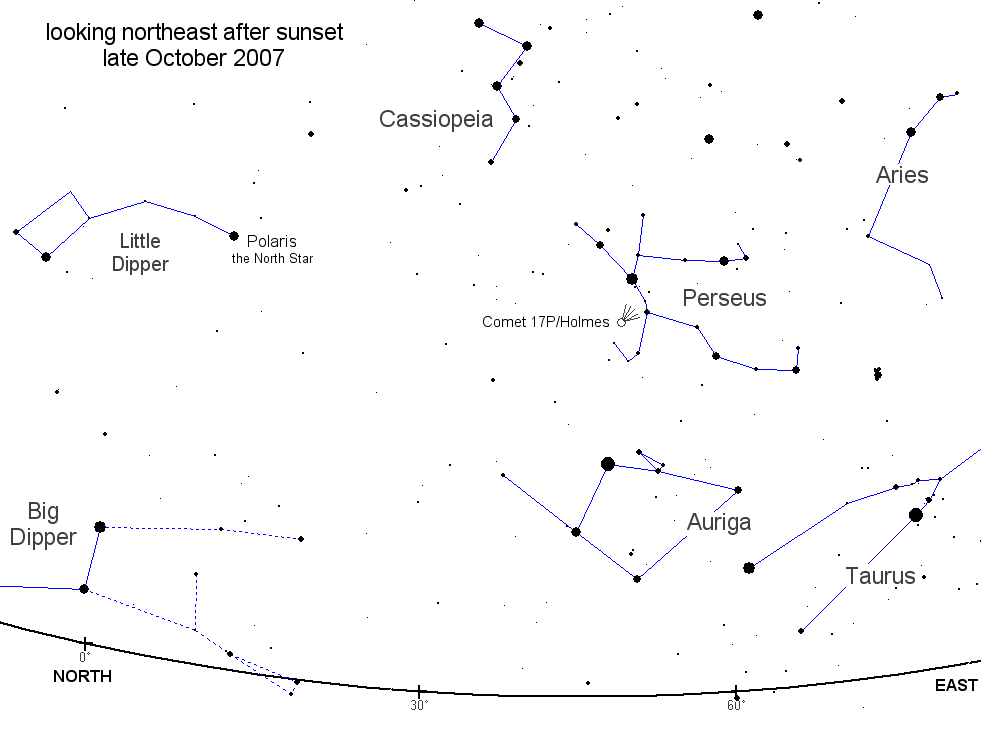
Sky and Telescope Article:
http://www.skyandtelescope.com/observing/home/10862521.html
Sunday, October 28, 2007
Missing Black Holes Found
Astronomers have discovered hundreds of black holes hiding deep inside dusty galaxies billions of light-years away.
The massive and growing black holes, discovered by NASA's Spitzer and Chandra space telescopes, represent a large fraction of a long-sought missing population. Their discovery implies there were hundreds of millions of additional black holes growing in our young universe, more than doubling the total amount known at that distance.
The discovery reveals that active, supermassive black holes were everywhere in the early universe. The findings are also the first direct evidence that most, if not all, massive galaxies in the distant universe spent their youths building supermassive black holes at their cores.
A Primer on Black Holes and Quasars
A black hole is the common name for an object so dense that not even light can escape its gravity. It is detected by studying its effects on nearby objects and matter (infrared radiation, radio emissions, x-rays, etc.). A supermassive black hole is black hole that has a mass ranging from 100 thousand to over 100 billion solar masses (the mass of the sun). It is currently thought that most, if not all galaxies, including the Milky Way, contain supermassive black holes at their centers.
Those old enough to remember the 1970s may remember Motorola's Quasar brand of color televisions, as well as their slogan: "The quality goes in before the name goes on." Well, the brand name was a reference to the astronomical term.
Many pronounce the word as "QUAY-zar," though some insist that it should be pronounced "QUAH-zar." In any case, the word is a contraction of the phrase "quasi-stellar radio source." The first quasars were discovered in the 1950s using radio telescopes and many quasars were observed just as radio sources with no visible light source. It was not until the 1960s that the radio sources were first linked to visible objects. And the abbreviation "quasar" was first used in a 1964 scientific paper. Astronomers have found that only 10% of quasars actually have a strong radio emission. So the name "quasi-stellar object" or QSO is sometimes used for the majority class of objects that are "radio-quiet." Still, many often refer to all of these objects as quasars.
Today, scientists generally agree that a quasar is the compact doughnut of gas and dust that surrounds a very active supermassive black hole at the center of a young galaxy. As the gas and dust are devoured by the black hole, they heat up and shoot out X-rays. A quasar may release energy in levels equal to the output of hundreds of average galaxies combined. The X-rays can be detected as a general glow in space, but often the quasars themselves can't be seen directly because the surrounding doughnut blocks them from our view.
For decades, a large population of active black holes has been considered missing. Based on studies done about 30 years ago, astronomers knew that there must be more quasars in the universe, but they didn't know where or how to find them until now.
The Research Team
The research team was led by Emanuel Daddi, now of the Commissariat a l'Energie Atomique in France. Daddi began the project while working at the National Optical Astronomy Observatory (NOAO) in Tucson, Arizona before relocating to France last year. Another team member was Mark Dickinson, an astronomer with NOAO. Dickinson led the infrared segment of the investigation using NASA's Spitzer space telescope. Also on the team was David Alexander of Durham University, United Kingdom, and David Elbaz of the Commissariat a l'Energie Atomique. Daddi, Dickinson, Alexander, and Elbaz were co-author of two new papers that will appear in the November 10 issue of The Astrophysical Journal. The team’s results were consistent with those recently obtained by another team led by Fabrizio Fiore of the Osservatorio Astronomico di Roma, Italy. The results of the second team will appear in the Jan. 1, 2008, issue of Astrophysical Journal.
The Observations
The team initially set out to study 1,000 dusty and massive galaxies that were busy making stars. The galaxies were about the same mass as our own spiral Milky Way galaxy, but irregular in shape. Most important, the galaxies were also thought to not have quasars. The galaxies were (and still are) located 9 billion to 11 billion light years away, which meant the team was seeing the galaxies as they were 9 to 11 billion years ago. Since the universe is thought to be about 13.5 billion years old, that would mean the team was looking at a universe that was only 2.5 to 4.5 billion years old, so these 1,000 galaxies would have been in their teenage years - the boom time when the galaxies were growing the most.
When the team examined the galaxies with Spitzer, they noticed that about 200 of the galaxies gave off an unusual amount of infrared light. X-ray data from Chandra, and a technique called "stacking," revealed the 200 galaxies were, in fact, hiding plump quasars. The scientists now think that the quasars heat the dust in their surrounding doughnut clouds, releasing the excess infrared light.
Prior to the investigation, astronomers had only seen the rarest and most energetic black holes from the early universe. But the team’s discovery more than doubles that number of black holes. Some were comparing the experience to having a blindfold removed from their eyes. By projecting their results to the rest of the sky, the team now thinks it has found most of the population of hidden quasars in the early universes.
The Findings
The newfound quasars are helping answer fundamental questions about how massive galaxies evolve. For instance, astronomers have learned that most massive galaxies steadily build up their stars and black holes simultaneously until they get too big and their black holes suppress star formation. It is thought that supermassive black holes have to consume on average about 10 solar masses each year. But that the brightest known quasars have to consume about 1,000 solar masses of material per year. Since they cannot continue at this rate forever, scientists now think that after quasar accretes the surrounding doughnut gas and dust, it settles down to what we consider an ordinary galaxy. Eventually, when the supermassive black holes get “supermassive” enough, they actually prevent new stars from forming, and the galaxy slowly grows dark as the remaining stars die.
The observations also suggest that collisions between galaxies might not play as large a role in galaxy evolution as previously believed. Some had thought that the merging of galaxies was required to begin quasar activity, but they now see that quasars can be active in solitary galaxies.
The Survey
Daddi’s team made their observations as part of the Great Observatories Origins Deep Survey (GOODS), the most sensitive survey to date of the distant universe at multiple wavelengths. GOODS unites extremely deep observations from NASA's Great Observatories (the Spitzer Space Telescope, the Hubble Space Telescope, the Chandra X-ray Observatory), from ESA's XMM-Newton X-ray Observatory, and from the most powerful ground-based facilities, to survey the distant universe to the faintest detectable limits across the broadest range of wavelengths.
For more information on the team’s discovery, visit http://www.spitzer.caltech.edu/spitzer and http://www.nasa.gov/spitzer; and http://chandra.harvard.edu/ and http://www.nasa.gov/mission_pages/chandra/main/index.html.
****************************************
THE SKY THIS WEEK
Oct 28 - Venus at greatest western elongation (46°)
Oct 30 - Mars is 3° south of the Moon
Oct 31 - Neptune is stationary. The body appears motionless in the sky due to the turning point between its direct and retrograde motion.
Nov 1 - Mercury is stationary. The body appears motionless in the sky due to the turning point between its direct and retrograde motion.
Nov 1, 5:18 P.M (EDT) - Last Quarter Moon
Nov 1 - Comet Arend perihelion (1.924 AU)
Nov 2 - Comet Arend closest approach to Earth (0.999 AU)
Nov 2 - Asteroid 1604 Tombaugh closest approach to Earth (1.881 AU)
Nov 3 - Peak of the Southern Taurid Meteor Shower. This is one of two showers visible in the fall and winter that originate from the constellation Taurus. Both of these showers appear to be caused by Periodic Comet Encke. The other shower is called the Northern Taurid shower The Southern Taurid meteors are visible from September 15 through December 15 with the peak on November 3. The average meteor rate ranges from 5 to 15 per hour. The coordinates for the radiant of the Southern Taurid shower is RA 03hrs 44min, +14°.
Meteors are best viewed from a dark-sky location. Observers in for the duration of the evening, or at least for several hours, should bring along a few things: a sleeping bag or blankets for warmth, a recliner or lawn chair, a hot beverage to help cut the chill, and binoculars to view the smoke trails of just-past meteors.
Nov 3 - Regulus is 0.03° north of the Moon, an occultation when viewed from some locations.
Nov 3 - Saturn is 1.8° north of the Moon
****************************************
THIS WEEK IN HISTORY
Oct 29, 1938 - Orson Welles' Broadcast of the "War of the Worlds"
Oct 30, 1981 - Venera 13 Launch (USSR Venus Lander/Flyby Mission)
Oct 30, 1999 - Discovery of the Los Angeles Meteorite (a Mars Meteorite)
Oct 31, 1936 - 1st Successful Rocket Engine Test in Pasadena, California (JPL's Beginnings)
November 2000 - Discovery of the NWA 480 Meteorite (a Mars Meteorite) in Morocco
Nov 2, 1885 - Harlow Shapley's Birthday
Nov 2, 1917 - 90th Anniversary, Mount Wilson 100-inch Telescope First Light
Nov 2, 2002 - 5th Anniversary, Stardust, Asteroid 5535 Annefrank Flyby
Nov 3, 1905 - August Kopff's Discovery of Asteroid 579 Sidonia
Nov 3, 1957 - 50th Anniversary, Sputnik 2 Launch (Laika Dog)
****************************************
MUSICAL DIVERSION
"The Ash Grove" is one of the few Welsh folk songs that has become known all over the world. The Welsh title is "Llwyn Onn" - "llywn" meaning "grove" and "onn" meaning "ash tree"
"According to Grove's Dictionary of Music and Musicians, a variation of the melody appeared as early as 1728. The song was called "Cease Your Funning" and it was part of the muscal "The Beggar Opera" by John Gay.
The more familiar tune is a very old harp melody that was first published (without words) in the 1802 collection entitled "The Bardic Museumsin" by Edward Jones (called "The King's Harpist"). About four years later the tune finally appeared with words in a collection that was appropriately entitled, "Welsh Melodies with Appropriate English Words."
Like many popular melodies, the tune of "The Ash Grove" has over the years been set to many texts. Some more suitable than others for singing in mixed company.
Among the more suitable texts are the Christian hymns, which include such titles as "Let All Things Now Living," "The Master Hath Come" and "On This Night Most Holy."
There are at least four Welsh texts for "The Ash Grove" and it is difficult to know which of these is truely the original, if any. The text below is one of the more popular of the four. It tells the sad story of a sailor's love for Gwen of Llwyn Onn. After her death, the sailor thinks only on Gwen and on other lost friends and loved ones. The Welsh text is in two stanzas and the English translation is in three, suggesting that either the Welsh language is more compact, or that some poetic license was used in the translation.
The Ash Grove
(Welsh)
Yn Nyffryn Llwyn Onn draw mi welais hardd feinwen
A minnau'n hamddena 'rol byw ar y don;
Gwyn ewyn y lli oedd ei gwisg, a disgleirwen
A'r glasfor oedd llygaid Gwen harddaf Llwyn Onn.
A ninnau'n rhodiana drwy'r lonydd i'r banna,
Sibrydem i'n gilydd gyfrinach byd serch;
A phan ddaeth hi'n adeg ffarwelio a'r wiwdeg,
Roedd tannau fy nghalon yng ngofal y ferch.
Cyn dychwel i borthladd wynebwn y tonnau,
Ond hyfryd yw'r hafan 'rol dicter y don;
Bydd melys anghofio her greulon y creigiau--
Un felly o'wn innau 'rol cyrraedd Llwyn Onn.
A thawel mordwyo wnaf mwyach a Gwenno
Yn llong fach ein bwthyn a hi wrth y llyw;
A hon fydd yr hafan ddiogel a chryno
I'r morwr a'i Wenno tra byddwn ni byw.
(English translation by John Oxenford)
The ash grove, how graceful, how plainly 'tis speaking,
The wind [harp] through it playing has language for me.
Whenever the light through its branches is breaking
A host of kind faces is gazing on me.
The friends of my childhood again are before me,
Each step wakes a memory as freely I roam.
With soft whispers laden its leaves rustle o'er me,
The ash grove, the ash grove again [alone] is my home.
My laughter is over, my step loses lightness,
Old countryside measures steal soft on my ear;
I only remember the past and its brightness,
The dear ones I mourn [long] for again gather here.
From out of the shadows their loving looks greet me
And wistfully searching the leafy green dome,
I find other faces fond bending to greet me,
The ash grove, the ash grove alone is my home.
My lips smile no more, my heart loses its lightness
No dream of my future my spirit can cheer;
I only can brood on the past and its brightness,
The dead I have mourned are again living here.
From ev'ry dark nook they press forward to meet me;
I lift up my eyes to the broad leafy dome,
And others are there looking downward to greet me;
The ash grove, the ash grove alone is my home.
To review some the history, the text, or to listen to the melody, check out this page from the "Songs of Wales" section of "Contemplations from the Marianas Trench - Music and Deep Thoughts" - http://www.contemplator.com/wales/ashgrv.html
To see a GIF image file of the score of the song, or to download an ABC file of the score, visit this page of "The Session" - http://www.thesession.org/tunes/display/997
To see and hear more on the hymn, "The Master Hath Come," visit this page of "The Cyber Hymnal" - http://www.cyberhymnal.org/htm/m/a/masthath.htm
For further detailed information about this tune and many different sets of lyrics in English and Welsh go to www.gurman.org/ashgrove
****************************************
Astronomers have discovered hundreds of black holes hiding deep inside dusty galaxies billions of light-years away.
The massive and growing black holes, discovered by NASA's Spitzer and Chandra space telescopes, represent a large fraction of a long-sought missing population. Their discovery implies there were hundreds of millions of additional black holes growing in our young universe, more than doubling the total amount known at that distance.
The discovery reveals that active, supermassive black holes were everywhere in the early universe. The findings are also the first direct evidence that most, if not all, massive galaxies in the distant universe spent their youths building supermassive black holes at their cores.
A Primer on Black Holes and Quasars
A black hole is the common name for an object so dense that not even light can escape its gravity. It is detected by studying its effects on nearby objects and matter (infrared radiation, radio emissions, x-rays, etc.). A supermassive black hole is black hole that has a mass ranging from 100 thousand to over 100 billion solar masses (the mass of the sun). It is currently thought that most, if not all galaxies, including the Milky Way, contain supermassive black holes at their centers.
Those old enough to remember the 1970s may remember Motorola's Quasar brand of color televisions, as well as their slogan: "The quality goes in before the name goes on." Well, the brand name was a reference to the astronomical term.
Many pronounce the word as "QUAY-zar," though some insist that it should be pronounced "QUAH-zar." In any case, the word is a contraction of the phrase "quasi-stellar radio source." The first quasars were discovered in the 1950s using radio telescopes and many quasars were observed just as radio sources with no visible light source. It was not until the 1960s that the radio sources were first linked to visible objects. And the abbreviation "quasar" was first used in a 1964 scientific paper. Astronomers have found that only 10% of quasars actually have a strong radio emission. So the name "quasi-stellar object" or QSO is sometimes used for the majority class of objects that are "radio-quiet." Still, many often refer to all of these objects as quasars.
Today, scientists generally agree that a quasar is the compact doughnut of gas and dust that surrounds a very active supermassive black hole at the center of a young galaxy. As the gas and dust are devoured by the black hole, they heat up and shoot out X-rays. A quasar may release energy in levels equal to the output of hundreds of average galaxies combined. The X-rays can be detected as a general glow in space, but often the quasars themselves can't be seen directly because the surrounding doughnut blocks them from our view.
For decades, a large population of active black holes has been considered missing. Based on studies done about 30 years ago, astronomers knew that there must be more quasars in the universe, but they didn't know where or how to find them until now.
The Research Team
The research team was led by Emanuel Daddi, now of the Commissariat a l'Energie Atomique in France. Daddi began the project while working at the National Optical Astronomy Observatory (NOAO) in Tucson, Arizona before relocating to France last year. Another team member was Mark Dickinson, an astronomer with NOAO. Dickinson led the infrared segment of the investigation using NASA's Spitzer space telescope. Also on the team was David Alexander of Durham University, United Kingdom, and David Elbaz of the Commissariat a l'Energie Atomique. Daddi, Dickinson, Alexander, and Elbaz were co-author of two new papers that will appear in the November 10 issue of The Astrophysical Journal. The team’s results were consistent with those recently obtained by another team led by Fabrizio Fiore of the Osservatorio Astronomico di Roma, Italy. The results of the second team will appear in the Jan. 1, 2008, issue of Astrophysical Journal.
The Observations
The team initially set out to study 1,000 dusty and massive galaxies that were busy making stars. The galaxies were about the same mass as our own spiral Milky Way galaxy, but irregular in shape. Most important, the galaxies were also thought to not have quasars. The galaxies were (and still are) located 9 billion to 11 billion light years away, which meant the team was seeing the galaxies as they were 9 to 11 billion years ago. Since the universe is thought to be about 13.5 billion years old, that would mean the team was looking at a universe that was only 2.5 to 4.5 billion years old, so these 1,000 galaxies would have been in their teenage years - the boom time when the galaxies were growing the most.
When the team examined the galaxies with Spitzer, they noticed that about 200 of the galaxies gave off an unusual amount of infrared light. X-ray data from Chandra, and a technique called "stacking," revealed the 200 galaxies were, in fact, hiding plump quasars. The scientists now think that the quasars heat the dust in their surrounding doughnut clouds, releasing the excess infrared light.
Prior to the investigation, astronomers had only seen the rarest and most energetic black holes from the early universe. But the team’s discovery more than doubles that number of black holes. Some were comparing the experience to having a blindfold removed from their eyes. By projecting their results to the rest of the sky, the team now thinks it has found most of the population of hidden quasars in the early universes.
The Findings
The newfound quasars are helping answer fundamental questions about how massive galaxies evolve. For instance, astronomers have learned that most massive galaxies steadily build up their stars and black holes simultaneously until they get too big and their black holes suppress star formation. It is thought that supermassive black holes have to consume on average about 10 solar masses each year. But that the brightest known quasars have to consume about 1,000 solar masses of material per year. Since they cannot continue at this rate forever, scientists now think that after quasar accretes the surrounding doughnut gas and dust, it settles down to what we consider an ordinary galaxy. Eventually, when the supermassive black holes get “supermassive” enough, they actually prevent new stars from forming, and the galaxy slowly grows dark as the remaining stars die.
The observations also suggest that collisions between galaxies might not play as large a role in galaxy evolution as previously believed. Some had thought that the merging of galaxies was required to begin quasar activity, but they now see that quasars can be active in solitary galaxies.
The Survey
Daddi’s team made their observations as part of the Great Observatories Origins Deep Survey (GOODS), the most sensitive survey to date of the distant universe at multiple wavelengths. GOODS unites extremely deep observations from NASA's Great Observatories (the Spitzer Space Telescope, the Hubble Space Telescope, the Chandra X-ray Observatory), from ESA's XMM-Newton X-ray Observatory, and from the most powerful ground-based facilities, to survey the distant universe to the faintest detectable limits across the broadest range of wavelengths.
For more information on the team’s discovery, visit http://www.spitzer.caltech.edu/spitzer and http://www.nasa.gov/spitzer; and http://chandra.harvard.edu/ and http://www.nasa.gov/mission_pages/chandra/main/index.html.
****************************************
THE SKY THIS WEEK
Oct 28 - Venus at greatest western elongation (46°)
Oct 30 - Mars is 3° south of the Moon
Oct 31 - Neptune is stationary. The body appears motionless in the sky due to the turning point between its direct and retrograde motion.
Nov 1 - Mercury is stationary. The body appears motionless in the sky due to the turning point between its direct and retrograde motion.
Nov 1, 5:18 P.M (EDT) - Last Quarter Moon
Nov 1 - Comet Arend perihelion (1.924 AU)
Nov 2 - Comet Arend closest approach to Earth (0.999 AU)
Nov 2 - Asteroid 1604 Tombaugh closest approach to Earth (1.881 AU)
Nov 3 - Peak of the Southern Taurid Meteor Shower. This is one of two showers visible in the fall and winter that originate from the constellation Taurus. Both of these showers appear to be caused by Periodic Comet Encke. The other shower is called the Northern Taurid shower The Southern Taurid meteors are visible from September 15 through December 15 with the peak on November 3. The average meteor rate ranges from 5 to 15 per hour. The coordinates for the radiant of the Southern Taurid shower is RA 03hrs 44min, +14°.
Meteors are best viewed from a dark-sky location. Observers in for the duration of the evening, or at least for several hours, should bring along a few things: a sleeping bag or blankets for warmth, a recliner or lawn chair, a hot beverage to help cut the chill, and binoculars to view the smoke trails of just-past meteors.
Nov 3 - Regulus is 0.03° north of the Moon, an occultation when viewed from some locations.
Nov 3 - Saturn is 1.8° north of the Moon
****************************************
THIS WEEK IN HISTORY
Oct 29, 1938 - Orson Welles' Broadcast of the "War of the Worlds"
Oct 30, 1981 - Venera 13 Launch (USSR Venus Lander/Flyby Mission)
Oct 30, 1999 - Discovery of the Los Angeles Meteorite (a Mars Meteorite)
Oct 31, 1936 - 1st Successful Rocket Engine Test in Pasadena, California (JPL's Beginnings)
November 2000 - Discovery of the NWA 480 Meteorite (a Mars Meteorite) in Morocco
Nov 2, 1885 - Harlow Shapley's Birthday
Nov 2, 1917 - 90th Anniversary, Mount Wilson 100-inch Telescope First Light
Nov 2, 2002 - 5th Anniversary, Stardust, Asteroid 5535 Annefrank Flyby
Nov 3, 1905 - August Kopff's Discovery of Asteroid 579 Sidonia
Nov 3, 1957 - 50th Anniversary, Sputnik 2 Launch (Laika Dog)
****************************************
MUSICAL DIVERSION
"The Ash Grove" is one of the few Welsh folk songs that has become known all over the world. The Welsh title is "Llwyn Onn" - "llywn" meaning "grove" and "onn" meaning "ash tree"
"According to Grove's Dictionary of Music and Musicians, a variation of the melody appeared as early as 1728. The song was called "Cease Your Funning" and it was part of the muscal "The Beggar Opera" by John Gay.
The more familiar tune is a very old harp melody that was first published (without words) in the 1802 collection entitled "The Bardic Museumsin" by Edward Jones (called "The King's Harpist"). About four years later the tune finally appeared with words in a collection that was appropriately entitled, "Welsh Melodies with Appropriate English Words."
Like many popular melodies, the tune of "The Ash Grove" has over the years been set to many texts. Some more suitable than others for singing in mixed company.
Among the more suitable texts are the Christian hymns, which include such titles as "Let All Things Now Living," "The Master Hath Come" and "On This Night Most Holy."
There are at least four Welsh texts for "The Ash Grove" and it is difficult to know which of these is truely the original, if any. The text below is one of the more popular of the four. It tells the sad story of a sailor's love for Gwen of Llwyn Onn. After her death, the sailor thinks only on Gwen and on other lost friends and loved ones. The Welsh text is in two stanzas and the English translation is in three, suggesting that either the Welsh language is more compact, or that some poetic license was used in the translation.
The Ash Grove
(Welsh)
Yn Nyffryn Llwyn Onn draw mi welais hardd feinwen
A minnau'n hamddena 'rol byw ar y don;
Gwyn ewyn y lli oedd ei gwisg, a disgleirwen
A'r glasfor oedd llygaid Gwen harddaf Llwyn Onn.
A ninnau'n rhodiana drwy'r lonydd i'r banna,
Sibrydem i'n gilydd gyfrinach byd serch;
A phan ddaeth hi'n adeg ffarwelio a'r wiwdeg,
Roedd tannau fy nghalon yng ngofal y ferch.
Cyn dychwel i borthladd wynebwn y tonnau,
Ond hyfryd yw'r hafan 'rol dicter y don;
Bydd melys anghofio her greulon y creigiau--
Un felly o'wn innau 'rol cyrraedd Llwyn Onn.
A thawel mordwyo wnaf mwyach a Gwenno
Yn llong fach ein bwthyn a hi wrth y llyw;
A hon fydd yr hafan ddiogel a chryno
I'r morwr a'i Wenno tra byddwn ni byw.
(English translation by John Oxenford)
The ash grove, how graceful, how plainly 'tis speaking,
The wind [harp] through it playing has language for me.
Whenever the light through its branches is breaking
A host of kind faces is gazing on me.
The friends of my childhood again are before me,
Each step wakes a memory as freely I roam.
With soft whispers laden its leaves rustle o'er me,
The ash grove, the ash grove again [alone] is my home.
My laughter is over, my step loses lightness,
Old countryside measures steal soft on my ear;
I only remember the past and its brightness,
The dear ones I mourn [long] for again gather here.
From out of the shadows their loving looks greet me
And wistfully searching the leafy green dome,
I find other faces fond bending to greet me,
The ash grove, the ash grove alone is my home.
My lips smile no more, my heart loses its lightness
No dream of my future my spirit can cheer;
I only can brood on the past and its brightness,
The dead I have mourned are again living here.
From ev'ry dark nook they press forward to meet me;
I lift up my eyes to the broad leafy dome,
And others are there looking downward to greet me;
The ash grove, the ash grove alone is my home.
To review some the history, the text, or to listen to the melody, check out this page from the "Songs of Wales" section of "Contemplations from the Marianas Trench - Music and Deep Thoughts" - http://www.contemplator.com/wales/ashgrv.html
To see a GIF image file of the score of the song, or to download an ABC file of the score, visit this page of "The Session" - http://www.thesession.org/tunes/display/997
To see and hear more on the hymn, "The Master Hath Come," visit this page of "The Cyber Hymnal" - http://www.cyberhymnal.org/htm/m/a/masthath.htm
For further detailed information about this tune and many different sets of lyrics in English and Welsh go to www.gurman.org/ashgrove
****************************************
Thursday, October 25, 2007
Check Out Comet 17P/Holmes
If you have an opportunity, please check out Comet 17P/Holmes. The comet nucleus (core) appears to be having an outburst of activity. It is possible that the nucleus may be breaking up, but this is not certain. In the last 48 hours the comet has greatly increased in brightness, now visible at magnitude 2.5! Recent reports suggest the coma (the atmosphere of the comet) is expanding and taking on a lopsided shape, perhaps the beginnings of a significant tail.
The coma appears yellow, probably the color of the reflected sunlight. The edges of the comet may appear green which likely signifies an atmosphere rich in diatomic carbon and cyanogen, typical components of greenish comets.
The comet appears just to the East of the constellation Perseus. If you are in the Tampa Bay area, Perseus will rise in the North East about 7PM and be completely above the horizon just after 8PM. Comet 17P/Holmes should be visible roughly to the East (left) of Epsilon Persei (the thigh of Perseus) which shines at magnitude 2.89. In fact, you might mistake the comet for Epsilon Persei because of its brightness.
Comet 17P/Holmes was discovered by British astronomer Edwin Holmes (1842-1919) on November 6, 1892 while conducting regular observations of the Andromeda Galaxy (M31). The orbital specifics for the comet are as follows: Aphelion distance, 5.2004 AU; Perihelion distance, 2.1655 AU; Semi-major axis, 3.618 AU ; Eccentricity, 0.4120; Orbital period, 7.0679 a (Julian years, lasting 365.25 days); Inclination, 19.1877°; Last perihelion, May 4, 2007; Next perihelion (predicted), March 27, 2014.
For more details, check out these Web pages:
Space Weather Home Page:
http://spaceweather.com/
Space Weather Sky Chart:
http://spaceweather.com/images2007/24oct07/skymap_north_holmes.gif?PHPSESSID=ctmhv5tmpkfnk942ajcl3k17o7
Sky and Telescope Article:
http://www.skyandtelescope.com/observing/home/10775326.html
If you have an opportunity, please check out Comet 17P/Holmes. The comet nucleus (core) appears to be having an outburst of activity. It is possible that the nucleus may be breaking up, but this is not certain. In the last 48 hours the comet has greatly increased in brightness, now visible at magnitude 2.5! Recent reports suggest the coma (the atmosphere of the comet) is expanding and taking on a lopsided shape, perhaps the beginnings of a significant tail.
The coma appears yellow, probably the color of the reflected sunlight. The edges of the comet may appear green which likely signifies an atmosphere rich in diatomic carbon and cyanogen, typical components of greenish comets.
The comet appears just to the East of the constellation Perseus. If you are in the Tampa Bay area, Perseus will rise in the North East about 7PM and be completely above the horizon just after 8PM. Comet 17P/Holmes should be visible roughly to the East (left) of Epsilon Persei (the thigh of Perseus) which shines at magnitude 2.89. In fact, you might mistake the comet for Epsilon Persei because of its brightness.
Comet 17P/Holmes was discovered by British astronomer Edwin Holmes (1842-1919) on November 6, 1892 while conducting regular observations of the Andromeda Galaxy (M31). The orbital specifics for the comet are as follows: Aphelion distance, 5.2004 AU; Perihelion distance, 2.1655 AU; Semi-major axis, 3.618 AU ; Eccentricity, 0.4120; Orbital period, 7.0679 a (Julian years, lasting 365.25 days); Inclination, 19.1877°; Last perihelion, May 4, 2007; Next perihelion (predicted), March 27, 2014.
For more details, check out these Web pages:
Space Weather Home Page:
http://spaceweather.com/
Space Weather Sky Chart:
http://spaceweather.com/images2007/24oct07/skymap_north_holmes.gif?PHPSESSID=ctmhv5tmpkfnk942ajcl3k17o7
Sky and Telescope Article:
http://www.skyandtelescope.com/observing/home/10775326.html
Saturday, October 20, 2007
This week's installment is shifting a bit, moving to cover a week range of Sunday through Saturday in order to better conform to other publications. Because of this, some items from the previous week dated for October 21 are duplicated here for consistency.
****************************************
APOPHIS, FUSE, LIGHT POLLUTION EFFECTS, AND BLACK HOLES
Asteroid Apophis Composition Identified
On October 9, MIT scientists announced they had for the first time determined the composition of an asteroid. The team was lead by Richard P. Binzel, professor of planetary sciences in the Department of Earth, Atmospheric, and Planetary Sciences (EAPS). Binzel worked with graduate students Cristina Thomas and Francesca DeMeo and others. Using the MIT Magellan telescope in Chile and NASA's Infrared Telescope Facility in Hawaii, the team has been learning as much as possible about asteroid 99942 Apophis and other asteroids. In their study, the team used both visible-light and infrared spectroscopy, which means it measured how an object reflects light of different wavelengths in order to determine the object's exact mineral constituents.
The team compared their observations with the many thousands of meteorites collected over the years and found that Apophis was a very good match for a rare meteorite type known as type LL chondrite. Type LL chondrites are low in metal content (about 2% metallic iron). The principle minerals are bronzite and olivine, but some oligoclase is also present. Type LL chondrites make up only 7.2% of all reported meteorite falls. By relying on the laboratory measurements for density and strength of these meteorites, we can infer many of the same properties for Apophis. Binzel presented the new findings October 9 at the annual meeting of the Division for Planetary Sciences of the American Astronomical Society.
Asteroid 99942 Apophis was discovered in 2004. On April 13, 2029, Apophis will come very close to Earth, missing by 22,000 miles. When it returns in 2036, there is a very small possibility - about one chance in 45,000 - that it could strike the earth. An object the size of Apophis, approximately 270 meters across, could destroy an area as large as France, or produce tsunamis over a wide area if it struck at sea. Binzel’s team used Apophis as their first case study to determine the composition of a potentially hazardous asteroid in order better determine how to defend Earth. Their work is sponsored by NASA and the National Science Foundation.
To learn more about NASA’s Near-Earth Asteroid Program, visit: http://neo.jpl.nasa.gov/ and to learn more about MITs Department of Earth, Atmospheric, and Planetary Sciences, visit: http://eapsweb.mit.edu/
Pulling the Fuse on FUSE
This week, scientists and engineers said their formal goodbyes to NASA's Far Ultraviolet Spectroscopic Explorer (FUSE). Since its launch into high Earth orbit on June 24, 1999, FUSE has explored the Universe using the technique of high-resolution spectroscopy in the far-ultraviolet spectral region. As a spectroscopic telescope, FUSE broke starlight down into its constituent spectra, or wavelengths, so scientists could study the chemistry, velocity and temperature of objects and regions invisible to telescopes on the ground. For example, scientists used FUSE to confirm the existence of a halo of hot gas around the Milky Way galaxy -- the exhalations of exploding stars. FUSE also looked for molecular hydrogen on Mars, a remnant of the planet's vanished water.
The Johns Hopkins University (JHU) had the lead role in developing and operating the mission, in collaboration with The University of Colorado at Boulder, The University of California at Berkeley, international partners the Canadian Space Agency (CSA) and the French Space Agency (CNES), and corporate partners. Planning for FUSE began in the early 1980's and some team members have been working on the project since they were JHU graduate students.
FUSE was designed for a three-year mission, but has been running for eight. In that time the mission obtained over 130 million seconds (over 4 years, combined) of observing time. FUSE made observations of 2,800 celestial objects. Then on July 12, the last of the telescope's four troublesome "reaction wheels" ground to a stop, making it impossible to aim at stars and galaxies. Controllers had been creatively solving satellite problems for years in order to extend the mission, but this was the straw that broke the camel's back.
On Thursday, October 18, the FUSE mission terminated science operations and the satellite was shut down. The process was quite involved because the engineers had to overcome all of the safety protocols programmed into the satellite systems. Controllers will continue a near year-long process of monitoring the satellite in order to make sure it "stays dead," so that it will not interfere with any current or future missions that may share the same goals or communication frequencies, etc. By some estimates, FUSE may continue tumbling in orbit for up to 30 years before it re-enters the atmosphere.
To date, more than 1,200 scientific papers have been published with FUSE data, and many more are expected in the future. The mountain of FUSE data is being stored at the Multimission Archive at the Space Telescope Science Institute in Baltimore. The science archive will form the lasting legacy of the FUSE mission. No similar missions are currently planned, so this archive will have to suffice for astronomers for the foreseeable future. To learn more about the FUSE mission, check out the mission home page of the Far Ultraviolet Spectroscopic Explorer: http://fuse.pha.jhu.edu/
David Dunlap Observatory Soon to Go Dark
Thirty-five years ago, University of Toronto (U of T) astronomer Tom Bolton proved the existence of black holes. A few leading astrophysicists had predicted that so-called "black holes" could be created when huge stars die and implode under their own mass. According to theories, these super-dense objects would exert such a powerful gravitational pull that not even light could escape their grasp. Essentially, black holes would be invisible - and that would make it extremely difficult to find one.
Bolton, then 28, spent many long nights at the David Dunlap Observatory in Richmond Hill. He charted the strange movements of a star that appeared to be tugged by an unseen companion. Gases were being sucked off the surface of the star and disappearing into the void of space. He published his findings in 1972, arguing that the only logical explanation was a black hole.
The Dunlap Observatory is a facility of the Department of Astronomy and Astrophysics at the U of T. Opened in 1935, the observatory was a gift to the university by Jessie Dunlap as a memorial to her husband David Alexander Dunlap, who was a mining entrepreneur and astronomy buff. The observatory boasts the largest optical telescope in Canada, measuring 1.88 meters (74 inches) in diameter. At the time of its opening it was the second biggest in the world.
Unfortunately, the historic observatory has fallen victim to the urban sprawl around Toronto. Even with the electronic upgrades done in the 1980s, light pollution has limited the observable reach of the telescope. U of T representatives began considering the sale of the observatory and the surrounding 190-acre property, which had increase in value many times over since the original gift. Unfortunately, under the original terms of the Dunlap gift, the property would revert back to the family of it were no longer used for astronomy. University representative began extensive talks with the Dunlap family.
Finally, in September, U of T announced they would work with the Dunlap heirs to begin the process to establish the Dunlap Institute at U of T’s St. George campus. The institute is planned to be a world-class facility using. The institute will be funded by the Dunlap family through the sale of the existing Dunlap Observatory and the surrounding property. A large portion of the proceeds would be given to create the new Institute, while a smaller portion would be retained by the Dunlap descendants. The proposal for the project goes to the university’s governing council on October 30 for final approval.
The U of T astronomers admit that the old observatory is still useful for examining the stars in our own galactic neighborhood. However, they also explain that in order do groundbreaking the work that changes our understanding of the universe, they must observe the most distant objects. And in order to study the farthest and faintest objects, a bigger telescope in a darker location would be needed. By developing the telescopic equipment, the university hopes to be able to create an observatory powerful enough to look back to virtually the beginning of time.
To learn more about U of T’s David Dunlap Observatory and proposal for the Dunlap Institute, visit the observatory home page: http://www.astro.utoronto.ca/DOD/
Largest Known Stellar Back Hole To Date
Astronomers have located in the nearby galaxy M33 (3 million light years away) an exceptionally massive black hole in orbit around a huge companion star. By combining data from NASA's Chandra X-ray Observatory and the Gemini telescope on Mauna Kea, Hawaii, the mass of the black hole, known as M33 X-7, was determined to be 15.7 times that of the Sun, making M33 X-7 the most massive stellar black hole known. A stellar black hole is formed from the collapse of the core of a massive star at the end of its life. The details of the discovery were published in a paper that appears in the October 18 issue of the journal Nature.
The discovery raised lots of questions about how such a big black hole could have been formed. M33 X-7 orbits a companion star that eclipses the black hole every three and a half days. The companion star also has an unusually large mass, 70 times that of the Sun, making it the most massive companion star in a binary system containing a black hole. Astronomers expect that the companion star will also go supernova, resulting in a pair of black holes.
The properties of the M33 X-7 binary system - a massive black hole in a close orbit around a massive companion star - are difficult to explain using conventional models for the evolution of massive stars. The parent star for the black hole must have had a mass greater than the existing companion in order to have formed a black hole before the companion star.
Such a massive star would have had a radius larger than the present separation between the present star and black hole, so the two stars must have been brought closer while sharing a common outer atmosphere. This process typically results in a large amount of mass being lost from the system, so much that the parent star should not have been able to form a 15.7 solar-mass black hole.
The black hole's original star must have shed gas at a rate about 10 times less than predicted by models before it exploded. If even more massive stars also lose very little material, it could explain the incredibly luminous supernova seen recently as SN 2006gy. The star that created SN 2006gy is thought to have been about 150 times the mass of the Sun when it exploded. It suggests that massive stars use less of their mass toward the end of their lives than it was once thought. This would have a big effect on the black holes eventually created by these stars.
To learn more about the discovery, and about the Chandra X-Ray Observatory check out these websites: http://chandra.harvard.edu/ and http://chandra.nasa.gov/ and to learn more about the Gemini Observatory, check out: http://www.gemini.edu/
****************************************
THE SKY THIS WEEK
Oct 21 - Peak of Orionid meteor shower. Observers under dark skies should see rates of 15 to 20 meteors per hour. The shower should also be strong a few days before and after the peak (about the 19th through the 23rd, called the maximum). This shower is caused by dust from Halley's Comet, which is also responsible for the Eta Aquarid Shower in the spring. Orionid meteors will appear to radiate from a point in the sky between the constellations Gemini and Orion, high in the southern sky. Meteors from the Orionid shower may be visible throughout the month of October and through the first week of November.
Meteors are best viewed from a dark-sky location. Observers in for the duration of the evening, or at least for several hours, should bring along a few things: a sleeping bag or blankets for warmth, a recliner or lawn chair, a hot beverage to help cut the chill, and binoculars to view the smoke trails of just-past meteors.
Oct 22 - Asteroid 2 Pallas is stationary. The body appears motionless in the sky due to the turning point between its direct and retrograde motion.
Oct 22 - Uranus is 1.8° south of Moon
Oct 23 - Mercury is in inferior conjunction
Oct 26, 12:52 AM - Full Moon, the Hunter’s Moon
Oct 26 - Moon at perigee, the point in the Moon's orbit when it is closest to Earth.
Oct 26 - Asteroid 48475 (1991 UD2) Occults HIP 13108, a 5.8 magnitude star
Oct 28 - Venus at its greatest western elongation (46°)
****************************************
THIS WEEK IN HISTORY
Oct 25, 1877 - Henry Russell's 130th Birthday
Oct 21, 1897 - Opening of Yerkes Observatory (110th Birthday). Yerkes Observatory is a facility of the Department of Astronomy and Astrophysics of the University of Chicago. It was established in 1897 on Geneva Lake in Williams Bay, Wisconsin. Until the mid-1960's, Yerkes Observatory housed all of the Department's activities. Today the 77-acre, park-like site in southeast Wisconsin provides laboratory space and access to telescopes for research and instruction. The telescopes at Yerkes include the 40-inch (102 cm) refractor constructed by Alvan Clark and Sons (the largest refractor), a 40-inch (102 cm) reflector, a 24-inch (61 cm) reflector, a 10-inch (25 cm) Cassegrain reflector, and a 7-inch (18 cm) Schmidt camera. To learn more, visit the Yerkes Observatory public home page: http://astro.uchicago.edu/yerkes/
The Yerkes Observatory and its grounds are in serious danger of being sold by the University of Chicago to local developers. To learn what is being done to help save the Yerkes Observatory, and to learn how you can help, visit the organization website, Save Yerkes Observatory: http://www.saveyerkes.com/
****************************************
MUSICAL DIVERSION
"The Minstrel Boy" is an emotionally stirring and inspirational song. It was written by Thomas Moore (1779-1852) who set the words to the melody of an ancient Irish aire called "The Moreen." It is widely thought that Moore composed the song in remembrance of a number of his friends, whom he met while studying at Trinity College, Dublin and who had participated in the 1798 rebellion of the United Irishmen. As the story goes, one friend was wounded, another friend died in prison, and a third was captured and later hung. Yet through it all, Moore refused to testify against his friends.
The song gained widespread popularity and became a favorite of many of the Irish who fought during the United States Civil War. The third first of the song was added at that time by unknown authors.
The song is notably associated with many U.S. organizations that historically had large numbers of members of Irish descent. These organizations include various city police departments and fire departments. The melody is frequently played at funerals of members and/or officers of such organizations who have died or been killed in service, typically on bagpipes. The song is also associated with the Irish Army and with traditionally Irish regiments and/or Irish Brigades found in other armies.
This song is quite popular and has been heard in many movies, such as the 2001 film "Black Hawk Down," and in many television series. Fans of Star Trek may remember that the song's first verse was sung by the character Miles O'Brien (actor Colm Meaney) in the Star Trek: The Next Generation fourth-season episode entitled "The Wounded." During the run of the spin-off series Star Trek: Deep Space Nine the tune became an unofficial theme song for the O'Brien character, and can be heard in several episodes.
The Minstrel Boy
The Minstrel Boy to the war is gone
In the ranks of death you will find him;
His father's sword he hath girded on,
And his wild harp slung behind him;
"Land of Song!" said the warrior bard,
"Tho' all the world betrays thee,
One sword, at least, thy rights shall guard,
One faithful harp shall praise thee!"
The Minstrel fell! But the foeman's chain
Could not bring that proud soul under;
The harp he lov'd ne'er spoke again,
For he tore its chords asunder;
And said "No chains shall sully thee,
Thou soul of love and brav'ry!
Thy songs were made for the pure and free,
They shall never sound in slavery!"
The third verse, added during the 1860s:
The Minstrel Boy will return we pray
When we hear the news, we all will cheer it,
The minstrel boy will return one day,
Torn perhaps in body, not in spirit.
Then may he play on his harp in peace,
In a world such as Heaven intended,
For all the bitterness of man must cease,
And ev'ry battle must be ended.
To review the history, the text, or to listen to the melody, check out this page from the “Songs of Ireland” section of "Contemplations from the Marianas Trench - Music and Deep Thoughts" - http://www.contemplator.com/ireland/minstrel.html
To see a GIF image file of the score of the song, or to download an ABC file of the score, visit this page of "The Session" - http://www.thesession.org/tunes/display/6782
The following link has JPEG image files of an 1895 edition of the score, including a solo line and piano accompaniment. It is two pages in length and presents the first and second verses. The link is on the website called Library Ireland, a free online reference library of Irish material:http://www.libraryireland.com/Irish-Melodies/The-minstrel-boy-1.php
****************************************
****************************************
APOPHIS, FUSE, LIGHT POLLUTION EFFECTS, AND BLACK HOLES
Asteroid Apophis Composition Identified
On October 9, MIT scientists announced they had for the first time determined the composition of an asteroid. The team was lead by Richard P. Binzel, professor of planetary sciences in the Department of Earth, Atmospheric, and Planetary Sciences (EAPS). Binzel worked with graduate students Cristina Thomas and Francesca DeMeo and others. Using the MIT Magellan telescope in Chile and NASA's Infrared Telescope Facility in Hawaii, the team has been learning as much as possible about asteroid 99942 Apophis and other asteroids. In their study, the team used both visible-light and infrared spectroscopy, which means it measured how an object reflects light of different wavelengths in order to determine the object's exact mineral constituents.
The team compared their observations with the many thousands of meteorites collected over the years and found that Apophis was a very good match for a rare meteorite type known as type LL chondrite. Type LL chondrites are low in metal content (about 2% metallic iron). The principle minerals are bronzite and olivine, but some oligoclase is also present. Type LL chondrites make up only 7.2% of all reported meteorite falls. By relying on the laboratory measurements for density and strength of these meteorites, we can infer many of the same properties for Apophis. Binzel presented the new findings October 9 at the annual meeting of the Division for Planetary Sciences of the American Astronomical Society.
Asteroid 99942 Apophis was discovered in 2004. On April 13, 2029, Apophis will come very close to Earth, missing by 22,000 miles. When it returns in 2036, there is a very small possibility - about one chance in 45,000 - that it could strike the earth. An object the size of Apophis, approximately 270 meters across, could destroy an area as large as France, or produce tsunamis over a wide area if it struck at sea. Binzel’s team used Apophis as their first case study to determine the composition of a potentially hazardous asteroid in order better determine how to defend Earth. Their work is sponsored by NASA and the National Science Foundation.
To learn more about NASA’s Near-Earth Asteroid Program, visit: http://neo.jpl.nasa.gov/ and to learn more about MITs Department of Earth, Atmospheric, and Planetary Sciences, visit: http://eapsweb.mit.edu/
Pulling the Fuse on FUSE
This week, scientists and engineers said their formal goodbyes to NASA's Far Ultraviolet Spectroscopic Explorer (FUSE). Since its launch into high Earth orbit on June 24, 1999, FUSE has explored the Universe using the technique of high-resolution spectroscopy in the far-ultraviolet spectral region. As a spectroscopic telescope, FUSE broke starlight down into its constituent spectra, or wavelengths, so scientists could study the chemistry, velocity and temperature of objects and regions invisible to telescopes on the ground. For example, scientists used FUSE to confirm the existence of a halo of hot gas around the Milky Way galaxy -- the exhalations of exploding stars. FUSE also looked for molecular hydrogen on Mars, a remnant of the planet's vanished water.
The Johns Hopkins University (JHU) had the lead role in developing and operating the mission, in collaboration with The University of Colorado at Boulder, The University of California at Berkeley, international partners the Canadian Space Agency (CSA) and the French Space Agency (CNES), and corporate partners. Planning for FUSE began in the early 1980's and some team members have been working on the project since they were JHU graduate students.
FUSE was designed for a three-year mission, but has been running for eight. In that time the mission obtained over 130 million seconds (over 4 years, combined) of observing time. FUSE made observations of 2,800 celestial objects. Then on July 12, the last of the telescope's four troublesome "reaction wheels" ground to a stop, making it impossible to aim at stars and galaxies. Controllers had been creatively solving satellite problems for years in order to extend the mission, but this was the straw that broke the camel's back.
On Thursday, October 18, the FUSE mission terminated science operations and the satellite was shut down. The process was quite involved because the engineers had to overcome all of the safety protocols programmed into the satellite systems. Controllers will continue a near year-long process of monitoring the satellite in order to make sure it "stays dead," so that it will not interfere with any current or future missions that may share the same goals or communication frequencies, etc. By some estimates, FUSE may continue tumbling in orbit for up to 30 years before it re-enters the atmosphere.
To date, more than 1,200 scientific papers have been published with FUSE data, and many more are expected in the future. The mountain of FUSE data is being stored at the Multimission Archive at the Space Telescope Science Institute in Baltimore. The science archive will form the lasting legacy of the FUSE mission. No similar missions are currently planned, so this archive will have to suffice for astronomers for the foreseeable future. To learn more about the FUSE mission, check out the mission home page of the Far Ultraviolet Spectroscopic Explorer: http://fuse.pha.jhu.edu/
David Dunlap Observatory Soon to Go Dark
Thirty-five years ago, University of Toronto (U of T) astronomer Tom Bolton proved the existence of black holes. A few leading astrophysicists had predicted that so-called "black holes" could be created when huge stars die and implode under their own mass. According to theories, these super-dense objects would exert such a powerful gravitational pull that not even light could escape their grasp. Essentially, black holes would be invisible - and that would make it extremely difficult to find one.
Bolton, then 28, spent many long nights at the David Dunlap Observatory in Richmond Hill. He charted the strange movements of a star that appeared to be tugged by an unseen companion. Gases were being sucked off the surface of the star and disappearing into the void of space. He published his findings in 1972, arguing that the only logical explanation was a black hole.
The Dunlap Observatory is a facility of the Department of Astronomy and Astrophysics at the U of T. Opened in 1935, the observatory was a gift to the university by Jessie Dunlap as a memorial to her husband David Alexander Dunlap, who was a mining entrepreneur and astronomy buff. The observatory boasts the largest optical telescope in Canada, measuring 1.88 meters (74 inches) in diameter. At the time of its opening it was the second biggest in the world.
Unfortunately, the historic observatory has fallen victim to the urban sprawl around Toronto. Even with the electronic upgrades done in the 1980s, light pollution has limited the observable reach of the telescope. U of T representatives began considering the sale of the observatory and the surrounding 190-acre property, which had increase in value many times over since the original gift. Unfortunately, under the original terms of the Dunlap gift, the property would revert back to the family of it were no longer used for astronomy. University representative began extensive talks with the Dunlap family.
Finally, in September, U of T announced they would work with the Dunlap heirs to begin the process to establish the Dunlap Institute at U of T’s St. George campus. The institute is planned to be a world-class facility using. The institute will be funded by the Dunlap family through the sale of the existing Dunlap Observatory and the surrounding property. A large portion of the proceeds would be given to create the new Institute, while a smaller portion would be retained by the Dunlap descendants. The proposal for the project goes to the university’s governing council on October 30 for final approval.
The U of T astronomers admit that the old observatory is still useful for examining the stars in our own galactic neighborhood. However, they also explain that in order do groundbreaking the work that changes our understanding of the universe, they must observe the most distant objects. And in order to study the farthest and faintest objects, a bigger telescope in a darker location would be needed. By developing the telescopic equipment, the university hopes to be able to create an observatory powerful enough to look back to virtually the beginning of time.
To learn more about U of T’s David Dunlap Observatory and proposal for the Dunlap Institute, visit the observatory home page: http://www.astro.utoronto.ca/DOD/
Largest Known Stellar Back Hole To Date
Astronomers have located in the nearby galaxy M33 (3 million light years away) an exceptionally massive black hole in orbit around a huge companion star. By combining data from NASA's Chandra X-ray Observatory and the Gemini telescope on Mauna Kea, Hawaii, the mass of the black hole, known as M33 X-7, was determined to be 15.7 times that of the Sun, making M33 X-7 the most massive stellar black hole known. A stellar black hole is formed from the collapse of the core of a massive star at the end of its life. The details of the discovery were published in a paper that appears in the October 18 issue of the journal Nature.
The discovery raised lots of questions about how such a big black hole could have been formed. M33 X-7 orbits a companion star that eclipses the black hole every three and a half days. The companion star also has an unusually large mass, 70 times that of the Sun, making it the most massive companion star in a binary system containing a black hole. Astronomers expect that the companion star will also go supernova, resulting in a pair of black holes.
The properties of the M33 X-7 binary system - a massive black hole in a close orbit around a massive companion star - are difficult to explain using conventional models for the evolution of massive stars. The parent star for the black hole must have had a mass greater than the existing companion in order to have formed a black hole before the companion star.
Such a massive star would have had a radius larger than the present separation between the present star and black hole, so the two stars must have been brought closer while sharing a common outer atmosphere. This process typically results in a large amount of mass being lost from the system, so much that the parent star should not have been able to form a 15.7 solar-mass black hole.
The black hole's original star must have shed gas at a rate about 10 times less than predicted by models before it exploded. If even more massive stars also lose very little material, it could explain the incredibly luminous supernova seen recently as SN 2006gy. The star that created SN 2006gy is thought to have been about 150 times the mass of the Sun when it exploded. It suggests that massive stars use less of their mass toward the end of their lives than it was once thought. This would have a big effect on the black holes eventually created by these stars.
To learn more about the discovery, and about the Chandra X-Ray Observatory check out these websites: http://chandra.harvard.edu/ and http://chandra.nasa.gov/ and to learn more about the Gemini Observatory, check out: http://www.gemini.edu/
****************************************
THE SKY THIS WEEK
Oct 21 - Peak of Orionid meteor shower. Observers under dark skies should see rates of 15 to 20 meteors per hour. The shower should also be strong a few days before and after the peak (about the 19th through the 23rd, called the maximum). This shower is caused by dust from Halley's Comet, which is also responsible for the Eta Aquarid Shower in the spring. Orionid meteors will appear to radiate from a point in the sky between the constellations Gemini and Orion, high in the southern sky. Meteors from the Orionid shower may be visible throughout the month of October and through the first week of November.
Meteors are best viewed from a dark-sky location. Observers in for the duration of the evening, or at least for several hours, should bring along a few things: a sleeping bag or blankets for warmth, a recliner or lawn chair, a hot beverage to help cut the chill, and binoculars to view the smoke trails of just-past meteors.
Oct 22 - Asteroid 2 Pallas is stationary. The body appears motionless in the sky due to the turning point between its direct and retrograde motion.
Oct 22 - Uranus is 1.8° south of Moon
Oct 23 - Mercury is in inferior conjunction
Oct 26, 12:52 AM - Full Moon, the Hunter’s Moon
Oct 26 - Moon at perigee, the point in the Moon's orbit when it is closest to Earth.
Oct 26 - Asteroid 48475 (1991 UD2) Occults HIP 13108, a 5.8 magnitude star
Oct 28 - Venus at its greatest western elongation (46°)
****************************************
THIS WEEK IN HISTORY
Oct 25, 1877 - Henry Russell's 130th Birthday
Oct 21, 1897 - Opening of Yerkes Observatory (110th Birthday). Yerkes Observatory is a facility of the Department of Astronomy and Astrophysics of the University of Chicago. It was established in 1897 on Geneva Lake in Williams Bay, Wisconsin. Until the mid-1960's, Yerkes Observatory housed all of the Department's activities. Today the 77-acre, park-like site in southeast Wisconsin provides laboratory space and access to telescopes for research and instruction. The telescopes at Yerkes include the 40-inch (102 cm) refractor constructed by Alvan Clark and Sons (the largest refractor), a 40-inch (102 cm) reflector, a 24-inch (61 cm) reflector, a 10-inch (25 cm) Cassegrain reflector, and a 7-inch (18 cm) Schmidt camera. To learn more, visit the Yerkes Observatory public home page: http://astro.uchicago.edu/yerkes/
The Yerkes Observatory and its grounds are in serious danger of being sold by the University of Chicago to local developers. To learn what is being done to help save the Yerkes Observatory, and to learn how you can help, visit the organization website, Save Yerkes Observatory: http://www.saveyerkes.com/
****************************************
MUSICAL DIVERSION
"The Minstrel Boy" is an emotionally stirring and inspirational song. It was written by Thomas Moore (1779-1852) who set the words to the melody of an ancient Irish aire called "The Moreen." It is widely thought that Moore composed the song in remembrance of a number of his friends, whom he met while studying at Trinity College, Dublin and who had participated in the 1798 rebellion of the United Irishmen. As the story goes, one friend was wounded, another friend died in prison, and a third was captured and later hung. Yet through it all, Moore refused to testify against his friends.
The song gained widespread popularity and became a favorite of many of the Irish who fought during the United States Civil War. The third first of the song was added at that time by unknown authors.
The song is notably associated with many U.S. organizations that historically had large numbers of members of Irish descent. These organizations include various city police departments and fire departments. The melody is frequently played at funerals of members and/or officers of such organizations who have died or been killed in service, typically on bagpipes. The song is also associated with the Irish Army and with traditionally Irish regiments and/or Irish Brigades found in other armies.
This song is quite popular and has been heard in many movies, such as the 2001 film "Black Hawk Down," and in many television series. Fans of Star Trek may remember that the song's first verse was sung by the character Miles O'Brien (actor Colm Meaney) in the Star Trek: The Next Generation fourth-season episode entitled "The Wounded." During the run of the spin-off series Star Trek: Deep Space Nine the tune became an unofficial theme song for the O'Brien character, and can be heard in several episodes.
The Minstrel Boy
The Minstrel Boy to the war is gone
In the ranks of death you will find him;
His father's sword he hath girded on,
And his wild harp slung behind him;
"Land of Song!" said the warrior bard,
"Tho' all the world betrays thee,
One sword, at least, thy rights shall guard,
One faithful harp shall praise thee!"
The Minstrel fell! But the foeman's chain
Could not bring that proud soul under;
The harp he lov'd ne'er spoke again,
For he tore its chords asunder;
And said "No chains shall sully thee,
Thou soul of love and brav'ry!
Thy songs were made for the pure and free,
They shall never sound in slavery!"
The third verse, added during the 1860s:
The Minstrel Boy will return we pray
When we hear the news, we all will cheer it,
The minstrel boy will return one day,
Torn perhaps in body, not in spirit.
Then may he play on his harp in peace,
In a world such as Heaven intended,
For all the bitterness of man must cease,
And ev'ry battle must be ended.
To review the history, the text, or to listen to the melody, check out this page from the “Songs of Ireland” section of "Contemplations from the Marianas Trench - Music and Deep Thoughts" - http://www.contemplator.com/ireland/minstrel.html
To see a GIF image file of the score of the song, or to download an ABC file of the score, visit this page of "The Session" - http://www.thesession.org/tunes/display/6782
The following link has JPEG image files of an 1895 edition of the score, including a solo line and piano accompaniment. It is two pages in length and presents the first and second verses. The link is on the website called Library Ireland, a free online reference library of Irish material:http://www.libraryireland.com/Irish-Melodies/The-minstrel-boy-1.php
****************************************
Monday, October 15, 2007
DAWN, ENCELADUS, DUST AND PLUTO
Many exciting things are happening in astronomy. Here are just a few.
Dawn is Under the Microscope
Dawn has been getting a check up since its launch on September 27. Members of NASA's Dawn mission control team have been sending commands and checking out spacecraft systems. The first test firing of one of Dawn's three ion engines began Saturday, October 6 and ran for 27 hours as the team evaluated the engine at five different throttle levels ranging from flight idle through full throttle. The test consumed less than .28 kilograms (10 ounces) of the spacecraft's xenon fuel supply -- less than the contents of a can of soda. Dawn's fuel tank carries 425 kilograms (937 pounds) of xenon propellant. Over their lifetime, Dawn's three ion propulsion engines will fire cumulatively for about 50,000 hours (over five years) -- a record for spacecraft. Good engine performance is vital to the success of Dawn's 8-year, 4.9 billion-kilometer (3-billion-mile) journey.
The team will test Dawn for two more months before they consider the spacecraft mission operational. Dawn will begin its exploration of asteroid Vesta in 2011 and the dwarf planet Ceres in 2015. By utilizing the same set of instruments at two separate destinations, scientists can more accurately formulate comparisons and contrasts. Dawn's science instrument suite will measure shape, surface topography, tectonic history, elemental and mineral composition, and will seek out water-bearing minerals. In addition, the team will measure the masses and gravity fields of Vesta and Ceres by monitoring how the Dawn spacecraft orbits the two bodies. For more on Dawn, check out the mission home page: http://dawn.jpl.nasa.gov/ .
Enceladus Jets are Better Understood
A recent analysis of images from NASA's Cassini spacecraft gave conclusive evidence that the observed jets of fine, icy particles spraying from Saturn's moon Enceladus originate from the hottest spots on the moon's "tiger stripe" fractures that straddle the moon's south polar region. The new results were published in the October 11, 2007, issue of the journal Nature.
Since the first images of the Enceladus jets were taken in 2005, imaging scientists suspected these jets, which collectively feed a plume that towers thousands of kilometers, or miles, above the moon, had been coming from the tiger stripes. But this work provides the first conclusive proof, as well as confirming a relationship between the jets and the unusual heat radiating from the fractures.
The scientists also suggest that the character of the jets may change depending on tidal frictional heating within the fractures and its variation over length of the moon's orbit around Saturn. However, more work remains to determine this.
The imaging team was the first of many to suggest that the jets may erupt from pockets of liquid water. This notion, combined with the unusually warm temperatures and the organic material detected in the vapor accompanying the icy particles, lead to the scientist to include Enceladus as one of the Saturnian moons that may contain a habitable zone for life. The next opportunity to learn more will come when Cassini flies through the plumes in March 2008, obtaining additional data about its chemical composition and the nature of its jets.
For more on Enceladus and the rest of the Saturn system, check out the mission home page: http://www.nasa.gov/cassini . You can find great information and graphics at these websites:http://saturn.jpl.nasa.gov/ , http://www.nasa.gov/cassini and http://ciclops.org/ .
Dust from Black Holes
New findings from NASA's Spitzer Space Telescope suggest that space dust – the same stuff that makes up living creatures and planets – was manufactured in large quantities in the winds of black holes that populated our early universe. The details will be published in an upcoming issue of the Astrophysical Journal Letters. The lead author is Ciska Markwick-Kemper of the University of Manchester, U.K.
Space dust is essential to the formation of planets, stars, galaxies and even life as we know it. The dust in our corner of the universe came from dying stars that were once a lot like our sun. But, when the universe was less than a tenth of its present age of 13.7 billion years, sun-like stars hadn't been around long enough to die and make dust. So what was making the dust when the universe was young?
Many have long thought that short-lived, massive exploding stars, or supernovae, might be the source, while others have suggested that a type of energetic, growing supermassive black hole, called a quasar, could be a contributing factor. A quasar consists of a supermassive black hole surrounded by a dusty doughnut-shaped cloud that feeds it. Theoretically, dust could form in the outer portion of the winds that slowly blow away from this doughnut cloud.
Markwick-Kemper and her team decided to test the quasar theory by investigating a quasar, called PG2112+059, located in the center of a galaxy about 8 billion light-years way. They found a mix of the ingredients that make up glass, sand, marble and even rubies and sapphires. While the mineral constituting glass was expected, the minerals for sand, marble and rubies were a surprise. Why? These minerals are not typically detected floating around galaxies, suggesting they could have been freshly formed in the winds rushing away from the quasar.
For instance, the ingredient that makes up sand, crystalline silicate, doesn't survive for long free-floating in space. Radiation from stars zaps the minerals back to an amorphous, glass-like state. The presence of crystalline silicate therefore suggests something – possibly the quasars winds – is churning out the newly made substance. For graphics and more information about Spitzer, visit http://www.spitzer.caltech.edu/spitzer and http://www.nasa.gov/spitzer .
Pluto Family Portrait
On October 12, astronomers announced that new images taken of the Pluto system are the sharpest ever made and 20 times brighter than those taken 30 years ago when Pluto’s large moon Charon was discovered. The images are expected to bring astronomers closer to estimating the sizes of Pluto's satellites, Nix, Hydra and Charon.
The images were taken by astronomer David Tholen using one of Mauna Kea’s twin Keck telescopes, and utilizing the Keck’s adaptive optics system in order to compensate for turbulence in Earth’s atmosphere. The work was done in early September, when Pluto was at its maximum brightness. Tholen took 16 images and combined them into a single picture.
The moons Nix and Hydra, discovered in 2005 with the Hubble Space Telescope, are currently estimated to be less than 62 miles in diameter. The moon Charon is estimated to be 753 miles (1,212 kilometers) and Pluto is estimated to be 1,429 miles. Many more images of the Pluto system will be taken over the next several lunar orbits around Pluto. This will allow astronomers to determine precise positions of the satellites, and thereby determine precise masses for Nix and Hydra.
The more definitive measurements are important for scientists planning the 2015 flyby of Pluto with NASA's New Horizons spacecraft. One of the current astronomy goals is to determine the proper exposure times for the New Horizons instruments before their arrival. To learn more about the New Horizons mission to Pluto and the Kuiper belt, check out the mission hope page: http://pluto.jhuapl.edu/
****************************************
THE SKY THIS WEEK
Here are some observing highlights for the week. These events are given from the perspective of observers in the northern hemisphere. No offence to southern-hemisphere folks, it's just because of where I live.
Oct 15, After Sunset - Moon, the planet Jupiter and the star Antares appear very close together.
Oct 19, 4:33 am EDT - first-quarter Moon
Oct 21 – Peak of the Orionid Meteor Shower. This shower is caused by dust from Halley's Comet, which is also responsible for the Eta Aquarid Shower in the spring. Meteors from the Orionid shower may be visible throughout the month of October and through the first week of November. The maximum will probably last from the 19th through the 23rd, with the peak around the 22nd. At its height the shower should produce 15 to 20 meteors per hour. The meteors will appear to originate from a point in the sky between the constellations Gemini and Orion, high in the southern sky during the October evenings.
Meteors are best viewed from a dark-sky location. Observers in for the duration of the evening, or at least for several hours, should bring along a few things: a sleeping bag or blankets for warmth, a recliner or lawn chair, a hot beverage to help cut the chill, and binoculars to view the smoke trails of just-past meteors.
****************************************
THIS WEEK IN HISTORY
Oct 15, 1997 - Cassini launch (10th anniversary). Ten years ago, a Titan IV rocket launched the Cassini spacecraft on its mission to Saturn. To learn about the work currently don by Cassini, visit the NASA Saturn home page: http://saturn.jpl.nasa.gov/
Oct 18, 1967 - Venera 4, Venus Landing (40th Anniversary). The Soviet spacecraft Venera 4 (Venus 4) launched June 12, 1967 (UTC) with an announced mission to study the Venusian atmosphere. On October 18, 1967, the spacecraft entered the Venusian atmosphere and released two thermometers, a barometer, a radio altimeter, and atmospheric density gauge, 11 gas analyzers, and two radio transmitters operating in the DM waveband. The main bus, which had carried the capsule to Venus, carried a magnetometer, cosmic ray detectors, hydrogen and oxygen indicators, and charged particle traps. The spacecraft braked and then deployed a parachute system after entering the Venusian atmosphere. Signals were returned by the spacecraft until it reached an altitude of 24.96 km.
Oct 19, 1967 - Mariner 5, Venus Flyby (40th Anniversary). The NASA spacecraft Mariner 5 (also called Mariner Venus ’67) was launched June 14, 1967 (UTC). Mariner 5 was a refurbished backup spacecraft for the Mariner 4 mission and was converted from a Mars mission to a Venus mission. The spacecraft was fully attitude stabilized, using the sun and Canopus as references. A central computer and sequencer subsystem supplied timing sequences and computing services for other spacecraft subsystems. The spacecraft passed 4,000 km from Venus on October 19, 1967. The spacecraft instruments measured both interplanetary and Venusian magnetic fields, charged particles, and plasmas, as well as the radio refractivity and UV emissions of the Venusian atmosphere.
Oct 20, 1632 - Birth of Christopher Wren (375th Birthday). Sir Christopher Wren, born Oct. 20, 1632, East Knoyle, Wiltshire, England, died Feb. 25, 1723, London. Designer, astronomer, geometrician, and the greatest English architect of his time. Wren designed 53 London churches, including St. Paul's Cathedral, as well as many secular buildings of note. He was a founder of the Royal Society (president 1680–82), and his scientific work was highly regarded by Sir Isaac Newton and Blaise Pascal. He was knighted in 1673.
Oct 21, 1897 - Opening of Yerkes Observatory (110th Birthday). Yerkes Observatory is a facility of the Department of Astronomy and Astrophysics of the University of Chicago. It was established in 1897 on Geneva Lake in Williams Bay, Wisconsin. Until the mid-1960's, Yerkes Observatory housed all of the Department's activities. Today the 77-acre, park-like site in southeast Wisconsin provides laboratory space and access to telescopes for research and instruction. The telescopes at Yerkes include the 40-inch (102 cm) refractor constructed by Alvan Clark and Sons (the largest refractor), a 40-inch (102 cm) reflector, a 24-inch (61 cm) reflector, a 10-inch (25 cm) Cassegrain reflector, and a 7-inch (18 cm) Schmidt camera. To learn more, visit the Yerkes Observatory public home page: http://astro.uchicago.edu/yerkes/
The Yerkes Observatory and its grounds are in serious danger of being sold by the University of Chicago to local developers. To learn what is being done to help save the Yerkes Observatory, and to learn how you can help, visit the organization website, Save Yerkes Observatory: http://www.saveyerkes.com/
****************************************
MUSICAL DIVERSION: HEART OF OAK
Heart of Oak is an 18th century song of the sea. The tune was written by Dr. William Boyce (1711-1779). The English words were written by the famous actor David Garrick (1716-1779) in 1759. Garrick is also credited with the theatrical blessing, "Break a Leg" as he was reportedly so involved in his performance of Richard III that he did not notice the pain of a fracture he incurred.
There is also an American set of lyrics, called The Liberty Song.
Heart of Oak
Come cheer up, my lads! 'tis to glory we steer,
To add something more to this wonderful year;
To honour we call you, not press you like slaves,
For who are so free as the sons of the waves?
Chorus:
Heart of oak are our ships, heart of oak are our men;
We always are ready, steady, boys, steady!
We'll fight and we'll conquer again and again.
We ne'er see our foes but we wish them to stay,
They never see us but they wish us away;
If they run, why we follow, and run them ashore,
For if they won't fight us, we cannot do more.
(Chorus)
They swear they'll invade us, these terrible foes,
They frighten our women, our children, and beaus;
But should their flat bottoms in darkness get o'er,
Still Britons they'll find to receive them on shore.
(Chorus)
We'll still make them fear, and we'll still make them flee,
And drub 'em on shore, as we've drubb'd 'em at sea;
Then cheer up, my lads! with one heart let us sing:
Our soldiers, our sailors, our statesmen and Queen.
(Chorus)
----------
Many versions of these words have developed over the years. Fans of Walt Disney motion pictures may recall that actors Peter Ustinov, Dean Jones and Suzanne Pleshette sung a version in the 1968 Disney film "Blackbeard's Ghost." And fans of the science fiction television series "Star Trek: The Next Generation" may remember an episode from the third season, entitled "Alegience," in which another version was sung. Below is the first verse and the chorus sung in that episode.
Come, cheer up, my lads, 'tis to glory we steer,
To find something new in this wonderful year;
To honour we call you, as freemen not slaves,
For who are so free as the sons of the waves?
Chorus:
Heart of oak are our ships, jolly tars are our men,
we always are ready; Steady, boy, steady!
We'll fight and we'll conquer again and again!
In the above chorus, the word "tar" is a slag term that was used for a sailor. Their hats and clothes were treated with tar to waterproof them. The tar-impregnated cloth, or tarpaulin, provided protection in harsh conditions. Because of this, a sailor was called a "tarpaulin," or "tar" for short. Fans of Gilbert and Sullivan may remember a song from the musical "HMS Pinafore" entitled "A British Tar."
To review the history, the text, or to listen to the melody, check out this page from the "Songs of the Sea" section of "Contemplations from the Marianas Trench - Music and Deep Thoughts" - http://www.contemplator.com/england/heartoak.html
To see a GIF image file of the score of the song, or to download an ABC file of the score, or other notations, visit this mirror site of Digital Tradition -http://sniff.numachi.com/pages/tiHEARTOAK;ttHEARTOAK.html
****************************************
Many exciting things are happening in astronomy. Here are just a few.
Dawn is Under the Microscope
Dawn has been getting a check up since its launch on September 27. Members of NASA's Dawn mission control team have been sending commands and checking out spacecraft systems. The first test firing of one of Dawn's three ion engines began Saturday, October 6 and ran for 27 hours as the team evaluated the engine at five different throttle levels ranging from flight idle through full throttle. The test consumed less than .28 kilograms (10 ounces) of the spacecraft's xenon fuel supply -- less than the contents of a can of soda. Dawn's fuel tank carries 425 kilograms (937 pounds) of xenon propellant. Over their lifetime, Dawn's three ion propulsion engines will fire cumulatively for about 50,000 hours (over five years) -- a record for spacecraft. Good engine performance is vital to the success of Dawn's 8-year, 4.9 billion-kilometer (3-billion-mile) journey.
The team will test Dawn for two more months before they consider the spacecraft mission operational. Dawn will begin its exploration of asteroid Vesta in 2011 and the dwarf planet Ceres in 2015. By utilizing the same set of instruments at two separate destinations, scientists can more accurately formulate comparisons and contrasts. Dawn's science instrument suite will measure shape, surface topography, tectonic history, elemental and mineral composition, and will seek out water-bearing minerals. In addition, the team will measure the masses and gravity fields of Vesta and Ceres by monitoring how the Dawn spacecraft orbits the two bodies. For more on Dawn, check out the mission home page: http://dawn.jpl.nasa.gov/ .
Enceladus Jets are Better Understood
A recent analysis of images from NASA's Cassini spacecraft gave conclusive evidence that the observed jets of fine, icy particles spraying from Saturn's moon Enceladus originate from the hottest spots on the moon's "tiger stripe" fractures that straddle the moon's south polar region. The new results were published in the October 11, 2007, issue of the journal Nature.
Since the first images of the Enceladus jets were taken in 2005, imaging scientists suspected these jets, which collectively feed a plume that towers thousands of kilometers, or miles, above the moon, had been coming from the tiger stripes. But this work provides the first conclusive proof, as well as confirming a relationship between the jets and the unusual heat radiating from the fractures.
The scientists also suggest that the character of the jets may change depending on tidal frictional heating within the fractures and its variation over length of the moon's orbit around Saturn. However, more work remains to determine this.
The imaging team was the first of many to suggest that the jets may erupt from pockets of liquid water. This notion, combined with the unusually warm temperatures and the organic material detected in the vapor accompanying the icy particles, lead to the scientist to include Enceladus as one of the Saturnian moons that may contain a habitable zone for life. The next opportunity to learn more will come when Cassini flies through the plumes in March 2008, obtaining additional data about its chemical composition and the nature of its jets.
For more on Enceladus and the rest of the Saturn system, check out the mission home page: http://www.nasa.gov/cassini . You can find great information and graphics at these websites:http://saturn.jpl.nasa.gov/ , http://www.nasa.gov/cassini and http://ciclops.org/ .
Dust from Black Holes
New findings from NASA's Spitzer Space Telescope suggest that space dust – the same stuff that makes up living creatures and planets – was manufactured in large quantities in the winds of black holes that populated our early universe. The details will be published in an upcoming issue of the Astrophysical Journal Letters. The lead author is Ciska Markwick-Kemper of the University of Manchester, U.K.
Space dust is essential to the formation of planets, stars, galaxies and even life as we know it. The dust in our corner of the universe came from dying stars that were once a lot like our sun. But, when the universe was less than a tenth of its present age of 13.7 billion years, sun-like stars hadn't been around long enough to die and make dust. So what was making the dust when the universe was young?
Many have long thought that short-lived, massive exploding stars, or supernovae, might be the source, while others have suggested that a type of energetic, growing supermassive black hole, called a quasar, could be a contributing factor. A quasar consists of a supermassive black hole surrounded by a dusty doughnut-shaped cloud that feeds it. Theoretically, dust could form in the outer portion of the winds that slowly blow away from this doughnut cloud.
Markwick-Kemper and her team decided to test the quasar theory by investigating a quasar, called PG2112+059, located in the center of a galaxy about 8 billion light-years way. They found a mix of the ingredients that make up glass, sand, marble and even rubies and sapphires. While the mineral constituting glass was expected, the minerals for sand, marble and rubies were a surprise. Why? These minerals are not typically detected floating around galaxies, suggesting they could have been freshly formed in the winds rushing away from the quasar.
For instance, the ingredient that makes up sand, crystalline silicate, doesn't survive for long free-floating in space. Radiation from stars zaps the minerals back to an amorphous, glass-like state. The presence of crystalline silicate therefore suggests something – possibly the quasars winds – is churning out the newly made substance. For graphics and more information about Spitzer, visit http://www.spitzer.caltech.edu/spitzer and http://www.nasa.gov/spitzer .
Pluto Family Portrait
On October 12, astronomers announced that new images taken of the Pluto system are the sharpest ever made and 20 times brighter than those taken 30 years ago when Pluto’s large moon Charon was discovered. The images are expected to bring astronomers closer to estimating the sizes of Pluto's satellites, Nix, Hydra and Charon.
The images were taken by astronomer David Tholen using one of Mauna Kea’s twin Keck telescopes, and utilizing the Keck’s adaptive optics system in order to compensate for turbulence in Earth’s atmosphere. The work was done in early September, when Pluto was at its maximum brightness. Tholen took 16 images and combined them into a single picture.
The moons Nix and Hydra, discovered in 2005 with the Hubble Space Telescope, are currently estimated to be less than 62 miles in diameter. The moon Charon is estimated to be 753 miles (1,212 kilometers) and Pluto is estimated to be 1,429 miles. Many more images of the Pluto system will be taken over the next several lunar orbits around Pluto. This will allow astronomers to determine precise positions of the satellites, and thereby determine precise masses for Nix and Hydra.
The more definitive measurements are important for scientists planning the 2015 flyby of Pluto with NASA's New Horizons spacecraft. One of the current astronomy goals is to determine the proper exposure times for the New Horizons instruments before their arrival. To learn more about the New Horizons mission to Pluto and the Kuiper belt, check out the mission hope page: http://pluto.jhuapl.edu/
****************************************
THE SKY THIS WEEK
Here are some observing highlights for the week. These events are given from the perspective of observers in the northern hemisphere. No offence to southern-hemisphere folks, it's just because of where I live.
Oct 15, After Sunset - Moon, the planet Jupiter and the star Antares appear very close together.
Oct 19, 4:33 am EDT - first-quarter Moon
Oct 21 – Peak of the Orionid Meteor Shower. This shower is caused by dust from Halley's Comet, which is also responsible for the Eta Aquarid Shower in the spring. Meteors from the Orionid shower may be visible throughout the month of October and through the first week of November. The maximum will probably last from the 19th through the 23rd, with the peak around the 22nd. At its height the shower should produce 15 to 20 meteors per hour. The meteors will appear to originate from a point in the sky between the constellations Gemini and Orion, high in the southern sky during the October evenings.
Meteors are best viewed from a dark-sky location. Observers in for the duration of the evening, or at least for several hours, should bring along a few things: a sleeping bag or blankets for warmth, a recliner or lawn chair, a hot beverage to help cut the chill, and binoculars to view the smoke trails of just-past meteors.
****************************************
THIS WEEK IN HISTORY
Oct 15, 1997 - Cassini launch (10th anniversary). Ten years ago, a Titan IV rocket launched the Cassini spacecraft on its mission to Saturn. To learn about the work currently don by Cassini, visit the NASA Saturn home page: http://saturn.jpl.nasa.gov/
Oct 18, 1967 - Venera 4, Venus Landing (40th Anniversary). The Soviet spacecraft Venera 4 (Venus 4) launched June 12, 1967 (UTC) with an announced mission to study the Venusian atmosphere. On October 18, 1967, the spacecraft entered the Venusian atmosphere and released two thermometers, a barometer, a radio altimeter, and atmospheric density gauge, 11 gas analyzers, and two radio transmitters operating in the DM waveband. The main bus, which had carried the capsule to Venus, carried a magnetometer, cosmic ray detectors, hydrogen and oxygen indicators, and charged particle traps. The spacecraft braked and then deployed a parachute system after entering the Venusian atmosphere. Signals were returned by the spacecraft until it reached an altitude of 24.96 km.
Oct 19, 1967 - Mariner 5, Venus Flyby (40th Anniversary). The NASA spacecraft Mariner 5 (also called Mariner Venus ’67) was launched June 14, 1967 (UTC). Mariner 5 was a refurbished backup spacecraft for the Mariner 4 mission and was converted from a Mars mission to a Venus mission. The spacecraft was fully attitude stabilized, using the sun and Canopus as references. A central computer and sequencer subsystem supplied timing sequences and computing services for other spacecraft subsystems. The spacecraft passed 4,000 km from Venus on October 19, 1967. The spacecraft instruments measured both interplanetary and Venusian magnetic fields, charged particles, and plasmas, as well as the radio refractivity and UV emissions of the Venusian atmosphere.
Oct 20, 1632 - Birth of Christopher Wren (375th Birthday). Sir Christopher Wren, born Oct. 20, 1632, East Knoyle, Wiltshire, England, died Feb. 25, 1723, London. Designer, astronomer, geometrician, and the greatest English architect of his time. Wren designed 53 London churches, including St. Paul's Cathedral, as well as many secular buildings of note. He was a founder of the Royal Society (president 1680–82), and his scientific work was highly regarded by Sir Isaac Newton and Blaise Pascal. He was knighted in 1673.
Oct 21, 1897 - Opening of Yerkes Observatory (110th Birthday). Yerkes Observatory is a facility of the Department of Astronomy and Astrophysics of the University of Chicago. It was established in 1897 on Geneva Lake in Williams Bay, Wisconsin. Until the mid-1960's, Yerkes Observatory housed all of the Department's activities. Today the 77-acre, park-like site in southeast Wisconsin provides laboratory space and access to telescopes for research and instruction. The telescopes at Yerkes include the 40-inch (102 cm) refractor constructed by Alvan Clark and Sons (the largest refractor), a 40-inch (102 cm) reflector, a 24-inch (61 cm) reflector, a 10-inch (25 cm) Cassegrain reflector, and a 7-inch (18 cm) Schmidt camera. To learn more, visit the Yerkes Observatory public home page: http://astro.uchicago.edu/yerkes/
The Yerkes Observatory and its grounds are in serious danger of being sold by the University of Chicago to local developers. To learn what is being done to help save the Yerkes Observatory, and to learn how you can help, visit the organization website, Save Yerkes Observatory: http://www.saveyerkes.com/
****************************************
MUSICAL DIVERSION: HEART OF OAK
Heart of Oak is an 18th century song of the sea. The tune was written by Dr. William Boyce (1711-1779). The English words were written by the famous actor David Garrick (1716-1779) in 1759. Garrick is also credited with the theatrical blessing, "Break a Leg" as he was reportedly so involved in his performance of Richard III that he did not notice the pain of a fracture he incurred.
There is also an American set of lyrics, called The Liberty Song.
Heart of Oak
Come cheer up, my lads! 'tis to glory we steer,
To add something more to this wonderful year;
To honour we call you, not press you like slaves,
For who are so free as the sons of the waves?
Chorus:
Heart of oak are our ships, heart of oak are our men;
We always are ready, steady, boys, steady!
We'll fight and we'll conquer again and again.
We ne'er see our foes but we wish them to stay,
They never see us but they wish us away;
If they run, why we follow, and run them ashore,
For if they won't fight us, we cannot do more.
(Chorus)
They swear they'll invade us, these terrible foes,
They frighten our women, our children, and beaus;
But should their flat bottoms in darkness get o'er,
Still Britons they'll find to receive them on shore.
(Chorus)
We'll still make them fear, and we'll still make them flee,
And drub 'em on shore, as we've drubb'd 'em at sea;
Then cheer up, my lads! with one heart let us sing:
Our soldiers, our sailors, our statesmen and Queen.
(Chorus)
----------
Many versions of these words have developed over the years. Fans of Walt Disney motion pictures may recall that actors Peter Ustinov, Dean Jones and Suzanne Pleshette sung a version in the 1968 Disney film "Blackbeard's Ghost." And fans of the science fiction television series "Star Trek: The Next Generation" may remember an episode from the third season, entitled "Alegience," in which another version was sung. Below is the first verse and the chorus sung in that episode.
Come, cheer up, my lads, 'tis to glory we steer,
To find something new in this wonderful year;
To honour we call you, as freemen not slaves,
For who are so free as the sons of the waves?
Chorus:
Heart of oak are our ships, jolly tars are our men,
we always are ready; Steady, boy, steady!
We'll fight and we'll conquer again and again!
In the above chorus, the word "tar" is a slag term that was used for a sailor. Their hats and clothes were treated with tar to waterproof them. The tar-impregnated cloth, or tarpaulin, provided protection in harsh conditions. Because of this, a sailor was called a "tarpaulin," or "tar" for short. Fans of Gilbert and Sullivan may remember a song from the musical "HMS Pinafore" entitled "A British Tar."
To review the history, the text, or to listen to the melody, check out this page from the "Songs of the Sea" section of "Contemplations from the Marianas Trench - Music and Deep Thoughts" - http://www.contemplator.com/england/heartoak.html
To see a GIF image file of the score of the song, or to download an ABC file of the score, or other notations, visit this mirror site of Digital Tradition -http://sniff.numachi.com/pages/tiHEARTOAK;ttHEARTOAK.html
****************************************
Sunday, October 07, 2007
METEORS IN THE NEWS
Meteors have certainly been in the news in recent weeks. If you have missed these stories, here is a recap.
The Peruvian Meteorite, September 16
Late Saturday night, September 16th, an orange fireball streaked across the Andean sky and crashed into a muddy field near Carancas, a sparsely populated highland wilderness about 6 miles from Lake Titicaca on the Peruvian border with Bolivia. The water-filled elliptical crater was 42 feet wide and 15 feet deep, but there was no immediate sign of wreckage or meteorite fragments. Over the next few days roughly 150 to 200 visitors to the crater reported smelling a foul stench and exhibited symptoms of dizziness, nausea and dermal injuries.
By September 21, verification of the impact was found in the South American seismic records. The impact registered a magnitude-1.5 tremor, a force as great as an explosion of 4.9 tons of dynamite. Also, and iron-rich magnetic fragment measuring 3 inches in length was recovered from the site.
By September 24, Peru's Mining, Metallurgy, and Geology Institute confirmed that the impact site coincided with a natural underground deposit of arsenic, and that visitors to the crater had inhaled arsenic fumes which, in addition to the excitement of the of the event for the local residents, would certainly have contributed to the symptoms of headache and nausea. As another item of interest, one local astronomer noted that this was the first confirmed Peruvian meteorite fall since June of this year, when another meteorite fell in the Arequipa province.
Finland Superbolide, September 28
Late Friday night, September 28th, a fireball streaked over Finland. Nicknamed the "super-meteor," the object was reported to be a superbolide, a fireball more than 100 times brighter than a full moon, and the brightest seen over Finland in more than 30 years. The meteoroid entered the atmosphere over Northern Ostrobothnia, passed over much of northern and eastern Finland and then exploded in mid-air. No fragments had been recovered as of this writing. Local astronomers think the meteoroid had a mass of approximately 200 kilograms and that the meteor was not part of any known annual meteoroid stream.
Minnesota/Iowa Fireball, October 3
On Wednesday, October 3rd just after 2pm, residents in Minnesota, Iowa and western Wisconsin reported seeing an orange and yellow fireball flash through a clear blue sky traveling from the northeast to the southwest. Some also reported hearing loud booms.
Early reports connected the fall with a wooden pallet found on a Minnesota interstate about that time, but law enforcement officials later assured the public that the pallet most likely fell from a truck on the roadway.
Because of how bright the object appeared to be in the middle of the day, local astronomers speculated that it was at least the size of a pea.
Is this a Meteor Increase?
I am certain there are many who see these news stories and wonder whether the rate of meteor falls is increasing. To the wondering, let me assure you that this is not the case. Because of the Earth’s proportion of water surface area to land surface area, and because much of Earth’s land masses have populations concentrated in specific areas, most of the fireballs and meteorite impacts go unnoticed by the general population.
Near-Earth Objects
These meteors, fireballs and superbolides are actually Near-Earth objects that, well, got very near the earth. Near-Earth Objects, or NEOs, are comets and asteroids that have been nudged by the gravitational attraction of nearby planets into orbits that allow them to enter the Earth's neighborhood. The comets originally formed in the cold outer planetary system and are composed mostly of water ice with embedded dust particles. The asteroids formed in the warmer inner solar system between the orbits of Mars and Jupiter, and they are composed mostly of rock and metal.
Because they are the primitive, leftover building blocks of the solar system formation process, comets and asteroids offer clues to the chemical mixture from which the planets formed some 4.6 billion years ago. If we wish to know the composition of the primordial mixture from which the planets formed, then we must determine the chemical constituents of the leftover debris from this formation process - the comets and asteroids.
On a daily basis, about one hundred tons of interplanetary material drifts down to the Earth's surface. Most of the smallest particles are the tiny dust grains released by comets as their ices vaporize in the solar neighborhood. The vast majority of the larger material originates as the collision fragments of asteroids that ran into one another many, many years ago.
About once every 100 years, rocky or iron asteroids larger than about 50 meters are expected to reach the Earth's surface and cause local disasters or produce the tidal waves that can inundate low lying coastal areas. On an average of every few hundred thousand years or so, asteroids larger than a kilometer could cause global disasters. In this case, the impact debris would spread throughout the Earth's atmosphere so that plant life would suffer from acid rain, partial blocking of sunlight and from the firestorms resulting from heated impact debris raining back down upon the Earth's surface.
Since their orbital paths often cross that of the Earth, collisions with near-Earth objects (NEOs) have occurred in the past and we should remain alert to the possibility of future close Earth approaches. It seems prudent to mount efforts to discover and study these objects, to characterize their sizes, compositions and structures and to keep an eye upon their future trajectories.
No one should be overly concerned about an Earth impact of an asteroid or comet. The threat to any one person from auto accidents, disease, other natural disasters and a variety of other problems is much higher than the threat from NEOs. Over long periods of time, however, the chances of the Earth being impacted are not negligible so that some form of NEO insurance is warranted. At the moment, our best insurance rests with the NEO scientists and their efforts to first find these objects and then track their motions into the future. We need to first find them, and then keep an eye on them.
As of October 2, 2007, 4853 Near-Earth objects (NEOs) have been discovered. 724 of these NEOs are asteroids with a diameter of approximately 1 kilometer or larger. Of this group, 874 have been classified as potentially hazardous asteroids, or asteroids that have a chance in some distant orbit to come very close to Earth.
To learn more about NEOs and about the tremendous NEO searches that are currently underway, please visit the home page of the NASA Near-Earth Object Program: http://neo.jpl.nasa.gov/
****************************************
THE SKY THIS WEEK
Here are some observing highlights for the week. These events are given from the perspective of observers in the northern hemisphere. No offence to southern-hemisphere folks, it's just because where I live.
October 8, Dawn - Venus, Saturn, and Regulus shine above the crescent Moon in the east.
October 8, 2007 - Peak of the Draconid Meteor Shower. Also called the October Draconids and the Giacobinids, this shower is caused by dust from Comet Giacobini-Zinner. Meteors from the October Draconid shower may be visible from October 7 to 10. The shower peaks annually on October 8/9. The rate of the shower is variable and the peak lasts only a few hours. This shower gives a good display only when the parent comet returns to perihelion, which is every 6.5 years. The meteors will appear to originate from a point in the sky near the head of the constellation Draco, the Dragon. Meteors are best viewed from a dark-sky location. Observers in for the duration of the evening, or at least for several hours, should bring along a few things: a sleeping bag or blankets for warmth, a recliner or lawn chair, a hot beverage to help cut the chill, and binoculars to view the smoke trails of just-past meteors.
October 9, 2007 - Venus is 3 degrees south of the star Regulus
October 11, 2007, 1:01 AM - New Moon
October 12, 2007 - Mercury stationary - The body appears motionless in the sky due to the turning point between its direct and retrograde motion.
October 12, 2007 - Mercury is 1.3 degrees north of the Moon
October 13, 2007 - Moon at apogee, the point in the Moon's orbit when it is farthest from Earth.
Terminology Notes:
Degree (°) - one three hundred sixtieth (1/360) of a circle
****************************************
THIS WEEK IN HISTORY
October 9, 1604, Kepler's Nova First Recorded – “Kepler's Nova” was thought at the time to be a "new star," but we now understand that it was a violently exploding star, or supernova. Also called “Kepler's Star,” or “Kepler's Supernova,” it is one of the few supernovae known to have occurred within the Milky Way Galaxy. Several astronomers around Europe noticed the new star about the same time, but the first to record its appearance was Jan Brunowski, assistant to German mathematician, astronomer and astrologer Johannes Kepler (1517-1634) who was working in Prauge. Kepler did not see the new star himself until October 17. Among his other maladies, Kepler suffered from weak eyesight and crippled hands, the effects of smallpox as a child. While this limited his observational skills, it did not diminish his fascination of the heavens, which he learned at a very early age from his mother. As the Imperial Mathematician, Kepler was able to perform extensive studies of the new star with the support and protection of Holy Roman Emperor Rudolph II (1552-1612) who was also living in Prague. When it was first observed, the new star was as bright as Mars, but within a few days it grew to its greatest brightness, estimated to be magnitude -2.5, even brighter than Jupiter. Kepler studied the new star until early 1606 when it had faded until it was no longer visible to the unaided eye. Many people at the time thought the new star held important implications for several areas of interest, including astrology, astronomy, chronology and theology. In 1606, Kepler published his observations and his thoughts in is comprehensive book, "De stella nova" (the new star). Kepler's work proved that the supernova was actually in the heavens and not just a phenomenon in Earth’s atmosphere. Like the discovery of Tycho's Nova years earlier, Kepler's Nova provided evidence that the stars were not perfect and unchanging. Astronomers today more formally refer to “Kepler’s Nova” as Supernova Remnant 1604 (SNR 1604). It is located in the constellation Ophiuchus at stellar coordinates RA 17 hours 30.6 minutes, Dec -21 degrees 29 minutes; distance, less than 20,000 light-years. To date, astronomers have not found the core of the exploded star (a stellar remnant), but they can see a nebula at the position where the supernova occurred. It is especially noticeable in the X-ray portion of the spectrum.
October 9, 1992, Peekskill Meteorite - A meteorite weighing 27.3 pounds slammed a hole through the trunk portion of a red 1980 Chevy Malibu then owned by Michelle Knapp in Peekskill, New York. The hole just missed the car's fuel tank. Prior to the impact, thousands of people in neighboring states heard the sonic booms and watched the greenish fireball for over 40 seconds it traveled north-northeast for about 700 to 800 kilometers (435 to 497 miles). It was later determined from the fireball path that the object had been orbiting the sun prior to the impact. Following the event, the car was purchased by a rock collector and became an attraction at national rock and meteorite conventions. (URL: http://www.nyrockman.com/peekskill.htm)
****************************************
STARS AND BARLEYCORNS
With all of this talk about falling stars and new stars, I couldn't help thinking about a folksong with a tune that has an uncertain national heritage (possibly English or Scottish), but that has been adopted into the English, Scottish and Irish repertoire of folksongs.
"The Star of the County Down" is a composition of the early 20th century. The lyric was written by Cathal McGarvey. He originally set the words to the tune "Gilderoy," which appeared with other songs as early as 1707. However, the tune best known today with "County Down" is another that apparently is even older (first time in print around 1635). This tune has been used for numerous songs, including "Divers and Lazarus" (Dives and Lazarus), "The Murder of Maria Martin," and "Claudy Banks." In 1906, composer Ralph Vaughan Williams arranged a hymn tune based on this melody that is sometimes called "Kingsford." The tune has been used for several English and American Hymns and Carols, including the hymn entitled, "O Sing a Song of Bethlehem." When sung with "County Down," the second half of the tune (the "B" part, as musicians would say) for the chorus.
The Star of the County Down
Near Banbridge town, in the County Down
One morning in July
Down a boreen green came a sweet colleen
And she smiled as she passed me by.
She looked so sweet from her two white feet
To the sheen of her nut-brown hair
Such a coaxing elf, I'd to shake myself
To make sure I was standing there.
Chorus:
From Bantry Bay up to Derry Quay
And from Galway to Dublin town
No maid I've seen like the sweet colleen
That I met in the County Down.
As she onward sped I shook my head
And I gazed with a feeling rare
And I said, says I, to a passerby
"who's the maid with the nut-brown hair?"
He smiled at me, and with pride says he,
"That's the gem of Ireland's crown.
She's young Rosie McCann from the banks of the Bann
She's the star of the County Down."
(Chorus)
I've travelled a bit, but never was hit
Since my roving career began
But fair and square I surrendered there
To the charms of young Rose McCann.
I'd a heart to let and no tenant yet
Did I meet with in shawl or gown
But in she went and I asked no rent
From the star of the County Down.
(Chorus)
At the crossroads fair I'll be surely there
And I'll dress in my Sunday clothes
And I'll try sheep's eyes, and deludhering lies
On the heart of the nut-brown rose.
No pipe I'll smoke, no horse I'll yoke
Though with rust my plow turns brown
Till a smiling bride by my own fireside
Sits the star of the County Down.
(Chorus)
----------
To review the history, the text, or to listen to the melody, check out
this page from the Irish Folk Music section of "Contemplations from the Marianas Trench - Music and Deep Thoughts" -
http://www.contemplator.com/ireland/star.html
To see a GIF image file of the score of the song, or to download an
ABC file of the score, visit this page of "The Session" -
http://www.thesession.org/tunes/display/4320
To see and hear more on the hymn, "O Sing a Song of Bethlehem," visit this page of "The Cyber Hymnal" -
http://www.cyberhymnal.org/htm/o/s/osingson.htm
Still with me? Good! Do remember me mentioning something about barleycorns? Well, here is the tie-in for that. When the tune was published around 1635 it was used as the melody for an even older English folksong called "John Barleycorn." One early version of the text appears in the Bannatyne Manuscript of 1568.
In the song, the character "John Barleycorn" is a personification of barley, an important cereal crop, and the foundation for alcoholic beverages such as beer and whisky. In the song, John Barleycorn suffers attacks, death, and indignities that correspond to the various stages of barley cultivation, reaping and malting. In fact, when author Jack London published in 1913 his autobiographical novel on his struggles with alcoholism, London entitled the book, John Barleycorn.
Some interpret the song as representing a pagan rite. Others suggest that an early form of the song may have been used by the early church in Saxon England to ease the conversion of pagans to Christianity, reasoning that John Barleycorn represented the pagan ideology of nature cycles, spirits, the harvest, and perhaps also human sacrifice, but that the song was Christianized in order to show John Barleycorn as a Christ-like figure. A popular hymn, "We Plough the Fields and Scatter", is often sung at Harvest Festival to the same tune. Below is a version of the song that was collected by poet Robert Burns and first published in 1782.
John Barleycorn
There was three kings into the east,
Three kings both great and high,
And they hae sworn a solemn oath
John Barleycorn should die.
They took a plough and plough'd him down,
Put clods upon his head,
And they hae sworn a solemn oath
John Barleycorn was dead.
But the cheerful Spring came kindly on'
And show'rs began to fall;
John Barleycorn got up again,
And sore surpris'd them all.
The sultry suns of Summer came,
And he grew thick and strong:
His head weel arm'd wi pointed spears,
That no one should him wrong.
The sober Autumn enter'd mild,
When he grew wan and pale;
His bendin joints and drooping head
Show'd he began to fail.
His colour sicken'd more and more,
He faded into age;
And then his enemies began
To show their deadly rage.
They've taen a weapon, long and sharp,
And cut him by the knee;
They ty'd him fast upon a cart,
Like a rogue for forgerie.
They laid him down upon his back,
And cudgell'd him full sore.
They hung him up before the storm,
And turn'd him o'er and o'er.
They filled up a darksome pit
With water to the brim,
They heav'd in John Barleycorn –
There, let him sink or swim!
They laid him upon the floor,
To work him farther woe;
And still, as signs of life appear'd,
They toss'd him to and fro.
They wasted o'er a scorching flame
The marrow of his bones;
But a miller us'd him worst of all,
For he crush'd him between two atones.
And they hae taen his very hero blood
And drank it round and round;
And still the more and more they drank,
Their joy did more abound.
John Barleycorn was a hero bold,
Of noble enterprise;
For if you do but taste his blood,
'Twill make your courage rise.
'Twill make a man forget his woe;
'Twill heighten all his joy:
'Twill make the widow's heart to sing,
Tho the tear were in her eye.
Then let us toast John Barleycorn,
Each man a glass in hand;
And may his great posterity
Ne'er fail in old Scotland!
****************************************
Meteors have certainly been in the news in recent weeks. If you have missed these stories, here is a recap.
The Peruvian Meteorite, September 16
Late Saturday night, September 16th, an orange fireball streaked across the Andean sky and crashed into a muddy field near Carancas, a sparsely populated highland wilderness about 6 miles from Lake Titicaca on the Peruvian border with Bolivia. The water-filled elliptical crater was 42 feet wide and 15 feet deep, but there was no immediate sign of wreckage or meteorite fragments. Over the next few days roughly 150 to 200 visitors to the crater reported smelling a foul stench and exhibited symptoms of dizziness, nausea and dermal injuries.
By September 21, verification of the impact was found in the South American seismic records. The impact registered a magnitude-1.5 tremor, a force as great as an explosion of 4.9 tons of dynamite. Also, and iron-rich magnetic fragment measuring 3 inches in length was recovered from the site.
By September 24, Peru's Mining, Metallurgy, and Geology Institute confirmed that the impact site coincided with a natural underground deposit of arsenic, and that visitors to the crater had inhaled arsenic fumes which, in addition to the excitement of the of the event for the local residents, would certainly have contributed to the symptoms of headache and nausea. As another item of interest, one local astronomer noted that this was the first confirmed Peruvian meteorite fall since June of this year, when another meteorite fell in the Arequipa province.
Finland Superbolide, September 28
Late Friday night, September 28th, a fireball streaked over Finland. Nicknamed the "super-meteor," the object was reported to be a superbolide, a fireball more than 100 times brighter than a full moon, and the brightest seen over Finland in more than 30 years. The meteoroid entered the atmosphere over Northern Ostrobothnia, passed over much of northern and eastern Finland and then exploded in mid-air. No fragments had been recovered as of this writing. Local astronomers think the meteoroid had a mass of approximately 200 kilograms and that the meteor was not part of any known annual meteoroid stream.
Minnesota/Iowa Fireball, October 3
On Wednesday, October 3rd just after 2pm, residents in Minnesota, Iowa and western Wisconsin reported seeing an orange and yellow fireball flash through a clear blue sky traveling from the northeast to the southwest. Some also reported hearing loud booms.
Early reports connected the fall with a wooden pallet found on a Minnesota interstate about that time, but law enforcement officials later assured the public that the pallet most likely fell from a truck on the roadway.
Because of how bright the object appeared to be in the middle of the day, local astronomers speculated that it was at least the size of a pea.
Is this a Meteor Increase?
I am certain there are many who see these news stories and wonder whether the rate of meteor falls is increasing. To the wondering, let me assure you that this is not the case. Because of the Earth’s proportion of water surface area to land surface area, and because much of Earth’s land masses have populations concentrated in specific areas, most of the fireballs and meteorite impacts go unnoticed by the general population.
Near-Earth Objects
These meteors, fireballs and superbolides are actually Near-Earth objects that, well, got very near the earth. Near-Earth Objects, or NEOs, are comets and asteroids that have been nudged by the gravitational attraction of nearby planets into orbits that allow them to enter the Earth's neighborhood. The comets originally formed in the cold outer planetary system and are composed mostly of water ice with embedded dust particles. The asteroids formed in the warmer inner solar system between the orbits of Mars and Jupiter, and they are composed mostly of rock and metal.
Because they are the primitive, leftover building blocks of the solar system formation process, comets and asteroids offer clues to the chemical mixture from which the planets formed some 4.6 billion years ago. If we wish to know the composition of the primordial mixture from which the planets formed, then we must determine the chemical constituents of the leftover debris from this formation process - the comets and asteroids.
On a daily basis, about one hundred tons of interplanetary material drifts down to the Earth's surface. Most of the smallest particles are the tiny dust grains released by comets as their ices vaporize in the solar neighborhood. The vast majority of the larger material originates as the collision fragments of asteroids that ran into one another many, many years ago.
About once every 100 years, rocky or iron asteroids larger than about 50 meters are expected to reach the Earth's surface and cause local disasters or produce the tidal waves that can inundate low lying coastal areas. On an average of every few hundred thousand years or so, asteroids larger than a kilometer could cause global disasters. In this case, the impact debris would spread throughout the Earth's atmosphere so that plant life would suffer from acid rain, partial blocking of sunlight and from the firestorms resulting from heated impact debris raining back down upon the Earth's surface.
Since their orbital paths often cross that of the Earth, collisions with near-Earth objects (NEOs) have occurred in the past and we should remain alert to the possibility of future close Earth approaches. It seems prudent to mount efforts to discover and study these objects, to characterize their sizes, compositions and structures and to keep an eye upon their future trajectories.
No one should be overly concerned about an Earth impact of an asteroid or comet. The threat to any one person from auto accidents, disease, other natural disasters and a variety of other problems is much higher than the threat from NEOs. Over long periods of time, however, the chances of the Earth being impacted are not negligible so that some form of NEO insurance is warranted. At the moment, our best insurance rests with the NEO scientists and their efforts to first find these objects and then track their motions into the future. We need to first find them, and then keep an eye on them.
As of October 2, 2007, 4853 Near-Earth objects (NEOs) have been discovered. 724 of these NEOs are asteroids with a diameter of approximately 1 kilometer or larger. Of this group, 874 have been classified as potentially hazardous asteroids, or asteroids that have a chance in some distant orbit to come very close to Earth.
To learn more about NEOs and about the tremendous NEO searches that are currently underway, please visit the home page of the NASA Near-Earth Object Program: http://neo.jpl.nasa.gov/
****************************************
THE SKY THIS WEEK
Here are some observing highlights for the week. These events are given from the perspective of observers in the northern hemisphere. No offence to southern-hemisphere folks, it's just because where I live.
October 8, Dawn - Venus, Saturn, and Regulus shine above the crescent Moon in the east.
October 8, 2007 - Peak of the Draconid Meteor Shower. Also called the October Draconids and the Giacobinids, this shower is caused by dust from Comet Giacobini-Zinner. Meteors from the October Draconid shower may be visible from October 7 to 10. The shower peaks annually on October 8/9. The rate of the shower is variable and the peak lasts only a few hours. This shower gives a good display only when the parent comet returns to perihelion, which is every 6.5 years. The meteors will appear to originate from a point in the sky near the head of the constellation Draco, the Dragon. Meteors are best viewed from a dark-sky location. Observers in for the duration of the evening, or at least for several hours, should bring along a few things: a sleeping bag or blankets for warmth, a recliner or lawn chair, a hot beverage to help cut the chill, and binoculars to view the smoke trails of just-past meteors.
October 9, 2007 - Venus is 3 degrees south of the star Regulus
October 11, 2007, 1:01 AM - New Moon
October 12, 2007 - Mercury stationary - The body appears motionless in the sky due to the turning point between its direct and retrograde motion.
October 12, 2007 - Mercury is 1.3 degrees north of the Moon
October 13, 2007 - Moon at apogee, the point in the Moon's orbit when it is farthest from Earth.
Terminology Notes:
Degree (°) - one three hundred sixtieth (1/360) of a circle
****************************************
THIS WEEK IN HISTORY
October 9, 1604, Kepler's Nova First Recorded – “Kepler's Nova” was thought at the time to be a "new star," but we now understand that it was a violently exploding star, or supernova. Also called “Kepler's Star,” or “Kepler's Supernova,” it is one of the few supernovae known to have occurred within the Milky Way Galaxy. Several astronomers around Europe noticed the new star about the same time, but the first to record its appearance was Jan Brunowski, assistant to German mathematician, astronomer and astrologer Johannes Kepler (1517-1634) who was working in Prauge. Kepler did not see the new star himself until October 17. Among his other maladies, Kepler suffered from weak eyesight and crippled hands, the effects of smallpox as a child. While this limited his observational skills, it did not diminish his fascination of the heavens, which he learned at a very early age from his mother. As the Imperial Mathematician, Kepler was able to perform extensive studies of the new star with the support and protection of Holy Roman Emperor Rudolph II (1552-1612) who was also living in Prague. When it was first observed, the new star was as bright as Mars, but within a few days it grew to its greatest brightness, estimated to be magnitude -2.5, even brighter than Jupiter. Kepler studied the new star until early 1606 when it had faded until it was no longer visible to the unaided eye. Many people at the time thought the new star held important implications for several areas of interest, including astrology, astronomy, chronology and theology. In 1606, Kepler published his observations and his thoughts in is comprehensive book, "De stella nova" (the new star). Kepler's work proved that the supernova was actually in the heavens and not just a phenomenon in Earth’s atmosphere. Like the discovery of Tycho's Nova years earlier, Kepler's Nova provided evidence that the stars were not perfect and unchanging. Astronomers today more formally refer to “Kepler’s Nova” as Supernova Remnant 1604 (SNR 1604). It is located in the constellation Ophiuchus at stellar coordinates RA 17 hours 30.6 minutes, Dec -21 degrees 29 minutes; distance, less than 20,000 light-years. To date, astronomers have not found the core of the exploded star (a stellar remnant), but they can see a nebula at the position where the supernova occurred. It is especially noticeable in the X-ray portion of the spectrum.
October 9, 1992, Peekskill Meteorite - A meteorite weighing 27.3 pounds slammed a hole through the trunk portion of a red 1980 Chevy Malibu then owned by Michelle Knapp in Peekskill, New York. The hole just missed the car's fuel tank. Prior to the impact, thousands of people in neighboring states heard the sonic booms and watched the greenish fireball for over 40 seconds it traveled north-northeast for about 700 to 800 kilometers (435 to 497 miles). It was later determined from the fireball path that the object had been orbiting the sun prior to the impact. Following the event, the car was purchased by a rock collector and became an attraction at national rock and meteorite conventions. (URL: http://www.nyrockman.com/peekskill.htm)
****************************************
STARS AND BARLEYCORNS
With all of this talk about falling stars and new stars, I couldn't help thinking about a folksong with a tune that has an uncertain national heritage (possibly English or Scottish), but that has been adopted into the English, Scottish and Irish repertoire of folksongs.
"The Star of the County Down" is a composition of the early 20th century. The lyric was written by Cathal McGarvey. He originally set the words to the tune "Gilderoy," which appeared with other songs as early as 1707. However, the tune best known today with "County Down" is another that apparently is even older (first time in print around 1635). This tune has been used for numerous songs, including "Divers and Lazarus" (Dives and Lazarus), "The Murder of Maria Martin," and "Claudy Banks." In 1906, composer Ralph Vaughan Williams arranged a hymn tune based on this melody that is sometimes called "Kingsford." The tune has been used for several English and American Hymns and Carols, including the hymn entitled, "O Sing a Song of Bethlehem." When sung with "County Down," the second half of the tune (the "B" part, as musicians would say) for the chorus.
The Star of the County Down
Near Banbridge town, in the County Down
One morning in July
Down a boreen green came a sweet colleen
And she smiled as she passed me by.
She looked so sweet from her two white feet
To the sheen of her nut-brown hair
Such a coaxing elf, I'd to shake myself
To make sure I was standing there.
Chorus:
From Bantry Bay up to Derry Quay
And from Galway to Dublin town
No maid I've seen like the sweet colleen
That I met in the County Down.
As she onward sped I shook my head
And I gazed with a feeling rare
And I said, says I, to a passerby
"who's the maid with the nut-brown hair?"
He smiled at me, and with pride says he,
"That's the gem of Ireland's crown.
She's young Rosie McCann from the banks of the Bann
She's the star of the County Down."
(Chorus)
I've travelled a bit, but never was hit
Since my roving career began
But fair and square I surrendered there
To the charms of young Rose McCann.
I'd a heart to let and no tenant yet
Did I meet with in shawl or gown
But in she went and I asked no rent
From the star of the County Down.
(Chorus)
At the crossroads fair I'll be surely there
And I'll dress in my Sunday clothes
And I'll try sheep's eyes, and deludhering lies
On the heart of the nut-brown rose.
No pipe I'll smoke, no horse I'll yoke
Though with rust my plow turns brown
Till a smiling bride by my own fireside
Sits the star of the County Down.
(Chorus)
----------
To review the history, the text, or to listen to the melody, check out
this page from the Irish Folk Music section of "Contemplations from the Marianas Trench - Music and Deep Thoughts" -
http://www.contemplator.com/ireland/star.html
To see a GIF image file of the score of the song, or to download an
ABC file of the score, visit this page of "The Session" -
http://www.thesession.org/tunes/display/4320
To see and hear more on the hymn, "O Sing a Song of Bethlehem," visit this page of "The Cyber Hymnal" -
http://www.cyberhymnal.org/htm/o/s/osingson.htm
Still with me? Good! Do remember me mentioning something about barleycorns? Well, here is the tie-in for that. When the tune was published around 1635 it was used as the melody for an even older English folksong called "John Barleycorn." One early version of the text appears in the Bannatyne Manuscript of 1568.
In the song, the character "John Barleycorn" is a personification of barley, an important cereal crop, and the foundation for alcoholic beverages such as beer and whisky. In the song, John Barleycorn suffers attacks, death, and indignities that correspond to the various stages of barley cultivation, reaping and malting. In fact, when author Jack London published in 1913 his autobiographical novel on his struggles with alcoholism, London entitled the book, John Barleycorn.
Some interpret the song as representing a pagan rite. Others suggest that an early form of the song may have been used by the early church in Saxon England to ease the conversion of pagans to Christianity, reasoning that John Barleycorn represented the pagan ideology of nature cycles, spirits, the harvest, and perhaps also human sacrifice, but that the song was Christianized in order to show John Barleycorn as a Christ-like figure. A popular hymn, "We Plough the Fields and Scatter", is often sung at Harvest Festival to the same tune. Below is a version of the song that was collected by poet Robert Burns and first published in 1782.
John Barleycorn
There was three kings into the east,
Three kings both great and high,
And they hae sworn a solemn oath
John Barleycorn should die.
They took a plough and plough'd him down,
Put clods upon his head,
And they hae sworn a solemn oath
John Barleycorn was dead.
But the cheerful Spring came kindly on'
And show'rs began to fall;
John Barleycorn got up again,
And sore surpris'd them all.
The sultry suns of Summer came,
And he grew thick and strong:
His head weel arm'd wi pointed spears,
That no one should him wrong.
The sober Autumn enter'd mild,
When he grew wan and pale;
His bendin joints and drooping head
Show'd he began to fail.
His colour sicken'd more and more,
He faded into age;
And then his enemies began
To show their deadly rage.
They've taen a weapon, long and sharp,
And cut him by the knee;
They ty'd him fast upon a cart,
Like a rogue for forgerie.
They laid him down upon his back,
And cudgell'd him full sore.
They hung him up before the storm,
And turn'd him o'er and o'er.
They filled up a darksome pit
With water to the brim,
They heav'd in John Barleycorn –
There, let him sink or swim!
They laid him upon the floor,
To work him farther woe;
And still, as signs of life appear'd,
They toss'd him to and fro.
They wasted o'er a scorching flame
The marrow of his bones;
But a miller us'd him worst of all,
For he crush'd him between two atones.
And they hae taen his very hero blood
And drank it round and round;
And still the more and more they drank,
Their joy did more abound.
John Barleycorn was a hero bold,
Of noble enterprise;
For if you do but taste his blood,
'Twill make your courage rise.
'Twill make a man forget his woe;
'Twill heighten all his joy:
'Twill make the widow's heart to sing,
Tho the tear were in her eye.
Then let us toast John Barleycorn,
Each man a glass in hand;
And may his great posterity
Ne'er fail in old Scotland!
****************************************
Subscribe to:
Posts (Atom)