Pages

Thursday, January 30, 2014

Plato May Be the Third Cosmic Vision

The concept known as Plato seems destined to be the next mission in ESA's Cosmic Vision program. Plato was chosen by an expert panel as the standout candidate in a competition run by the European Space Agency (ESA). The Paris-based organization's Science Policy Committee will now have the final say at its meeting in February. If given the go-ahead, Plato would probably not launch until 2024.

The name of the mission is an acronym that stands for PLAnetary Transits and Oscillations of stars. It is not really one telescope but rather a suite of 34 telescopes mounted on a single satellite. The intention is for Plato to sweep about half the sky, to investigate some of its brightest and nearest stars. It would monitor these stars for the tell-tale tiny dips in light that occur when planets move across their faces.

Critically, Plato would be tuned to seek out rocky worlds orbiting in the "habitable zone" - the region around a star where water can keep a liquid state. A fundamental part of its quest would be to perform an intricate study of the host stars themselves, using their pulsations to probe their structure and properties.

Such observations, termed asteroseismology, would provide key, complementary information for the proper characterization of the rocky worlds. Although other missions have pursued this kind of science before, Plato is described as a major leap forward in capability. The hope is that it could find really promising targets for follow-up by the big ground-based telescopes due to come online in the next decade. These facilities, which will have primary mirrors measuring tens of meters in diameter, should be able to examine the atmospheres of distant worlds for possible life signatures. The James Webb Space Telescope, the successor to Hubble, due for launch at the end of this decade, would likely still be working in 2024/2025 and could also pursue Plato's discoveries.

Plato has spent the past two years in an assessment process that has pitted it against four other concepts. These alternatives included another planet observatory (Echo), an asteroid mission (Marco Polo-R), an X-ray telescope (Loft), and a satellite that would perform a precise test of Einstein's equivalence principle (STE-Quest).

All were competing to be the third medium-class launch opportunity to be offered under ESA's so-called Cosmic Vision program, which defines the organization's space science priorities. "Medium class" means a cost to the agency of no more than about 600m euros (£490m; $820m), although following the practice of previous missions this does not include the budget for instruments. These are usually provided directly by ESA's national member agencies and mean the final price tag can approach one billion euros. All the competitors were invited to make a final presentation to representatives of the scientific community, industry, and national member agencies on January 21. This was followed by closed-session discussions by two working groups, which rated the quality of the missions. Their recommendations were then passed to ESA's top space science advisory committee (SSAC) to make an evaluation. It proposed that Plato be carried forward as the mission of choice, and this preference has now been sent on by ESA's executive to the SPC. The committee has the prerogative of "selection" at its February 19 gathering, and could still reject Plato - but this would be a major surprise.

The final green light is known as "adoption" in ESA-speak. This is unlikely to happen until 2015, after member states have made firm commitments on their participation and an industrial team to build the satellite has been identified. One big industrial contribution from the UK seems assured. This would be the camera detector at the base of the telescope suite. Supplied by e2v in Chelmsford, the array of more than 130 charge-coupled devices would be 0.9 square meters in area. This would make it the largest camera system ever flown in space, and twice the size of the array e2v produced for ESA's recently launched Gaia telescope.

The first two medium-class missions to be selected under ESA's Cosmic Vision program in 2011 were Solar Orbiter, a space telescope to study the Sun, to launch in 2017; and Euclid, a telescope to investigate "dark energy", to fly in 2020.

NASA plans a similar mission to Plato called Tess (Transiting Exoplanet Survey Satellite) in 2017, but the specifications mean that its rocky worlds will probably be in closer orbits around lower-mass stars than the discoveries made by the European project. In other words, the Plato planets are more likely to be in the habitable zones of more Sun-like stars.


-

Friday, January 24, 2014

NEOWISE Reactivation Plus 25 Days

In its first 25 days of operations, the newly reactivated NEOWISE mission has detected 857 minor bodies in our solar system, including 22 near-Earth objects (NEOs) and four comets. Three of the NEOs are new discoveries; all three are hundreds of meters in diameter and dark as coal.


NEOWISE originally was called the Wide-field Infrared Survey Explorer (WISE), which had made the most comprehensive survey to date of asteroids and comets. The spacecraft was shut down in 2011 after its primary mission was completed. But in September 2013, it was reactivated, renamed and given a new mission, which is to assist NASA's efforts to identify the population of potentially hazardous near-Earth objects (NEOs). NEOWISE also can assist in characterizing previously detected asteroids that could be considered potential targets for future exploration missions.

More than 100 asteroids were captured in the above view from NASA's Wide-field Infrared Survey Explorer, or WISE, during its primary all-sky survey. Image credit: NASA/JPL-Caltech/UCLA

The NEOWISE mission has just passed its post-restart survey readiness review, and the project has verified that the ability to measure asteroid positions and brightness is as good as it was before the spacecraft entered hibernation in early 2011. At the present rate, NEOWISE is observing and characterizing approximately one NEO per day, giving astronomers a much better idea of the objects' sizes and compositions.

Out of the more than 10,500 NEOs that have been discovered to date, only about 10 percent have had any physical measurements made of them; the reactivated NEOWISE will more than double that number.

JPL manages the NEOWISE mission for NASA's Science Mission Directorate in Washington. The Space Dynamics Laboratory in Logan, Utah, built the science instrument. Ball Aerospace & Technologies Corp. of Boulder, Colo., built the spacecraft. Science operations and data processing take place at the Infrared Processing and Analysis Center at the California Institute of Technology in Pasadena. Caltech manages JPL for NASA.

More information on NEOWISE is online at: http://www.jpl.nasa.gov/wise/ .


-

Thursday, January 23, 2014

Landers That "Think On Their Feet", So to Speak

Engineers at NASA's Jet Propulsion Laboratory in Pasadena, California, are testing a sophisticated flight-control algorithm that could allow for more precise, pinpoint landings of future Martian spacecraft.

Flight testing of the new Fuel Optimal Large Divert Guidance algorithm - G-FOLD for short - for planetary pinpoint landing is being conducted jointly by JPL engineers in cooperation with Masten Space Systems in Mojave, Calif., using Masten's XA-0.1B "Xombie" vertical-launch, vertical-landing experimental rocket.

NASA's Space Technology Mission Directorate is facilitating the tests via its Game-Changing Development and Flight Opportunities Programs; the latter managed at NASA's Dryden Flight Research Center at Edwards Air Force Base, Calif. The two space technology programs work together to test game-changing technologies by taking advantage of Flight Opportunities' commercially provided suborbital platforms and flights.

Current powered-descent guidance algorithms used for spacecraft landings are inherited from the Apollo era. These algorithms do not optimize fuel usage and significantly limit how far the landing craft can be diverted during descent. The new G-FOLD algorithm invented by JPL autonomously generates fuel-optimal landing trajectories in real time and provides a key new technology required for planetary pinpoint landing. Pinpoint landing capability will allow robotic missions to access currently inaccessible science targets. For crewed missions, it will allow increased precision with minimal fuel requirements to enable landing larger payloads in close proximity to predetermined targets.

Masten Space Systems launched the Xombie July 30, 2013 from the company's test pad at the Mojave Air and Space Port. JPL and Masten are planning to conduct a second flight test with a more complicated divert profile in August, pending data analysis.

To simulate a course correction during a Martian entry in the July test, Masten's Xombie was given a vertical descent profile to an incorrect landing point. About 90 feet into the profile, the G-FOLD flight control software was automatically triggered to calculate a new flight profile in real-time, and the rocket was successfully diverted to the "correct" landing point some 2,460 feet away.

On September 20, 2013, another flight was made at the Mojave Air and Space Sport in the California desert. This flight was the conclusion of the test campaign to assess the performance of the G-FOLD algorithm under mission conditions. More ambitious than the previous flights, this test had the Xombie vehicle initially travel diagonally away from the target landing site. This simulated a worst-case spacecraft landing maneuver and forced the G-FOLD algorithm to calculate, in real time, a flight path that crossed over itself to reach the safe landing site.

The accurately executed half-mile-long (0.8-kilometer), three-dimensional divert shows the potential of what G-FOLD could mean for future space missions. Compared to the software used to land NASA's Mars Curiosity rover in August 2012, G-FOLD can provide six times more divert range for a lander of that class. Such a capability would be needed for landing on Europa or for human missions to Mars. G-FOLD also may reduce the difficulty of future robotic missions to Mars, allowing rovers to land closer to features of interest instead of driving long distances to reach them. A future rover similar to Curiosity might be able to land right next to a target of scientific interest like Mount Sharp instead of driving for a year to get there.

Even though this is the culmination of the current round of testing, JPL still has far-reaching plans for G-FOLD and for further tests of other landing technologies. "G-FOLD presents a dramatic improvement in our ability to execute large divert maneuvers with limited fuel," said Martin Regehr, who leads JPL's Autonomous Descent and Ascent Powered-flight Testbed (ADAPT). To further enhance future mission capability, JPL plans to use ADAPT to demonstrate terrain-relative navigation using the Lander Vision System (LVS) together with G-FOLD in 2014.

Click Here to Watch the September 20 Flight.

This effort was performed by JPL, with participation from the University of Texas at Austin; Masten Space Systems, Inc., Mojave, California; and NASA's Flight Opportunity Program, which is managed by NASA's Dryden Flight Research Center, Edwards, California.

Masten Space Systems is one of seven suborbital reusable launch companies contracted by NASA's Flight Opportunities Program to fly experiments in sub-orbital space to verify new technologies work as expected in this harsh environment.

JPL, a division of the California Institute of Technology, Pasadena, manages the Curiosity project for NASA's Science Mission Directorate, Washington. For information about Curiosity's accomplishments over the past year, visit: http://mars.jpl.nasa.gov/msl .

For more on flight tests of Curiosity's landing radar, visit: http://www.nasa.gov/topics/solarsystem/features/F-18_flying_msl_radar.html .

For more on NASA's Space Technology Mission Directorate, visit: http://www.nasa.gov/directorates/spacetech/home/ .


-

Wednesday, January 22, 2014

Herschel Detects Water on Ceres!

Scientists using the Herschel space observatory have made the first definitive detection of water vapor on Ceres, the largest and roundest object in the asteroid belt. Plumes of water vapor are thought to shoot up periodically from Ceres when portions of its icy surface warm slightly. Ceres is classified as a dwarf planet, a solar system body bigger than an asteroid and smaller than a planet. Herschel is a European Space Agency (ESA) mission with important NASA contributions.

Artist impression of dwarf planet Ceres, at lower left, surrounded by a cloud of water vapor. Image Credit: ESA/ATG medialab

“This is the first time water vapor has been unequivocally detected on Ceres or any other object in the asteroid belt and provides proof that Ceres has an icy surface and an atmosphere,” said Michael Küppers of ESA in Spain, lead author of a paper in the journal Nature.

The results come at the right time for NASA's Dawn mission, which is on its way to Ceres now after spending more than a year orbiting the large asteroid Vesta. Dawn is scheduled to arrive at Ceres in the spring of 2015, where it will take the closest look ever at its surface.

“We've got a spacecraft on the way to Ceres, so we don't have to wait long before getting more context on this intriguing result, right from the source itself,” said Carol Raymond, the deputy principal investigator for Dawn at NASA's Jet Propulsion Laboratory in Pasadena, Calif. “Dawn will map the geology and chemistry of the surface in high resolution, revealing the processes that drive the outgassing activity.”

For more than the last century, Ceres was known as the largest asteroid in our solar system. But in 2006, the International Astronomical Union, the governing organization responsible for naming planetary objects, reclassified Ceres as a dwarf planet because of its large size. It is roughly 590 miles (950 kilometers) in diameter. When it first was spotted in 1801, astronomers thought it was a planet orbiting between Mars and Jupiter. Later, other cosmic bodies with similar orbits were found, marking the discovery of our solar system's main belt of asteroids.

This graph shows variability in the intensity of the water absorption signal detected at Ceres by the Herschel space observatory on March 6, 2013. Full Image and Caption Scientists believe Ceres contains rock in its interior with a thick mantle of ice that, if melted, would amount to more fresh water than is present on all of Earth. The materials making up Ceres likely date from the first few million years of our solar system's existence and accumulated before the planets formed.

Until now, ice had been theorized to exist on Ceres but had not been detected conclusively. It took Herschel's far-infrared vision to see, finally, a clear spectral signature of the water vapor. But Herschel did not see water vapor every time it looked. While the telescope spied water vapor four different times, on one occasion there was no signature.

Here is what scientists think is happening: when Ceres swings through the part of its orbit that is closer to the sun, a portion of its icy surface becomes warm enough to cause water vapor to escape in plumes at a rate of about 6 kilograms (13 pounds) per second. When Ceres is in the colder part of its orbit, no water escapes.

The strength of the signal also varied over hours, weeks and months, because of the water vapor plumes rotating in and out of Herschel's views as the object spun on its axis. This enabled the scientists to localize the source of water to two darker spots on the surface of Ceres, previously seen by NASA's Hubble Space Telescope and ground-based telescopes. The dark spots might be more likely to outgas because dark material warms faster than light material. When the Dawn spacecraft arrives at Ceres, it will be able to investigate these features.

The results are somewhat unexpected because comets, the icier cousins of asteroids, are known typically to sprout jets and plumes, while objects in the asteroid belt are not.

“The lines are becoming more and more blurred between comets and asteroids,” said Seungwon Lee of JPL, who helped with the water vapor models along with Paul von Allmen, also of JPL. “We knew before about main belt asteroids that show comet-like activity, but this is the first detection of water vapor in an asteroid-like object.”

The research is part of the Measurements of 11 Asteroids and Comets Using Herschel (MACH-11) program, which used Herschel to look at small bodies that have been or will be visited by spacecraft, including the targets of NASA's previous Deep Impact mission and upcoming Origins Spectral Interpretation Resource Identification Security Regolith Explorer (OSIRIS-Rex). Laurence O' Rourke of the European Space Agency is the principal investigator of the MACH-11 program.

Herschel is a European Space Agency mission, with science instruments provided by consortia of European institutes and with important participation by NASA. While the observatory stopped making science observations in April 2013, after running out of liquid coolant, as expected, scientists continue to analyze its data. NASA's Herschel Project Office is based at JPL. JPL contributed mission-enabling technology for two of Herschel's three science instruments. The NASA Herschel Science Center, part of the Infrared Processing and Analysis Center at the California Institute of Technology in Pasadena, supports the U.S. astronomical community.

Dawn's mission is managed by JPL for NASA's Science Mission Directorate in Washington. Dawn is a project of the directorate's Discovery Program, managed by NASA's Marshall Space Flight Center in Huntsville, Ala. UCLA is responsible for overall Dawn mission science. Orbital Sciences Corp. in Dulles, Va., designed and built the spacecraft. The German Aerospace Center, the Max Planck Institute for Solar System Research, the Italian Space Agency and the Italian National Astrophysical Institute are international partners on the mission team. Caltech manages JPL for NASA.

More information about Herschel is online at: http://www.esa.int/SPECIALS/herschel . More information about NASA's role in Herschel is available at: http://www.nasa.gov/herschel . For more information about NASA's Dawn mission, visit: http://www.nasa.gov/dawn .


-

Before and After on "Murray Ridge"

Sometime between December 26, 2013 and January 8, 2014, a span of just 13 days, a bright rock came into view near NASA's Mars Exploration Rover Opportunity, on "Murray Ridge," a section of the rim of Endeavour Crater where Opportunity is working on north-facing slopes during the rover's sixth Martian winter. The images below show the evidence of the appearance.

Image Credit: NASA/JPL-Caltech

The Opportunity rover had completed a short drive just before taking the second image, and one of its wheels likely knocked the rock -- dubbed "Pinnacle Island" -- to this position. The rock is about the size of a doughnut.

The above images are from Opportunity's panoramic camera (Pancam). The one on the left is from 3,528th Martian day, or sol, of the rover's work on Mars (December 26, 2013). The one on the right, with the newly arrived rock, is from Sol 3540 (January 8, 2014). Much of the rock is bright-toned, nearly white. A portion is deep red in color. Pinnacle Island may have been flipped upside down when a wheel dislodged it, providing an unusual circumstance for examining the underside of a Martian rock.

Opportunity landed on Mars on January 24, 2004 PST (January 25, 2004 UTC) on what was to be a three-month mission, but instead the rover has lived beyond its prime mission and roved the planet for nearly 10 years. Mission highlights, including a gallery of selected images from both rovers is at http://mars.nasa.gov/mer10/.


-

Tuesday, January 21, 2014

John Lowry Dobson (1915-2014)

John Lowry Dobson (September 14, 1915 – January 15, 2014) was an amateur astronomer and best known for the Dobsonian telescope, a portable, low-cost altazimuth/Newtonian reflector telescope. The Dobsonian design is considered revolutionary since it allowed amateur astronomers to build fairly large telescopes. Dobson was less known for his efforts to promote awareness of astronomy (and his unorthodox views of cosmology) through public lectures including his performances of "sidewalk astronomy." Dobson was also the co-founder of the amateur astronomical group, the San Francisco Sidewalk Astronomers.

Dobson was born in Beijing, China. His maternal grandfather founded Peking University, originally known then as Imperial University of Peking, in 1898. Dobson’s  mother was a musician and his father taught zoology at the University. In 1927, Dobson and his parents moved to San Francisco, California. His father accepted a teaching position at Lowell High School and taught there until the 1950s. Dobson spent 23 years in a Vedanta Society monastery, after which he became more active in promoting astronomy.

As a teen, John Dobson became a “belligerent” atheist. He said: “I could see that these two notions cannot arise in the same being: ‘do unto others as you would that they do unto’ and ‘if you're not a good boy, it's into hell for keeps.’… They must be spoofing us. So I became an atheist, a belligerent atheist. If anybody started a conversation about the subject, I was a belligerent atheist.”

Over time, Dobson became interested in the universe and its workings. He earned a masters degree in chemistry at the University of California, Berkeley in 1943, working in E. O. Lawrence's lab. In 1944, Dobson attended a lecture by a Vedantan swami. Dobson said the swami “revealed to him a world he had never seen.” That same year, Dobson joined the Vedanta Society monastery in San Francisco, becoming a monk of the Ramakrishna Order. One of John's responsibilities at the monastery was to reconcile astronomy with the teachings of Vedanta. That job led him to build telescopes on the side. He took to wheeling them around outside the monastery, fascinating the neighbors who would congregate around him.

Dobson’s interest in telescope building was in part to better understand the universe, and in part to inspire in others a curiosity about the cosmos. To this end, Dobson often offered assistance and corresponded about his work with those outside the monastery. Telescope building was not part of the curriculum at the monastery, however, and much of Dobson’s correspondence was written in code so as to attract less attention. For instance, a telescope was referred to as a "geranium", which is a type of flower. A "potted geranium" referred to a telescope in a tube and rocker, while a "geranium in bloom" referred to a telescope whose mirror was now aluminized.

Eventually, Dobson was given the option of ceasing his telescope building or leaving the order. He chose to stop building telescopes so that he could remain at the monastery. But one day, another monk wrongly accused him as missing and reported him to the head swami. Dobson was expelled in 1967. However, he maintained that the accusation was not the true reason for his expulsion. The true reason, Dobson contended, was a result of a misunderstanding. The head swami read a paper that was presumably written by Dobson that contradicted the reconciliation of science with Vedanta, and the swami thought Dobson had rejected the swami's teachings.

After leaving the order in 1967, Dobson, along with Bruce Sams and Jeffery Roloff,  founded the San Francisco Sidewalk Astronomers, an amateur astronomy organization dedicated to popularizing astronomy among people on the street. Sams had built a large telescope but, because he was only 12 at the time, Sams was not eligible for membership in the only local club, the San Francisco Amateur Astronomers. And so, the "San Francisco Sidewalk Astronomers" was born. It was also at this time that Dobson's simple form of telescope, which came to be known as the Dobsonian, became well known after he started teaching classes to the public on how to make your own telescope.

Dobson was later asked to speak at the Vedanta Society of Southern California in Hollywood, and continued to spend two months there each year teaching telescope and cosmology classes. Dobson spent two more months at his home in San Francisco, and spent most of the rest of each year traveling as an invited guest for astronomical societies, where he spoke about telescope building, sidewalk astronomy, and his views of cosmology and the scientific establishment. Dobson claimed the Big Bang model did not hold up to scrutiny, and instead advocated a non-standard cosmology; a “Recycling” Steady State model of the universe where matter in the universe is forever expanding outward, but matter also “recycles” over time via quantum tunneling. In an essay entitled, “Origins”, Dobson also argued that such a universe could allow for life to be ubiquitous and ever-present.

In 2004, the Crater Lake Institute presented John Dobson with its Annual Award for Excellence in Public Service for pioneering sidewalk astronomy in the national parks and forests, "where curious minds and dark skies collide." In 2005, the Smithsonian magazine listed John Dobson as among 35 individuals who have made a major difference during the lifetime of that periodical.

Dobson, with editor Norman Sperling, authored the 1991 book How and Why to Make a User-Friendly Sidewalk Telescope. This book helped popularize what came to be known as the Dobsonian mount, and treats the "why" as importantly as the "how". It covers Dobson's background and his philosophy on astronomy and the universe, and his belief in the importance of popular access to astronomy for proper appreciation of the universe. John Dobson is now in the process of publishing Beyond Space and Time (2004) and The Moon is New (2008).

Dobson's life and ideas were the subject of the 2005 documentary A Sidewalk Astronomer. He was also featured in the PBS series The Astronomers, and appeared twice on The Tonight Show Starring Johnny Carson. Dobson also appears as one of the speakers in Universe: The Cosmology Quest, a documentary about non-standard cosmological theories.

On January 15, 2014, John Dobson died peacefully at a hospital in Burbank, California. He was 98.


-

Monday, January 20, 2014

Rosetta Answers Wakeup Call

On Monday, January 20, ESA's Rosetta spacecraft responded to communications from mission controllers after being in deliberate hibernation for 31 months.

Rosetta is chasing down Comet 67P/Churyumov-Gerasimenko, where it will become the first space mission to rendezvous with a comet, the first to attempt a landing on a comet’s surface, and the first to follow a comet as it swings around the Sun.

Since its launch in 2004, Rosetta has made three flybys of Earth and one of Mars to help it on course to its rendezvous with 67P/Churyumov-Gerasimenko, encountering asteroids Steins and Lutetia along the way.

Operating on solar energy alone, Rosetta was placed into a deep space slumber in June 2011 as it cruised out to a distance of nearly 800 million km from the warmth of the Sun, close to the orbit of Jupiter.

Now, as Rosetta’s orbit has brought it back to within ‘only’ 673 million km from the Sun, there is enough solar energy to power the spacecraft fully again.

Thus today, still about 9 million km from the comet, Rosetta’s pre-programmed internal ‘alarm clock’ woke up the spacecraft. After warming up its key navigation instruments, coming out of a stabilizing spin, and aiming its main radio antenna at Earth, Rosetta sent a signal to let mission operators know it had survived the most distant part of its journey.

The signal was received by NASA’s Goldstone ground station in California at 18:18 GMT, during the first window of opportunity the spacecraft had to communicate with Earth. It was immediately confirmed in ESA’s space operations center in Darmstadt and the successful wake-up announced via the @ESA_Rosetta twitter account, which tweeted: "Hello, world!"

“We have our comet-chaser back,” says Alvaro Giménez, ESA’s Director of Science and Robotic Exploration. “With Rosetta, we will take comet exploration to a new level. This incredible mission continues our history of ‘firsts’ at comets, building on the technological and scientific achievements of our first deep space mission Giotto, which returned the first close-up images of a comet nucleus as it flew past Halley in 1986.”

“This was one alarm clock not to hit snooze on, and after a tense day we are absolutely delighted to have our spacecraft awake and back online,” adds Fred Jansen, ESA’s Rosetta mission manager.
Comets are considered the primitive building blocks of the Solar System and likely helped to ‘seed’ Earth with water, perhaps even the ingredients for life. But many fundamental questions about these enigmatic objects remain, and through its comprehensive, in situ study of Comet 67P/Churyumov-Gerasimenko, Rosetta aims to unlock the secrets contained within.

“All other comet missions have been flybys, capturing fleeting moments in the life of these icy treasure chests,” says Matt Taylor, ESA’s Rosetta project scientist. “With Rosetta, we will track the evolution of a comet on a daily basis and for over a year, giving us a unique insight into a comet’s behavior and ultimately helping us to decipher their role in the formation of the Solar System.”
But first, essential health checks on the spacecraft must be completed. Then the eleven instruments on the orbiter and ten on the lander will be turned on and prepared for studying Comet 67P/Churyumov-Gerasimenko.

“We have a busy few months ahead preparing the spacecraft and its instruments for the operational challenges demanded by a lengthy, close-up study of a comet that, until we get there, we know very little about,” says Andrea Accomazzo, ESA’s Rosetta operations manager.

Rosetta’s first images of 67P/Churyumov-Gerasimenko are expected in May, when the spacecraft is still 2 million km from its target. Towards the end of May, the spacecraft will execute a major manoeuver to line up for its critical rendezvous with the comet in August.

After rendezvous, Rosetta will start with two months of extensive mapping of the comet’s surface, and will also make important measurements of the comet’s gravity, mass and shape, and assess its gaseous, dust-laden atmosphere, or coma. The orbiter will also probe the plasma environment and analyze how it interacts with the Sun’s outer atmosphere, the solar wind.

Using these data, scientists will choose a landing site for the mission’s 100 kg Philae probe. The landing is currently scheduled for 11 November and will be the first time that a landing on a comet has ever been attempted.

In fact, given the almost negligible gravity of the comet’s 4 km-wide nucleus, Philae will have to use ice screws and harpoons to stop it from rebounding back into space after touchdown.

Among its wide range of scientific measurements, Philae will send back a panorama of its surroundings, as well as very high-resolution pictures of the surface. It will also perform an on-the-spot analysis of the composition of the ices and organic material, including drilling down to 23 cm below the surface and feeding samples to Philae’s on-board laboratory for analysis.

The focus of the mission will then move to the ‘escort’ phase, during which Rosetta will stay alongside the comet as it moves closer to the Sun, monitoring the ever-changing conditions on the surface as the comet warms up and its ices sublimate.

The comet will reach its closest distance to the Sun on 13 August 2015 at about 185 million km, roughly between the orbits of Earth and Mars. Rosetta will follow the comet throughout the remainder of 2015, as it heads away from the Sun and activity begins to subside.

“We will face many challenges this year as we explore the unknown territory of comet 67P/Churyumov-Gerasimenko and I’m sure there will be plenty of surprises, but today we are just extremely happy to be back on speaking terms with our spacecraft,” adds Matt Taylor.

Rosetta is a mission of the European Space Agency, Paris, with contributions from its member states and NASA. Rosetta's Philae lander is provided by a consortium led by the German Aerospace Center, the Max Planck Institute for Solar System Research, the French National Space Agency and the Italian Space Agency. JPL manages the U.S. contribution of the Rosetta mission for NASA's Science Mission Directorate in Washington. The Microwave Instrument for the Rosetta Orbiter was built at JPL and JPL is home to its principal investigator, Samuel Gulkis. The Southwest Research Institute, San Antonio, developed the Rosetta orbiter's Ion and Electron Sensor (IES) and is home to its principal investigator, James Burch. The Southwest Research Institute, Boulder, Colo., developed the Alice instrument and is home to its principal investigator, Alan Stern.

More information about Rosetta is available online at: http://www.esa.int/rosetta and http://rosetta.jpl.nasa.gov .


-

Friday, August 30, 2013

NuSTAR Delivers the Good Stuff!

NASA's Nuclear Spectroscopic Telescope Array, or NuSTAR, is giving the wider astronomical community a first look at its unique X-ray images of the cosmos. The first batch of data from the black-hole hunting telescope was first made available on August 29th via NASA's High Energy Astrophysics Science Archive Research Center, or HEASARC.

Sculptor Galaxy Shines with X-rays
Above is a composite image of the Sculptor galaxy, combining observations from NuSTAR and the European Southern Observatory in Chile. Image Credit: NASA/JPL-Caltech/JHU
 
The images, taken from July to August 2012, shortly after the spacecraft launched, comprise an assortment of extreme objects, including black holes near and far. The more distant black holes are some of the most luminous objects in the universe, radiating X-rays as they ferociously consume surrounding gas. One type of black hole in the new batch of data is a blazar—an active, supermassive black hole—that is pointing a jet toward Earth. Also in the mix are X-ray binaries—pairs of black holes in which one partner feeds off the other—as well as the remnants of supernovas.

The data set only contains complete observations. Data will be released at a later date for those targets still being observed. Astronomers can use the data to better understand the capabilities of NuSTAR and design their future observing proposals. The first opportunity will be this fall, for joint observations with XMM-Newton.

The European Space Agency's XMM-Newton X-ray telescope, like NASA's Chandra X-ray Observatory, complements NuSTAR. While XMM-Newton and Chandra see lower-energy X-ray light, NuSTAR is the first telescope capable of focusing high-energy X-ray light, allowing for more detailed images than were possible before.

Sizzling Remains of a Dead Star
Above is an image of supernova remnant Cassiopeia A, located 11,000 light-years away, was taken by NuSTAR. Blue indicates the highest energy X-ray light. Red and green show the lower end of NuSTAR's energy range, which overlaps the capabilities of NASA's high-resolution Chandra X-ray Observatory. Image Credit: NASA/JPL-Caltech/DSS
 
Astronomers can compare data sets from different missions using HEASARC, which gives them a broader understanding of an object of interest. NuSTAR's high-energy observations help scientists bridge a gap that existed previously in X-ray astronomy, and will lead to new revelations about the bizarre and energetic side of our universe.

Other NASA missions with data available via HEASARC include Chandra, Fermi, Swift, Cosmic Background Explorer (COBE), Wilkinson Microwave Anisotropy Probe (WMAP) and many more.

The HEASARC is a service of the Astrophysics Science Division at NASA's Goddard Space Flight Center in Greenbelt, Maryland, and the High Energy Astrophysics Division of the Smithsonian Astrophysics Observatory in Cambridge, Mass. HEASARC holdings include data obtained by NASA's high-energy astronomy missions observing in the extreme-ultraviolet, X-ray, and gamma-ray bands, as well as data from missions, balloons and ground-based facilities that have studied the relic cosmic microwave background. HEASARC is online at http://heasarc.gsfc.nasa.gov .

Above is an artist's concept of the fully-deployed NuSTAR in Earth orbit. The section the foreground and to the top, contains the two round "lenses" for the observatory. The light they receive is focused on the receiving points in the rear section, located 10 meters away. Image Credit: NASA/JPL-Caltech/JHU

Launched June 13, 2012 aboard an Orbital Sciences Pegasus XL rocket, NuSTAR is a Small Explorer mission led by Caltech and managed by NASA's Jet Propulsion Laboratory, Pasadena, California, for NASA's Science Mission Directorate in Washington. The spacecraft was built by Orbital Sciences Corporation, Dulles, Virginia. Its instrument was built by a consortium including Caltech; JPL; the University of California, Berkeley; Columbia University, New York; NASA's Goddard Space Flight Center, Greenbelt, Md.; the Danish Technical University in Denmark; Lawrence Livermore National Laboratory, Livermore, Calif.; ATK Aerospace Systems, Goleta, California, and with support from the Italian Space Agency (ASI) Science Data Center.

NuSTAR's mission operations center is at UC Berkeley, with ASI providing its equatorial ground station located at Malindi, Kenya. The mission's outreach program is based at Sonoma State University, Rohnert Park, California NASA's Explorer Program is managed by Goddard. JPL is managed by Caltech for NASA.

Click here to visit NASA's NuSTAR page.

Click here to visit Caltech's NuSTAR mission website.


-

Thursday, August 29, 2013

Bruce Churchill Murray, 1931 - 2013

Bruce Churchill Murray, the Caltech professor of planetary science and geology who served as director of the Jet Propulsion Laboratory (JPL) from 1976 to 1982, died at his home in Oceanside, California on August 29 at the age of 81. Murray was JPL's director during the Viking landings on Mars and the early missions of Voyager 1 and 2 as the twin spacecraft flew by Jupiter and Saturn.

Murray and Carl Sagan
The above image shows Bruce C. Murray (left) and Carl Sagan (right) looking at a map of Mars. The photo was taken in 1976 in Murray's office while Sagan was living in Pasadena and working on the Viking mission. Image credit: NASA/JPL-Caltech

As JPL director, Murray faced a rapidly shrinking budget as NASA's priorities solidified around the space shuttle and its focus on taking astronauts and payloads to low Earth orbit. As the agency cut back its planetary program, he gained a substantial expansion of JPL's civil affairs program with a large solar energy research project funded by the Department of Energy.

Murray also waged political battles in Washington to save the planetary program — and JPL. In 1979, Murray joined with the late astronomer Carl Sagan and engineer Louis Friedman to found the Planetary Society, a membership-based nonprofit organization dedicated to exploring the solar system and expanding public advocacy for space exploration.

Murray salvaged for JPL the Galileo mission to Jupiter, but lost the American half of the two-satellite International Solar Polar Mission (eventually launched with JPL instruments as the European Space Agency's Ulysses by space shuttle Discovery) and a proposed U.S. mission to Halley's comet. Murray also brought the American portion of the joint Netherlands/United Kingdom/U.S. Infrared Astronomy Satellite to JPL, and Caltech gained the project's science data center.

In the midst of budget cuts in 1981, Murray struck a defiant note in an interview with Discover magazine. "We're sitting here watching the coffin being nailed shut, and what's inside is imagination and vision," he told the publication. "I wasn't appointed director to preside over the dissolution of the U.S. space exploration program ... I'm not going to be squeezed down to nothing."

During Murray's leadership, JPL launched Seasat, one of the earliest Earth-observing satellites; the Solar Mesosphere Explorer, an Earth-orbiting spacecraft that investigated the ozone in Earth's upper atmosphere; and Shuttle Imaging Radar-A, designed to fly aboard Space Shuttle Columbia as the first instrument that imaged Earth using radar pulses, rather than optical light, as illumination.

A strong advocate of planetary exploration, Murray disagreed with the focus of the Viking missions — the search for life on Mars — because he saw it as premature, thinking that without an adequate understanding of Martian surface chemistry, the biological instruments would not be able to provide unambiguous results.

After earning a Ph.D. in geology at MIT in 1955, Murray worked as a geologist for Standard Oil until 1958, then served two years in the U.S. Air Force. He came to Caltech in 1960, initially working in planetary astronomy, and soon became part of the imaging science team for JPL's first two missions to Mars, Mariners 3 and 4. He served a similar role on Mariners 6, 7 and 9, using their imagery to begin constructing a geologic history for Mars.

Murray published more than 130 scientific papers and authored or co-authored seven books. After he retired as director in late 1982 Murray returned to Caltech's Geological and Planetary Sciences Division, and was later named an emeritus professor at the campus.

Murray is survived by his wife, Suzanne Moss, five children and grandchildren.

Asteroid 4957 Brucemurray is named after him.


-

Ceres Could Hold More Than We Thought

There is a new article on the Astrobiology Magazine that describes the dwarf planet Ceres as a "game changer" in that scientist may find more on that small body than they originally expected.

 
Above is the dwarf planet Ceres as seen by the Hubble Space Telescope. Image Credit: NASA, ESA, J. Parker (Southwest Research Institute), P. Thomas (Cornell University), L. McFadden (University of Maryland, College Park), and M. Mutchler and Z. Levay (STScI)

NASA's Dawn mission will arrive at Ceres in March of 2015. Discovered in 1801, Ceres was then thought to be a planet, but has since been reclassified (in 2006) as a dwarf planet. Ceres is the closest of its class to the orbit of Earth, orbiting in the asteroid belt between Mars and Jupiter. Ceres bears many similarities to Jupiter's moon Europa and Saturn's moon Enceladus, both considered to be potential sources for harboring life.

Ceres is the most massive body in the asteroid belt, and larger than some of the icy moons scientists consider ideal for hosting life. It is twice the size of Enceladus, which may hold liquid water beneath its surface.

Unlike other asteroids, the Texas-sized Ceres is round, suggesting that it almost certainly formed in the early solar system. If it formed later, there would have been less ice available, and so Ceres would not be as rounded in shape.

Ceres' shape, size and total mass reveal it to be a body of very low density. Scientists suggest it might even have had a liquid ocean at one point in its history. Once difference between Ceres and other icy solar system bodies is that it's closer to the Sun. Ceres is close enough to feel the Sun's warmth, allowing its ice to melt and reform.

Exploring the interior of this dwarf planet could provide insight into the early solar system, especially locations where water and other volatiles might have existed. For this reason, Ceres is thought to be the key to understanding the history of water in the middle solar system.

Click here to read the full article online at Astrobiology Magazine.

Click here to learn more about NASA's Dawn mission to Vesta and Ceres.


-

Wednesday, August 28, 2013

Curiosity's Progress As Of August 27th

NASA's Mars rover Curiosity left the 'Glenelg' area on July 4, 2013, on a 'rapid transit route' to the entry point for the mission's next major destination, the lower layers of Mount Sharp.
Image Credit: NASA/JPL-Caltech

As we noted earlier today, NASA's Mars rover Curiosity left the "Glenelg" area on July 4, 2013, on a "rapid transit route" to the entry point for the mission's next major destination, the lower layers of Mount Sharp. As of August 27, 2013, Curiosity has driven about 0.86 mile (1.39 kilometers) since leaving Glenelg, with about 4.46 miles (7.18 kilometers) remaining to get to the entry point. The rover's drive on August 27, the 376th sol (Martian day) of the mission, was the first Curiosity drive using the rover's autonomous navigation capability to safely drive beyond the area that rover drivers on Earth could evaluate from images before the drive. The rover can analyze stereo images that it takes during the drive and choose the best path to continue driving.

The rapid transit route was plotted on the basis of images from the High Resolution Imaging Science Experiment (HiRISE) camera on NASA's Mars Reconnaissance Orbiter. Actual drives are based on images from Curiosity's own cameras, and the total driving distance to the entry point could differ from the length of the rapid transit route.

Curiosity's science team has identified some geological waypoints along the rapid transit route where driving may be suspended for a few sols to allow time for studying local features. The rover has about 0.31 mile (500 meters) left to go before reaching the first of these waypoints. For a broader-context image of the area, click here.

The above map shows Curiosity's location at the end of the Sol 376 drive, in the context of the mission's initial drive from the landing site at Bradbury Landing to Glenelg and the route of the current drive from Glenelg to the Mount Sharp entry point. Geological waypoints along the route are also indicated. The base map is from the orbiting HiRISE camera. North is toward the top. The dark ground south of the rapid transit route has dunes of dark, wind-blown material. The 4-kilometer scale bar on the map is about 2.5 miles long.

NASA's Jet Propulsion Laboratory, a division of the California Institute of Technology, Pasadena, manages the Mars Science Laboratory Project for NASA's Science Mission Directorate, Washington. JPL designed and built the project's Curiosity rover.

More information about Curiosity is online at http://www.nasa.gov/msl and http://mars.jpl.nasa.gov/msl/.

Click here to visit the NASA/JPL website for the Mars Curiosity mission.

Click here to visit the main NASA website for the Mars Curiosity mission.

Click here to visit the NASA Mars Exploration website for the Mars Curiosity mission.

Click here to follow the mission on Facebook.

Click here to follow the mission on Twitter.


-

Curiosity Has Soloed!

NASA's Mars Curiosity has soloed—that is, the rover has used autonomous navigation for the first time. This capability lets the rover decide for itself how to drive safely on Mars.

View Ahead After Curiosity's Sol 376 Drive Using Autonomous Navigation
Above is a mosaic of images from the Navigation Camera (Navcam) on NASA's Mars rover Curiosity, showing the scene from the rover's position on the 376th Martian day, or sol, of the mission (Aug. 27, 2013). The images were taken right after Curiosity completed the first drive during which it used autonomous navigation on unknown ground. Credit: NASA/JPL-Caltech

This autonomous functionality will help the rover cover the remaining ground en route to Mount Sharp, where geological layers hold information about environmental changes on ancient Mars. The capability uses software that engineers adapted to this larger and more complex vehicle from a similar capability used by NASA's Mars Exploration Rover Opportunity, which is also currently active on Mars.

Using autonomous navigation, or autonav, Curiosity can analyze images it takes during a drive to calculate a safe driving path. This enables it to proceed safely even beyond the area that the human rover drivers on Earth can evaluate ahead of time.

On Tuesday, August 27, Curiosity successfully used autonomous navigation to drive onto ground that could not be confirmed safe before the start of the drive. This was a first for Curiosity. In a preparatory test last week, Curiosity plotted part of a drive for itself, but kept within an area that operators had identified in advance as safe.

"Curiosity takes several sets of stereo pairs of images, and the rover's computer processes that information to map any geometric hazard or rough terrain," said Mark Maimone, rover mobility engineer and rover driver at NASA's Jet Propulsion Laboratory, Pasadena, California. "The rover considers all the paths it could take to get to the designated endpoint for the drive and chooses the best one."

The drive on Tuesday, the mission's 376th Martian day, or "sol," took Curiosity across a depression where ground-surface details had not been visible from the location where the previous drive ended. The drive included about 33 feet (10 meters) of autonomous navigation across hidden ground as part of a day's total drive of about 141 feet (43 meters).

"We could see the area before the dip, and we told the rover where to drive on that part. We could see the ground on the other side, where we designated a point for the rover to end the drive, but Curiosity figured out for herself how to drive the uncharted part in between," said JPL's John Wright, a rover driver.

Curiosity is nearly two months into a multi-month trek from the "Glenelg" area, where it worked for the first half of 2013, to an entry point for the mission's major destination: the lower layers of a 3-mile-tall (5-kilometer-tall) mound called Mount Sharp.

The latest drive brought the distance traveled since leaving Glenelg to 0.86 mile (1.39 kilometers). The remaining distance to the Mount Sharp entry point is about 4.46 miles (7.18 kilometers) along a "rapid transit route." That route was plotted on the basis of images from the High Resolution Imaging Science Experiment (HiRISE) camera on NASA's Mars Reconnaissance Orbiter. The actual driving route, which will be based on images from Curiosity's own cameras, could be longer or shorter.

Curiosity's science team has picked a few waypoints along the rapid transit route to Mount Sharp where driving may be suspended for a few days for science. The rover has about 0.31 mile (500 meters) left to go before reaching the first of these waypoints, which appears from orbiter images to offer exposed bedrock for inspection.

"Each waypoint represents an opportunity for Curiosity to pause during its long journey to Mount Sharp and study features of local interest," said Curiosity Project Scientist John Grotzinger of the California Institute of Technology, Pasadena. "These features are geologically interesting, based on HiRISE images, and they lie very close to the path that provides the most expeditious route to the base of Mount Sharp. We'll study each for several sols, perhaps selecting one for drilling if it looks sufficiently interesting."

After landing inside Gale Crater in August 2012, Curiosity drove eastward to the Glenelg area, where it accomplished the mission's major science objective of finding evidence for an ancient wet environment that had conditions favorable for microbial life. The rover's route is now southwestward. At Mount Sharp, in the middle of Gale Crater, scientists anticipate finding evidence about how the ancient Martian environment changed and evolved.

JPL, a division of Caltech, manages the Mars Science Laboratory Project for NASA's Science Mission Directorate, Washington. JPL designed and built the project's Curiosity rover.

Click here to visit the NASA/JPL website for the Mars Curiosity mission.

Click here to visit the main NASA website for the Mars Curiosity mission.

Click here to visit the NASA Mars Exploration website for the Mars Curiosity mission.

Click here to follow the mission on Facebook.

Click here to follow the mission on Twitter.


-

Tuesday, August 27, 2013

The Sun is About to Flip, Magnetically Speaking

According to the measurements from NASA-supported observatories, something big is about to happen—the sun's vast magnetic field is about to flip. Observations indicate the sun is no more than 3 to 4 months away from a complete magnetic field reversal. And this change is expected to have ripple effects throughout the solar system.

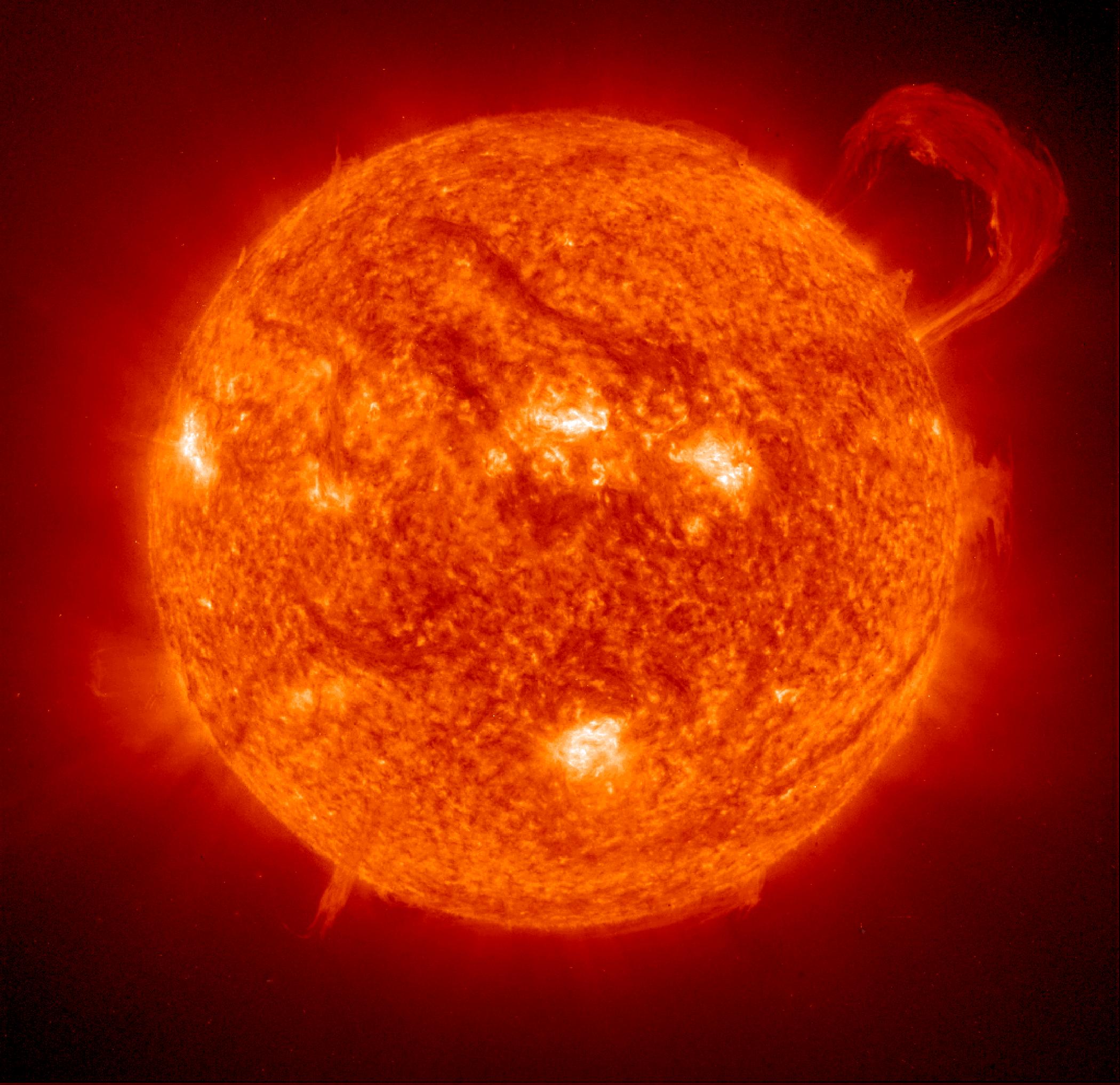
Handle on the Sun (click to enlarge)
The above image was taken September 14, 1999, by the Extreme Ultraviolet Imaging Telescope (EIT). Note the huge, handle-shaped prominence. Taken in the 304 angstrom wavelength, prominences are huge clouds of relatively cool dense plasma suspended in the Sun's hot, thin corona. At times, they can erupt, escaping the Sun's atmosphere. Emission in this spectral line shows the upper chromosphere at a temperature of about 60,000 degrees K. Every feature in the image traces magnetic field structure. The hottest areas appear almost white, while the darker red areas indicate cooler temperatures. Image Credit: NASA/European Space Agency
 
The sun's magnetic field changes polarity approximately every 11 years. It happens at the peak of each solar cycle as the sun's inner magnetic dynamo re-organizes itself. The coming reversal will mark the midpoint of Solar Cycle 24. Half of 'Solar Max' will be behind us, with half yet to come.

The poles are a herald of change. The polar magnetic fields weaken, go to zero, and then emerge again with the opposite polarity. This process is a regular part of the solar cycle.

A reversal of the sun's magnetic field is, literally, a big event. The domain of the sun's magnetic influence (also known as the "heliosphere") extends billions of kilometers beyond Pluto. Changes to the field's polarity ripple all the way out to the Voyager probes, on the doorstep of interstellar space.

When solar physicists talk about solar field reversals, their conversation often centers on the "current sheet."  The current sheet is a sprawling surface jutting outward from the sun's equator where the sun's slowly-rotating magnetic field induces an electrical current.  The current itself is small, only one ten-billionth of an amp per square meter (0.0000000001 amps/m2), but there’s a lot of it: the amperage flows through a region 10,000 km thick and billions of kilometers wide.  Electrically speaking, the entire heliosphere is organized around this enormous sheet.

During field reversals, the current sheet becomes very wavy. These undulations have been likened to the seams on a baseball. As Earth orbits the sun, it dips in and out of the current sheet. Transitions from one side to another can stir up stormy space weather around our planet.

Cosmic rays are also affected. These are high-energy particles accelerated to nearly light speed by supernova explosions and other violent events in the galaxy.  Cosmic rays are a danger to astronauts and space probes, and some researchers say they might affect the cloudiness and climate of Earth. The current sheet acts as a barrier to cosmic rays, deflecting them as they attempt to penetrate the inner solar system. A wavy, crinkly sheet acts as a better shield against these energetic particles from deep space.

Observations show that the north pole has already changed sign, while the south pole will soon catch up. Once both poles are reversed, the second half of Solar Max will begin.


-

Roaming: Ancient Beijing Observatory

In central Beijing, tucked behind the southwest exit of the Jianguomen subway station, stands a stone platform which rises 14 meters (46 feet) above street level. Surrounded by modern towers and hotels, this ancient structure was the research center for some of the most important scholars of the Ming and Qing dynasties. This is the site of the Ancient Beijing Observatory.
 
The Beijing Ancient Observatory.

Above is a present-day view of the Ancient Beijing Observatory. Image Credit: China Museums (http://chinamuseums.com)

Built in A.D. 1442 during the Ming Dynasty, the observatory offers unique insight into ancient scientific techniques. Though research at the observatory ceased in 1929, it achieved a world record for 487 years of continuous astronomical observation.

But astronomical research in China dates back much farther than this structure. In 1279, the Chinese astronomers WangXun and Guo Shoujing built a small observatory just north of this location. And before that, during the Song Dynasty (960-1279), astronomers created a catalogue of 1848 stars and 283 constellations. And some research dates even farther back, with some astronomical records dating to the Han Dynasty (206 B.C. to A.D. 220).

Astronomy and astrology have historically played a role in the decision-making and planning of China’s emperors. This is because the ancient Chinese believed there was a relationship between the sky and earth, and that observations in the sky could predict wars and accidents. As a result, astronomical research was relegated to upper-class scholars and selected foreign missionaries, and the observatory was not open to the public.

New emperors often ordered a new calendar to be made. Releasing a more accurate calendar was a sign that the new emperor was truly sanctioned by the heavens. Beginning in the Qing Dynasty, more than 100 calendars were produced. The earliest calendars were based on the lunar orbit, but this was not suitable for farming, so in time the solar orbit was added. This lunisolar calendar helped farmers plan their crops. The year was divided into 24 solar terms which predicted the changing of the seasons. In 1281, astronomer Guo Shoujing calculated that one year was 365.2425 days, 300 years before western astronomers made the same discovery and created the Gregorian calendar. The lunisolar calendar system was used until 1911 when the western solar calendar was adopted.

In addition to tracking movements in the sky, astronomers also tracked the wind, rain and snow, making their practice a combination of astronomy, astrology, and meteorology.

From 1669 to 1674, Emperor Kangxi commissioned the Flemish Jesuit missionary Ferdinand Verbiest (1623 – 1688) to design six bronze astronomical instruments, a celestial globe, the equatorial armillary sphere, the ecliptic armillary, the quadrant, the altazimuth and the sextant (it is not known why Verbiest based these instruments on the outmoded designs of Tycho Brahe, as the research of the day was well into the era of telescopic astronomy). In 1715, Killian Stumpf designed two other instruments—the azimuth theodolite, which is a combination of an altazimuth and quadrant and is used to measure the vertical and horizontal angles and altitudes of celestial bodies. In 1744, Emperor Qianlong ordered the construction of the last astronomical instrument—the new armillary sphere—to be added to the ancient observatory. These instruments occupied the roof of the observatory, while the older instruments were moved to the yard below.

All of the observatory's instruments except the altazimuth theodolite are adorned with bronze dragons at the base, signifying that astronomy was a special discipline for the emperor. A telescope was never added to the collection, although the emperor acquired one and kept it at the palace for personal use. The observatory was raided in 1900 during the Eight-Nation Alliance's siege of Beijing, and the instruments were taken by foreign troops. The French returned five of the instruments the next year, while the Germans took five of them to Europe to display at Potsdam Hall. They were finally returned in 1921. Several of the instruments were sent to Nanjing for safekeeping after the Japanese invaded China.

The site was opened to the public as a museum in 1983. It is operated in conjunction with the Beijing Planetarium and currently receives about 500 visitors per week. There are detailed English descriptions available. In the courtyards surrounding the Ancient Observatory, there are three exhibitions about the history of astronomy in China, the uses of the various instruments and examples of ancient instruments such as water clocks and sundials. Visitors can also climb to the top of the observatory, which has 99 steps to signify a relationship to the emperor. There they can look at additional instruments displayed on the roof.

To learn more about Ancient Beijing Observatory, click here to visit the website of the Beijing Planetarium.

To learn more about Ancient Beijing Observatory, click here to visit China’s travel website.


-

Monday, August 26, 2013

Robert Samuel Kraemer, 1928 - 2013

Robert S. Kraemer with a model of NASA/JPL's Viking orbiter-lander. Image Credit: Rogers Photo Archive

Robert Samuel Kraemer, NASA’s former director of planetary exploration who was also an expert in rocket engines, died August 20 at an assisted living center in Catonsville, Maryland. He was 84. The cause was complications from a fall at his home two months ago.

Kraemer joined NASA in 1967 and, in one of his early assignments, managed the development of a Mars surface laboratory mission at NASA’s headquarters in Washington.  After the project was canceled because of congressional concerns, he was appointed manager of advanced planetary programs and technology and in 1970 was named director of planetary programs. Kraemer oversaw the successful completion of 12 missions to launch spacecraft into the solar system to study its planets, moons and more. He faced political, financial and technical challenges in managing an unprecedented surge of planetary exploration that produced groundbreaking results. Kraemer was associated with the missions Mariner 9 and 10, Pioneer 10 and 11, Helios 1 and 2, Viking 1 and 2, Voyager 1 and 2 and Pioneer Venus 1 and 2. Kraemer was described as a very technically competent and a very good engineer, and he was very good at picking the right people for the right job.

The son of a citrus rancher and a homemaker, Kraemer was born on October 21, 1928, in Fullerton, California, and raised in Placentia, Calif. He received a bachelor’s degree in aeronautical engineering from the University of Notre Dame in 1950.

After receiving a master’s degree in aeronautics and rocket propulsion from the California Institute of Technology in 1951, he worked for North American Aviation’s Rocketdyne Division in Canoga Park, California, on rocket propulsion for a secret intercontinental cruise missile called Navaho.

After Rocketdyne, Kraemer then worked as chief engineer for space systems at Ford Aeronutronic in Newport Beach, California, where he worked until he joined NASA. He retired in 1990.

Kraemer wrote several books, including Rocketdyne: Powering Humans into Space and Beyond the Moon: A Golden Age of Planetary Exploration 1971-1981. He received the Distinguished Service Medal, NASA’s highest honor.

Kraemer lived in Rockville from 1967 to 1981, when he moved to Annapolis. Since 2007, he had lived in Catonsville.

Kraemer is survived by his wife of 59 years, Anne Park Kraemer of Catonsville; six children, David Kraemer and Anita Kraemer, both of Catonsville, Timothy Kraemer of Germantown, Md., Stephen Kraemer of Athens, Ga., Kathryn McCoy of Kensington and Joan Compere of Ellicott City; two brothers; a sister; and 11 grandchildren.


-

Kepler Looking for Work

NASA has ended Kepler's primary and extended missions. But much mission data is still to be analyzed and NASA is seeking a new purpose for the space telescope.


Kepler
Above is a reaction wheel (in its housing), identical to those used aboard NASA's Kepler Space Telescope. Kepler launched with four working wheels. Image Credit: Ball Aerospace & Technologies Corporation

Following months of analysis and testing, NASA's Kepler Space Telescope team ended its attempts to restore the spacecraft to full working order, and now is considering what new science research it can carry out in its current condition.

Two of Kepler's four gyroscope-like reaction wheels, which are used to precisely point the spacecraft, have failed. The first was lost in July 2012, and the second in May. Engineers' efforts to restore at least one of the wheels have been unsuccessful.

Kepler completed its prime mission in November 2012 and then began its four-year extended mission. However, the spacecraft needs three functioning wheels to continue its search for Earth-sized exoplanets, which are planets outside our solar system, orbiting stars like our sun in what's known as the habitable zone -- the range of distances from a star where the surface temperature of a planet might be suitable for liquid water. As scientists analyze previously collected data, the Kepler team also is looking into whether the space telescope can conduct a different type of science program, potentially including an exoplanet search, using the remaining two good reaction wheels and thrusters.

"Kepler has made extraordinary discoveries in finding exoplanets including several super-Earths in the habitable zone," said John Grunsfeld, associate administrator for NASA's Science Mission Directorate in Washington. "Knowing that Kepler has successfully collected all the data from its prime mission, I am confident that more amazing discoveries are on the horizon."

On August 8th, engineers conducted a system-level performance test to evaluate Kepler's current capabilities. They determined wheel 2, which failed last year, can no longer provide the precision pointing necessary for science data collection. The spacecraft was returned to its point rest state, which is a stable configuration where Kepler uses thrusters to control its pointing with minimal fuel use.

"At the beginning of our mission, no one knew if Earth-size planets were abundant in the galaxy. If they were rare, we might be alone," said William Borucki, Kepler science principal investigator at NASA's Ames Research Center in Moffett Field, California. "Now at the completion of Kepler observations, the data holds the answer to the question that inspired the mission: Are Earths in the habitable zone of stars like our sun common or rare?"

An engineering study will be conducted on the modifications required to manage science operations with the spacecraft using a combination of its remaining two good reaction wheels and thrusters for spacecraft attitude control.

Informed by contributions from the broader science community in response to the call for scientific white papers announced August 2nd, the Kepler project team will perform a study to identify possible science opportunities for a two-wheel Kepler mission.

Depending on the outcome of these studies, which are expected to be completed later this year, NASA will assess the scientific priority of a two-wheel Kepler mission. Such an assessment may include prioritization relative to other NASA astrophysics missions competing for operational funding at the NASA Senior Review board early next year.

From the data collected in the first half of its mission, Kepler has confirmed 135 exoplanets and identified over 3,500 candidates. The team continues to analyze all four years of collected data, expecting hundreds, if not thousands, of new discoveries including the long-awaited Earth-size planets in the habitable zone of sun-like stars. Though the spacecraft will no longer operate with its unparalleled precision pointing, scientists expect Kepler’s most interesting discoveries are still to come.

Meanwhile, preparations are underway for hosting the second Kepler Science Conference November 4-8, at NASA's Ames Research Center. This will be an opportunity to share not only the investigations of the Kepler project team, but also those of the wider science community using publicly accessible data from Kepler.

Ames is responsible for the Kepler mission concept, ground system development, mission operations, and science data analysis. NASA's Jet Propulsion Laboratory in Pasadena, California, managed Kepler mission development.

Ball Aerospace & Technologies Corp. in Boulder, Colo., developed the Kepler flight system and supports mission operations with the Laboratory for Atmospheric and Space Physics at the University of Colorado in Boulder.

The Space Telescope Science Institute in Baltimore archives, hosts and distributes Kepler science data. Kepler is NASA's 10th Discovery Mission and was funded by the agency's Science Mission Directorate.

Click here to learn more about Kepler's upcoming science conference.

Click here to learn more about NASA's call for two-wheel science proposals.

Click here to learn more about NASA's Kepler spacecraft.


-