Pages

Tuesday, September 21, 2010

Uranus at Opposition 2010

Tuesday, September 21, marks the opposition of Uranus—the point in Uranus’ orbit where it appears in  Earth’s sky opposite from the sun. The planet can be found wandering between the constellations Pisces and Cetus. Uranus can be easy to see, but not so easy to recognize as a planet. If you have charts, then you can find dim Uranus in a clear, very dark sky using binoculars or even naked-eye. When using a telescope of aperture 10 inches or larger, the planet may appear blue-green in color. The publishers of Sky and Telescope have a basic chart here:

http://www.skyandtelescope.com/observing/objects/planets/12435011.html        

More on Uranus

The planet Uranus is the seventh planet from the sun, the third-largest planet in our solar system, and the fourth most massive planet our solar system. Uranus is named after the ancient Greek god of the sky, who was also the father of Cronus (Roman, Saturn) and the grandfather of Zeus (Roman, Jupiter). Like the five classical planets (Mercury, Venus, Mars, Jupiter, and Saturn), Uranus is visible to the naked eye, but it was not recognized as a planet by ancient astronomers because of its dimness and slow orbit. Its discovery, the first made using a telescope, was announced on March 13, 1781 by German-British astronomer Sir William Herschel.

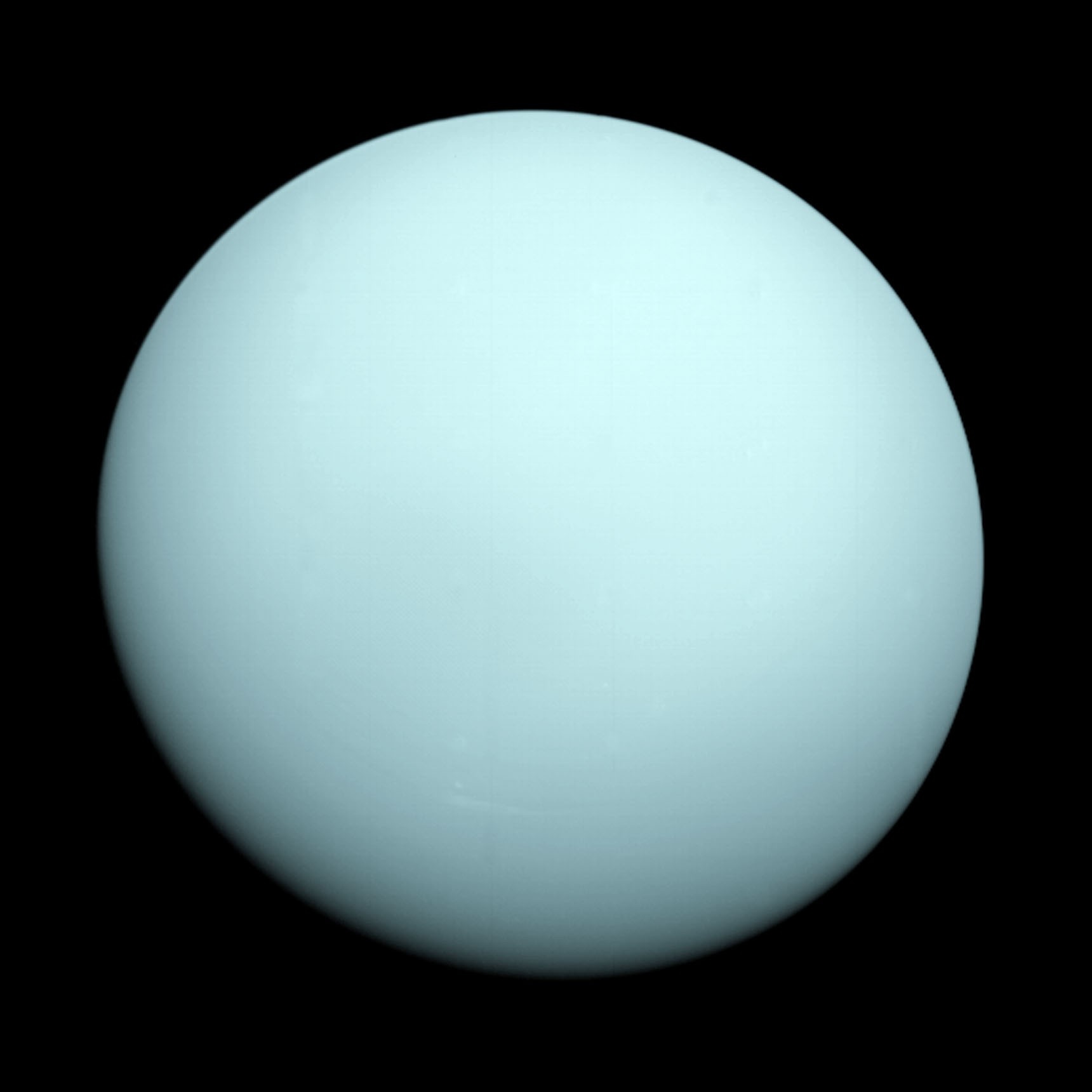
NASA's Voyager 2 spacecraft at Uranus. Image Credit NASA

Like the planet Neptune, Uranus shares similarities to Jupiter and Saturn in that they consist primarily of hydrogen and helium. But unlike Jupiter and Saturn, the pair also has lots of water, ammonia, methane, and traces of hydrocarbons. Uranus has the coldest planetary atmosphere in the solar system, with a minimum temperature of 49 Kelvins (-224 degrees Celsius). The cloud structure is complex and layered, with water thought to make up the lowest-level clouds, and methane thought to make up the highest-level clouds. The interior of Uranus is composed mainly of ices and rock.

Like all gas giants (Jupiter, Saturn, Uranus, and Neptune), has a ring system, and magnetosphere, and many moons. But the Uranian system is different from the others in that its axis of rotation is tilted sideways, nearly into the plane of Uranus’ orbit. As seen from Earth, the Uranian rings can sometimes appear as circles around the planet, and sometimes appear edge-on. In 1986, the NASA Voyager 2 spacecraft transmitted to Earth images of Uranus as it flew by. In those images, Uranus appeared as a virtually featureless planet in visible light without the cloud bands or storms that astronomers associate with the other gas giants. But images taken from Earth in recent years have shown signs of seasonal change and increased weather activity, as Uranus approached its equinox. The wind speeds on Uranus can reach 250 meters per second (900 km/h, or 560 mph).

Voyager at Uranus

Launched on August 20, 1977, the Voyager 2 spacecraft passed closest to the planet Uranus on January 24, 1986, coming within 81,500 kilometers (50,600 miles) of the cloudtops. Voyager 2's images of the five largest moons around Uranus revealed complex surfaces indicative of varying geologic pasts. The cameras also detected 10 previously unseen moons. Several instruments studied the ring system, uncovering the fine detail of the previously known rings and two newly detected rings. Voyager data showed that the planet's rate of rotation is 17 hours, 14 minutes. The spacecraft also found a Uranian magnetic field that is both large and unusual. In addition, the temperature of the equatorial region, which receives less sunlight over a Uranian year, is nevertheless about the same as that at the poles.

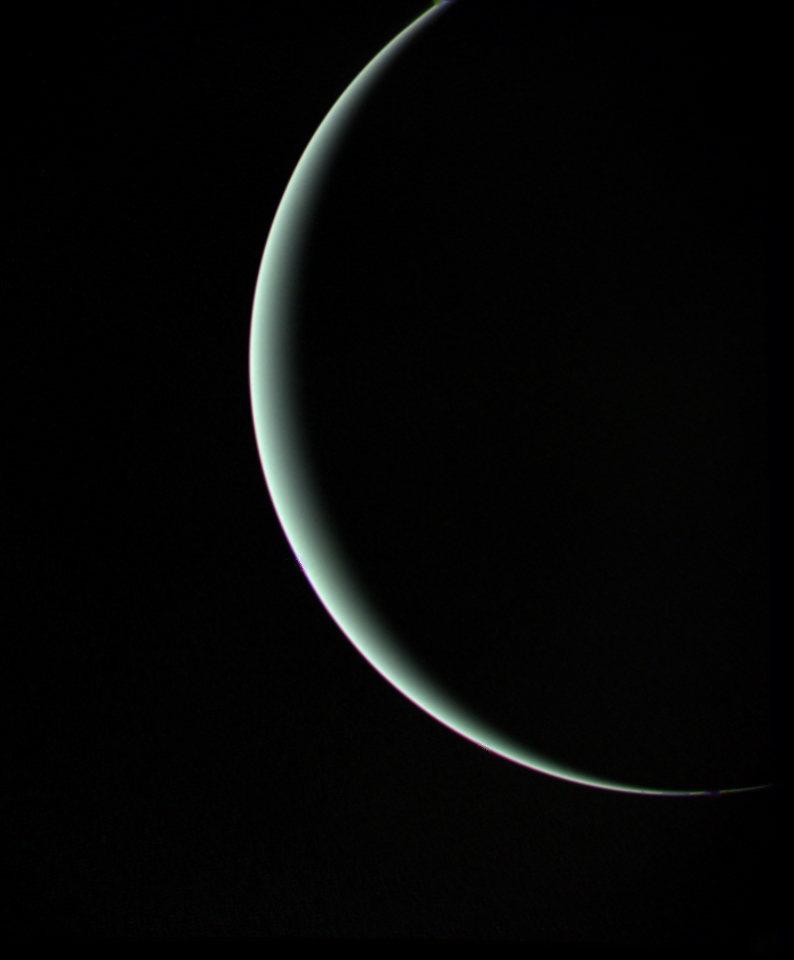
Voyager 2 image of a crescent-Uranus after passing beyond the planet. Image Credit: NASA

For more on the planet Uranus, the Voyager program and the ongoing Voyager Interstellar Mission, visit these links:

NASA - Solar System Exploration - Uranus
http://solarsystem.nasa.gov/planets/profile.cfm?Object=Uranus

NASA/JPL - Voyager, the Interstellar Mission
http://voyager.jpl.nasa.gov/

NSSDC - Voyager Project Information
http://nssdc.gsfc.nasa.gov/planetary/voyager.html
_

Saturday, September 18, 2010

Observe the Moon Tonight!

Tonight, Saturday, September 18, the world will join the NASA Goddard Space Flight Center’s Visitor Center in Greenbelt, Maryland, as well as other NASA Centers to celebrate the first annual International Observe the Moon Night (InOMN).
Earth's Moon. Image Credit NASA.

InOMN provides the opportunity for the general public, NASA partners, and amateur astronomers to learn about lunar science and to view the Moon - many for the first time - through telescopes.
InOMN began last August as a celebration of the successful journey of NASA’s Lunar Reconnaissance Orbiter (LRO) around the Moon (http://www.nasa.gov/lro/). After the launch of LRO on June 18, 2009, Goddard's Education and Outreach Team hosted the event, "We're at the Moon!" The same day, the event "National Observe the Moon Night," was hosted at NASA's Ames Research Center (ARC) in Moffett Field, California by the Lunar Crater Observation and Sensing Satellite and NASA Lunar Science Institute (NLSI) teams. NLSI is based at NASA Ames. This year, both teams decided to expand the event by partnering with other NASA institutions, organizations and communities around the world.
Tonight the moon will be a waxing gibbous, about 82% of full. In the Tampa Bay area the Moon rises about 3:25 PM and sets about 2:40 AM.
Visit this link to find out more about International Observe the Moon Night: http://observethemoonnight.org/
...and visit this link to find observing locations in your area hosted by participating organizations.

Lunar Reconnaissance Orbiter (LRO)

Scientists think that on the moon humans will develop technologies to survive in the infinite frontier of space, because the moon presents the same challenges that humans will encounter throughout the universe: harmful radiation, electrified dust, and extreme temperatures.


Artist concept of the Lunar Reconnaissance Orbiter (LRO). Image Credit: NASA
Just as a scout finds the safest way for expeditions on Earth, NASA sent a robotic scout, called the Lunar Reconnaissance Orbiter (LRO), to gather crucial data on the lunar environment that will help astronauts prepare for long-duration lunar expeditions.
LRO will spend at least a year in a low polar orbit approximately 50 kilometers (31 miles) above the lunar surface, while its seven instruments find safe landing sites, locate potential resources, characterize the radiation environment and test new technology.
Learn more about LRO at the mission site: http://www.nasa.gov/lro/
More on the Moon
The moon is Earth's only natural satellite and the only astronomical body other than Earth ever visited by human beings. The moon is the brightest object in the night sky but gives off no light of its own. Instead, it reflects light from the sun. Like Earth and the rest of the solar system, the moon is about 4.6 billion years old.
The LRO imaging tools are busily mapping the Moon in 7 UV and visible wavelengths (320 nm through 689 nm). This color composite shows 320 nm light in blue, 415 nm in green and 689 nm in red, scene is ~1000 km wide. Credit: NASA/GSFC/Arizona State University

The moon is much smaller than Earth. The moon's average radius (distance from its center to its surface) is 1,079.6 miles (1,737.4 kilometers), about 27 percent of the radius of Earth.
The moon is also much less massive than Earth. The moon has a mass (amount of matter) of 8.10 x 10¹⁹ tons (7.35 x 10¹⁹ metric tons). Its mass in metric tons would be written out as 735 followed by 17 zeroes. Earth is about 81 times that massive. The moon's density (mass divided by volume) is about 3.34 grams per cubic centimeter, roughly 60 percent of Earth's density.
Because the moon has less mass than Earth, the force due to gravity at the lunar surface is only about 1/6 of that on Earth. Thus, a person standing on the moon would feel as if his or her weight had decreased by 5/6. And if that person dropped a rock, the rock would fall to the surface much more slowly than the same rock would fall to Earth.
Despite the moon's relatively weak gravitational force, the moon is close enough to Earth to produce tides in Earth's waters. The average distance from the center of Earth to the center of the moon is 238,897 miles (384,467 kilometers). That distance is growing -- but extremely slowly. The moon is moving away from Earth at a speed of about 1 1/2 inches (3.8 centimeters) per year.
The temperature at the lunar equator ranges from extremely low to extremely high -- from about -280 degrees F (-173 degrees C) at night to +260 degrees F (+127 degrees C) in the daytime. In some deep craters near the moon's poles, the temperature is always near -400 degrees F (-240 degrees C).
The moon has no life of any kind. Compared with Earth, it has changed little over billions of years. On the moon, the sky is black -- even during the day -- and the stars are always visible.
A person on Earth looking at the moon with the unaided eye can see light and dark areas on the lunar surface. The light areas are rugged, cratered highlands known as terrae (TEHR ee). The word terrae is Latin for lands. The highlands are the original crust of the moon, shattered and fragmented by the impact of meteoroids, asteroids, and comets. Many craters in the terrae exceed 25 miles (40 kilometers) in diameter. The largest is the South Pole-Aitken Basin, which is 1,550 miles (2,500 kilometers) in diameter.
The dark areas on the moon are known as maria (MAHR ee uh). The word maria is Latin for seas; its singular is mare (MAHR ee). The term comes from the smoothness of the dark areas and their resemblance to bodies of water. The maria are cratered landscapes that were partly flooded by lava when volcanoes erupted. The lava then froze, forming rock. Since that time, meteoroid impacts have created craters in the maria.
The moon has no substantial atmosphere, but small amounts of certain gases are present above the lunar surface. People sometimes refer to those gases as the lunar atmosphere. This "atmosphere" can also be called an exosphere, defined as a tenuous (low-density) zone of particles surrounding an airless body. Mercury and some asteroids also have an exosphere.
Learn more about our moon at these sites:
NASA’s Lunar Reconnaissance Orbiter (LRO) Mission:
Earth’s Moon - NASA’s Solar System Exploration site:
http://observethemoonnight.org/

Moon - World Book at NASA:

Monday, August 23, 2010

Jupiter Fireball

Jupiter is becoming quite popular planet...for impacts, that is. On August 20 at 18:22 UTC, two amateur astronomers in Japan independently recorded an apparent impact on Jupiter. The first report came from Masayuki Tachikawa of Kumamoto city.

Masayuki Tachikawa of Kumamoto city was first to report the event. Soon after Tachikawa made his report, Tokyo amateur astronomer Aoki Kazuo discovered that he also had recorded the fireball.

The above image was recorded by amateur astronomer Masayuki Tachikawa from Kyushu. The image was recorded using a webcam attached to a six-inch f/7.3 refractor telescope. This version of the image, with the added arrow graphic, was posted by Japan television station KYODO.

The separation between the two observing locations, approximately 800 km, rules out the possibility that the event took place near Earth and reinforces the association of the fireball with Jupiter. The most likely explanation for the event is that a small comet or asteroid hit the gas giant.

The August 20 impact was the third time in only 13 months that amateurs detected impacts on Jupiter. The earlier events occurred on July 19, 2009 and June 3, 2010. The July 19 impact is now thought to be caused by an asteroid about 500 meters (1,600 feet) wide. The resulting impact in the cloud layer was approximately the size of the Pacific Ocean. The June 3 impact was reported by Australian amateur Anthony Wesley, who was at the time watching live video feed from his telescope. Wesley's observation was confirmed by amateur Christ Go, who was taking video from his telescope in the Philippines. Unlike the July 2009 event, the impact from June 3 of this year left no visible scar or debris in the clouds, causing astronomers to be uncertain as to the actual depth of the impact penetration.

In 1994, Comet Shoemaker-Levy 9 broke into more than 20 pieces and pelted Jupiter with a string of impacts. At the time, astronomers estimated that cometary impacts could occur on Jupiter every 50 to 250 years.

Because Jupiter is receiving impacts more frequently, researchers are rethinking their estimates of Jupiter impact rates. In addition, many researchers are calling for a global network to monitor Jupiter around the clock in order to measure the Jupiter impact rate.

-

Sunday, August 15, 2010

Perseids Afterglow and U.S. Priorities for the Next Decade

Perseids Afterglow

The peak of the Perseid meteor shower may be past, but there is still plenty to see before this shower completely fades away for another year. If you missed the peak, here are some of the highlights which have been documented on the Web:

U.S. Priorities for the Next Decade

On Friday, August 13, the National Research Council (NRC) held a briefing to review their report identifying the highest-priority research activities for U.S. astronomy and astrophysics in the next decade. This is the sixth decadal survey of the NRC and it states that it will "set the nation firmly on the path to answering profound questions about the cosmos." The report prioritizes proposed activities based on their ability to advance science in key areas, and for the first time also takes into account factors such as risks in technical readiness, schedule, and cost.

The report identifies space- and ground-based research activities in three categories: large, midsize, and small. The large space activities are those exceeding $1 billion. The top priority in this category is an orbital observatory called the Wide-Field Infrared Survey Telescope (WFIRST). It is expected that this space telescope would help settle fundamental questions about the nature of dark energy, determine the likelihood of other Earth-like planets over a wide range of orbital parameters, and survey our Milky Way galaxy and others. The ground-based large-scale initiatives are those that that exceed a budget of $135 million. The first priority of these is the Large Synoptic Survey Telescope (LSST), a wide-field optical survey telescope that would observe more than half the sky every four nights, and address diverse areas of study such as dark energy, supernovae, and time-variable phenomena.

The recommended research activities are encapsulated by three science objectives: deepening understanding of how the first stars, galaxies, and black holes formed, locating the closest habitable Earth-like planets beyond the solar system for detailed study, and using astronomical measurements to unravel the mysteries of gravity and probe fundamental physics.

Along with WFIRST, other priorities in the large-scale space category recommended in the report are an augmentation to NASA’s Explorer program, which supports small- and medium-sized missions that provide high scientific returns; the Laser Interferometer Space Antenna (LISA), which could enable detection of long gravitational waves or "ripples in space-time"; and the International X-Ray Observatory, a large-area X-ray telescope that could transform understanding of hot gas associated with stars, galaxies, and black holes in all evolutionary stages.

Other recommended ground-based research projects include the formation of a Midscale Innovations Program within the NSF, which would fill a funding gap for compelling research activities that cost between $4 million and $135 million. In addition, the report recommends participation in the U.S.-led international Giant Segmented Mirror Telescope, a next generation large optical telescope that is vital for continuing the long record of U.S. leadership in ground-based optical astronomy. The next priority is participation in an international ground-based high-energy gamma-ray telescope array.

For midsize space-based activities, the first priority is the New Worlds Technology Development Program, which lays the scientific groundwork for a future mission to study nearby Earth-like planets. Top priority for ground-based midsize research is the Cerro Chajnantor Atacama Telescope (CCAT), which would provide short wavelength radio surveys of the sky to study dusty material associated with galaxies and stars.

Research priorities were selected through an extensive review that included input from nine expert panels, six study groups, and a broad survey of the astronomy and astrophysics community. With the help of an outside contractor, the committee developed independent appraisals of the technical readiness and schedule and cost risks. In addition, the survey reassessed projects that were recommended in past surveys but not formally started.

The research recommendations represent a cohesive plan with realistic budgetary scenarios, the report says, with ranges based on current projected budgets for NASA, NSF, and the U.S. Department of Energy -- the agencies largely responsible for funding and implementing the research activities. It also identifies smaller, unranked research initiatives to augment core fundamental research. An independent standing committee should regularly advise the agencies on strategy and progress of the projects and produce annual reports.

The report notes that astronomical research continues to offer significant benefits to the nation beyond astronomical discoveries by capturing the public's attention and promoting general science literacy and proficiency. In addition, the research serves as a gateway to science, technology, engineering, and mathematics careers, and a number of important and often unexpected technological breakthroughs. The report makes several recommendations to improve astronomy and astrophysics education and calls for more U.S. participation in international research projects.

Read the full report is available here:
http://www.nap.edu/catalog.php?record_id=12951

See the archived webcast is available here:
http://www.tvworldwide.com/events/nas/100813/

-

Monday, August 09, 2010

2010 Perseid Meteor Shower Underway


The Perseid meteor shower is one of the three best annual showers, the other two being the Orionid shower, which peaks around October 21, and the Geminid shower, which peaks around December 13.


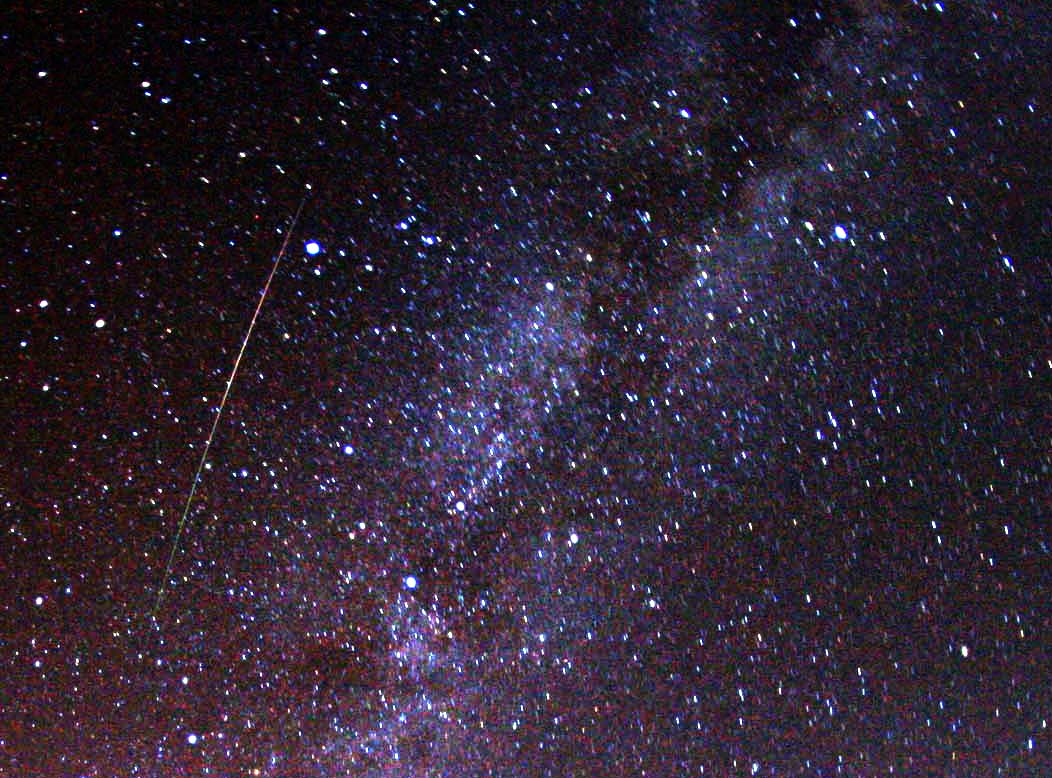
This image shows a multicolored, 2009 Perseid meteor passing just to the left of the Milky Way. Image Credit: Mila Zinkova. Permission granted to display the image here.

Perseid meteors may be visible from July 25 through Aug. 21 with the peak on Thursday, August 11/Friday, August 12. This is a reliable shower, giving consistent rates each year. During its maximum (August 12/13) the meteor hourly rate averages 50 to 68, and sometimes higher. The meteors enter the atmosphere at about 59 km/second and are yellow in color. The Perseid shower occurs each year when Earth passes through the debris trail of Periodic Comet Swift-Tuttle, also called Comet 1862 III, discovered on July 16, 1862 by Lewis Swift and then independently discovered three days later by Horace Tuttle. Perseid meteors will appear to originate from a point in the constellation of Perseus (Right Ascension 03hrs 04min, Declination +58°).

Meteoroid, Meteor and Meteorite

The terms meteor, meteorite and meteoroid are confusing to many, and with good reason. They all refer to the same object, but under different circumstances. Let us first examine the origin of these terms. The word meteor comes from the Greek word meteoron, meaning astronomical phenomenon, or something in the heaven above. This meaning can be understood when we consider that meteorology is the science dealing with the atmosphere and its phenomenon. In its most literal sense, anything that we may see in the sky could be called a meteor, whether it be a thunder cloud, a supernova or a UFO. For the purpose of sanity, we shall confine its usage to relatively small bodies which drift through space, fall into Earth's atmosphere, and sometimes reach the ground.

A meteoroid is a relatively small object, smaller than an asteroid or minor planet, drifting through space in orbit around the Sun. Bits smaller than grains of sand are sometimes called micrometeoroids. A meteor is the effect produced as the meteoroid plows into our atmosphere and streaks across the sky. A glowing trail, sometimes called a train, is created to mark the path of the meteoroid as it falls. When a meteoroid, or a fragment of it, reaches the ground, it is called a meteorite. These may be found, dug up, held, and examined. The only way to hold a meteoroid is either to float with it in space or fall with it through the sky!

Many meteoroids are the size of salt or sugar grains and most are no bigger than grains of rice, though some can be the size of giant boulders weighing several tons. As the meteoroids enter Earth's atmosphere, at speeds ranging from 11 to 72 kilometers (7 to 45 miles) per second, their surfaces collide with the atoms and molecules of the atmosphere. These collisions break loose material from their surface and also break up the atoms and molecules of both the meteoric material and the atmosphere into charged particles. The ionized atoms are excited and begin to glow 50 to 75 miles up. These glowing tubes that the meteoroids create as they pass are called trails or trains. Some meteor trails are short, and some are long -- spanning 20 degrees or more across the sky. Most trails are white, blue, or yellow, but some can be red or even green. These ionized trails also show as reflections on radar. Astronomers have used radar since 1945 to record the rate of meteors that fall. Radar observations allow astronomers to track meteor showers that occur during the daytime as well.

Perseid Visibility Growing

The Perseid peak is still days away, but observers around the globe are already seeing hourly rates of 10 or more, with occasional fireballs. The early reports could be indicating that the peak on Thursday night / Friday morning will be quite a show.

-
Lasers Take the Twinkle Out of the Night Sky

If you are a hopeless romantic, you probably love to see a nighttime sky filled with twinkling stars. But if you are an astronomer, probably not so much. Now a team of University of Arizona astronomers led by Michael Hart has developed a technique that allows astronomers to stop the twinkling effect over a wide field of view, enabling Earth-based telescopes to obtain images that are as crisp as those made using the Hubble Space Telescope, and much faster. The technique is called laser adaptive optic and the team describes it in the August 5 issue of Nature.

Normally, light from celestial objects is blurred by atmospheric turbulence by the time it reaches the optics of a ground-based telescope. Most of that distortion happens less than a half mile above the ground, where heat rises from the surface and disturbs the air.

The new technique can be thought of as noise-canceling process, only for light waves instead of for sound waves. The heart of the process is formed by a bundle of five green lasers and a pliable mirror.

Hart and his team demonstrated the process from their observatory on Mount Hopkins, south of Tucson, Arizona. The five lasers are used to detect turbulence in the atmosphere. Any light reflected back from each laser, and the amount reflected back, indicates the amount of turbulence in the telescope’s field of view. The turbulence data is then fed into a computer which control’s the telescope’s adaptive mirror.

The back of the mirror is covered with 336 actuators, or small magnetic pins surrounded by coils. When the computer sends electric current through the coils, the actuators move, causing the mirror to warp just enough to cancel out the turbulence which causes the twinkle in the atmosphere. The corrective movements are too tiny for the human eye to see and happen a thousand times each second.

Astronomers and engineers have advanced adaptive optics over the past 15 to 20 years, but the technology was limited in that it could only be applied to a very narrow portion of the telescope’s field of view. According to Hart, this new technology can be applied over the telescope’s entire field of view. There is some trade-off in the new technique, in that it sacrifices some of the very high resolution in order to gain a larger field of view. Hart expects that this trade-off is well worth it because of the many scientific uses that it makes possible.

One use could be to study very old galaxies that formed around 10 billion years ago. These are known to astronomers as high red-shift galaxies and are thought to be billions of light years away.

The new technique would allow astronomers to study the spectral characteristics and chemical composition of these galaxies. Until now, such a study was difficult because the light from these galaxies was so faint.

For more information check out these links:

University of Arizona, Department of Astronomy and Steward Observatory
http://www.as.arizona.edu/

University of Arizona article: Taking the Twinkle Out of the Night Sky
http://uanews.org/node/33078

* If you enjoyed our site, please visit some of our sponsors before you leave *

-

Saturday, August 07, 2010

Sol Awakens

On Sunday, August 1st at 8:55 UTC, our star, known as Sol, finally stirred after a year of slumber. The signs are telling astronomers that the sun is awakening to another cycle of solar activity. Experts do not expect the activity to peak, weakly, until mid-2013.

NASA SDO Image of the sun, July 27, 2010, five days prior to the CME. Image Credit: NASA

On that recent Sunday orbiting satellites witnessed a sizable flare erupting from the large sunspot region designated 1092. The strength of the outburst was estimated at C3, relatively modest, but it still triggered an impressive coronal mass ejection (CME) that shot out from the star at more than 600 miles (1,000 km) per second.

The event was caught by NASA's recently-launched Solar Dynamics Observatory (SDO). It watched as the magnetic disturbance caused an enormous filament of superheated gas to pulse across the Sun's disk.

VIDEO: NASA SDO - Filament Eruption and Solar Flare, August 1, 2010

On the night side of Earth, skywatchers at far northern and southern locations enjoyed colorful auroral displays over the night of August 3 to 4.

Since the CME, the big spot in region 1092 has been joined by a second, smaller group, called 1093. If you want to take a look for yourself, remember to view by indirect light, or by using a safe solar filter.

Check Out These Sites:

NASA's Solar Dynamics Observatory (SDO)
http://sdo.gsfc.nasa.gov/

VIDEO: NASA SDO - Filament Eruption and Solar Flare, August 1, 2010
http://www.youtube.com/watch?v=thm6SCv-sj0&feature=player_embedded

-

Wednesday, April 14, 2010

Alonso Theatre Department Does Great!

Hey, friends.

I'm taking time out to promote another blog. The Arts Council of Hillsborough County posted an article on the fantastic achievement of the Alonso High School Theatre Department, in the selection of their One-Act competition piece to represent the state of Florida in the 2010 International Thespian Festival in June. Please check out today's blog and spread the word!

http://artscouncilofhillsboroughcounty.blogspot.com/2010/04/alonso-high-thespains-mosi-kic-advisory.html

-

Sunday, January 03, 2010

The People Sang Praises to God
(2 Chronicles 3:1-17; 5:1-14)

God blessed His servant King David in many ways but He chose David’s son, Solomon, to build the temple. In 2 Chronicles chapter 1 we learn of the beginnings of Solomon’s reign. Following his coronation, Solomon asked God to give him wisdom and knowledge to lead the nation of Israel. God was pleased that Solomon did not ask for wealth, honor, the death of his enemies, or long life. However, God blessed Solomon with those very things, as well as with wisdom and knowledge.

In 2 Chronicles chapters 2 through 3 we learn of the building of the temple. The wise king led the temple construction and dedication. He built the temple on Mount Moriah, where God had appeared to his father David. Solomon organized a tremendous task force of almost 160,000 workers. The temple was to be great for a great God, and the resources were abundant. The inside of the temple was decorated very lavishly with gold and fine wood. These precious things reminded the worshipers of the greatness of God.

In 2 Chronicles chapter 5 we read that when the construction was completed, Solomon brought into the temple the things his father had set apart for the Lord God. The work was then consecrated as the people praised God. They expressed a sense of unity and oneness. The people and the priests praised God with the playing of instruments. There were cymbals, harps and lyres (a kind of harp). Many priests played shofars--a ram's horn, blown like a trumpet. They also raised their voices together in praise to God. They sang, "He is good. His love endures forever." God was very pleased by their praise. He filled the temple with a cloud of His glory.

In 1 Peter chapter 2, the Apostle Peter described the followers of Christ as living stones, being built into a house of worship as we come to God. We are a royal priesthood; a holy nation! We, who once lived in darkness, have been brought into God’s wonderful light through His great mercy. All of this was done so that we, like Solomon, would sing God’s praises.

-

Sunday, December 20, 2009

A Very Special Night

(Luke 2:1-20)

Around the age of twenty years, a young Gaius Octavius Thurinus was adopted by his great-uncle, the Roman politician Gaius Julius Caesar, and also given the name Gaius Julius Caesar. He later received the honorary title of Augustus, and was then later renamed Gaius Julius Caesar Augustus. Augustus was the first emperor of the Roman Empire, reigning from 27 BC until his death in AD 14.

In 4 BC, Augustus issued a decree that in every region controlled by the Roman empire, the inhabitants were required to record their names and have their goods rated at a certain value, so that the emperor would understand how rich every country, city, family, and house was. Judea was included in this census--while Herod ruled Judea as king, he did so as a servant of Rome and Augustus. This census was done as a preliminary to taking a poll tax in the provinces, which followed a few years later. This initial census took place during the time that Quirinius was governor of Syria, which he controlled from 4 BC to AD 1. Interestingly enough, the actual taxing took place during his second instance as governor, from AD 6 to AD 11.

The usual Roman method of census was for the individual to enroll from their place of residence. But it was the Jewish custom to enroll by tribes and families. Both Joseph and Mary were of the family line of David, and would have enrolled where the family had its landed inheritance--Bethlehem. The timed journey of the couple from Nazareth in Galilee to Bethlehem was necessary to fulfill the prophecy of Micah (Micah 5:2). Without Mary, Joseph or Augustus being aware, God was able to manipulate people and events so that His Messiah would be born in Bethlehem.

It seems that the city of David was overflowing with his descendants that had returned home to be enrolled. It also seems that Mary and Joseph were not the first to arrive, perhaps because Joseph had led their journey at a careful pace out of consideration for Mary’s condition.

The formal lodgings in Bethlehem were filled, but Mary and Joseph managed to find something. Luke says that they found a stable or stall, possibly attached to one of the inns that they visited in search of rooms.

We do not now how long the enrollment process took, but we do know that while the couple was in Bethlehem, the time came for Jesus to be born. Mary closely wrapped the newborn Jesus in a long, narrow cloth in a manner that was done in the Near East during Bible times.

The “manger” where Jesus was laid is thought to have been a feeding trough for animals in the stall or stable. Tradition suggests that because of the numerous rock outcroppings in the region, Jesus was born in a cave. If this was the case, the manger may have been cut out of a rock wall.

God did not announce the joyous event of Jesus' birth to dignitaries in palaces but to lowly shepherds. Along with agriculture, tending flocks formed the basis of the economy of Palestine. What’s more, sheep raised on the hillside around Bethlehem may have been destined for temple sacrifices in Jerusalem, just six miles to the north.

Some of Israel's great heroes were shepherds, including Abraham, Isaac, Jacob, and David. Several passages in Scripture characterize God as a Good Shepherd. And yet, the occupation of shepherd was held in low esteem, especially those who were hirelings rather than owners. Shepherds lived most of the year outside, away from town and townspeople.

When the angel appeared to the shepherds, they were appropriately surprised and frightened. The shepherds were not just impressed by the visible brightness of the scene, but by the radiance of God’s own glory.

The angel told the shepherds not to fear and then explained that he brought Good News, not just for the Jews, but for all people. The angel then tells them the words that Jews had longed for centuries to hear--this was the Christ, or the Messiah, God’s anointed One. But not just the Messiah, but also the Lord God Himself! The angel then gave the shepherds a sign by describing how they would find the baby--not in a palace or even in a grand home, but wrapped in swaddling cloths and lying in a manger or stall.

As if the shepherds had not received enough of a shock to their systems, they when beheld a sky filled with angels that praised and gave glory to God. The angels also announced that God wished peace upon those whom God favored.

Once the angels were gone, it did not take the shepherds long to decide that they were going to find this baby. We do not know how long it took, but we know that they found the baby Jesus and Mary and Joseph, just as the angel had described.

The excited shepherds told the couple everything about their experience and what the angel had told them. Mary took in everything they said. She treasured it, or held it in high value and considered it often in the years to come.

In the end, the shepherds returned to their flocks and to their lives. But they did so rejoicing. This Christmas, how can you proclaim the birth of God’s Messiah? What can you do to help others know that Jesus has come?

-

Sunday, December 13, 2009

Joseph Learns About Jesus
(Matthew 1:18-26)

Who was Joseph--God’s choice for the earthly father of Jesus? Why did God choose him? The Bible does not tell us much. However, God must have been confident in Joseph’s faithfulness for God to entrust the paternal care of His beloved Son. It seems pretty certain that God selected both Mary and Joseph carefully. Matthew describes Joseph as a son of David. Luke traced the genealogy of Jesus (Luke 3:23-38) beginning with His identification as the son of Joseph.

Mary and Joseph was betrothed to be married, similar to a modern-day engagement but was much more serious. That word has a different connotation in today’s language. The relationship of Mary and Joseph was one of pledged commitment with legal and social implications; however, the couple was not yet married, nor had they consummated their union. When Joseph learned of Mary’s pregnancy, he considered how to end the relationship. Joseph could have done it in an embarrassing and public manner, but his righteous and charitable spirit impressed him to dismiss her privately so as not to embarrass her.

Before Joseph could carry out his decision, an angel of the Lord intervened with the truth of Mary’s pregnancy. He told Joseph the baby was the Child of God, conceived by the Holy Spirit. God wanted Joseph to have no reservations about Mary, but to take her into his house and care for her. Joseph demonstrated obedience by responding to God’s instructions to accept Mary. Joseph and Mary were given the privilege of naming the child. The angel told Joseph to name the baby Jesus, which is the Greek equivalent of the Hebrew “Joshua,” meaning “the Lord saves,” or “the Lord is salvation.” The Child would be named this because He would save His people from their sins.

Scripture does not mention Joseph after Jesus’ childhood. We can only speculate as to Joseph’s life span. Many historians think that Joseph died sometime between Jesus’ visit to the temple and the beginning of His public ministry at age 30. We know that Joseph was chosen by God to impart human influence on the life of Jesus. Whom has God chosen you to influence? Pray that God will use you to build lasting spiritual foundations in the lives of others as you obey His leading in your life.

-

Sunday, December 06, 2009

Mary, God's Servant

(Luke 1:26-56)

Hundreds of years before Jesus' birth, many of God's prophets spoke about the birth and the life of the promised Messiah. The one most quoted at Christmas time may be that of the prophet Isaiah (Isaiah 7:14), who prophesied specifically that the Messiah would be born to a virgin.

God sent the angel Gabriel to a young woman in the town of Nazareth to tell His plans for the birth of the Messiah. Gabriel told Mary that out of all women, she was chosen to carry the Christ child. Mary was both surprised and humbled at the prospect of being the mother of the Messiah. However, she demonstrated submissiveness to God's will by stating that she was God's servant. A servant does whatever their master says, and does not question the master's motive, authority, or reasoning. Mary accepted her role and asked that God's will be done.

Gabriel also told Mary that her cousin Elizabeth was miraculously pregnant in her old age. Immediately after Gabriel departed, Mary traveled to see her cousin. When Elizabeth heard Mary's greeting, the baby leaped in her womb, and Elizabeth was filled with the Holy Spirit. She cried out and then exclaimed, “Blessed above all other women are you! And blessed is the Fruit of your womb! How am I granted that the mother of my Lord should come to me?”

In reaction to Elizabeth’s words, Mary offered praise for the greatness of God and thanksgiving for being used by Him. She proclaimed, “My soul magnifies the Lord, and my spirit rejoices in God my Savior, for He has looked upon the low station of His handmaiden. From now on all generations will call me blessed! For He Who is almighty has done great things for me--and holy is His name! And His mercy is on those who fear Him with godly reverence, from generation to generation.”

God could have selected any young virgin, but He chose Mary. She accepted her role in God's plan and asked that God's will be done. Is God calling you into a role that surprises and humbles you--perhaps one that feels too challenging? How will you respond?

-

Sunday, November 29, 2009

Hannah was Thankful for Answered Prayer
(1 Samuel 1:1-20)

Hannah was first of the two wives of Elkanah. The second wife was Peninnah. Elkanah greatly loved Hannah, but she was barren, unable to give children to Elkanah like Peninnah did. Still, Peninnah was jealous of Hannah because of Elkanah’s favoritism.

Even with Elkanah’s love and attentiveness, Hannah was sad. She longed for a baby. Hannah even endured Peninnah’s teasing for being barren.

Each year, Hannah traveled to the city of Shiloh to worship, make sacrifice to the Lord, and ask the Lord for a child. Hannah vowed that if the Lord gave her a son, she would give him for service to the Lord. The priest Eli watched Hannah praying and crying, thinking she was drunk.

After Hannah explained to Eli, he told Hannah to go in peace with his hope that God would grant her prayer. Hannah was greatly encouraged by Eli. The next morning, she worshiped again and then returned to her home. Hannah persevered in prayer. As a difficult situation lingers, it can become hard to pray; yet Jesus taught us to persevere as Hannah did.

“Ask and it will be given to you; seek and you will find; knock and the door will be opened to you. For everyone who asks receives; he who seeks finds; and to him who knocks, the door will be opened.”
--Matthew 7:7-8 NIV

God gave Hannah the desire of her heart—a baby boy. She named him Samuel. Just as she promised, Hannah took Samuel to Shiloh after he was weaned. Apparently, Hannah did not give her decision a second thought. She willing followed through on her commitment.

Is prayer a priority in your life? Where do you pray? How do you pray? Ask God to give you the earnestness and faith of Hannah in your prayers to Him.

-

Sunday, November 22, 2009

David’s Efforts to Worship and Give Thanks
(1 Chronicles 13; 15:1-4, 11-12, 14-28; 16:1-43)

King David made two attempts to return the Ark of the Covenant to Jerusalem. The first attempt failed because David did make sure that the ark was shown the proper respect required by God.

Later, in the second attempt, David made sure that everyone respected the ark and that all of God’s rules were followed. First, David prepared a place for the Ark. Next, he reminded the people of God’s laws regarding the ark. The tribe of Levi was chosen by God to carry the Ark and to be priests. God chose them because they were the only ones who stood with Moses against the people who worshipped the golden calf. The Levites were consecrated to God and assumed priestly responsibilities. It was their responsibility to maintain the holiness of the temple; therefore, they were the only ones qualified to carry the ark.

Next, David prepared and organized the people for worship. Note that congregational worship requires leadership and preparation. Our church leaders help us to worship God. Being a musician himself, David knew the value to expressing praise through music and poetry. Take a moment to think about those people in your congregation that contribute to your worship experiences. You may even want to send a note of thanks to them for playing an instrument, singing, or leading in congregational worship.

David made sure that offerings were given, that the peopled were blessed, and that they all participated in fellowship. These three things are important elements of worship. In Old Testament times, the worship leader stood and loudly proclaimed a blessing with outstretched hands. In the prayer, he asked for God’s blessing, protection, and mercy. As the name Yahweh was proclaimed, the people gained a strong sense of their belonging to God.

Take a few minutes to read the song of thanksgiving and praise that is given in 1 Chronicles 7-36. Thanksgiving is a natural response of worship. True worship focuses on God’s actions and recognizes His attributes. What causes you to praise God? What encourages you to give God thanks?

-

Sunday, November 15, 2009

Elijah Prayed and Knew that God Would Help
(1 Kings 17:1-24; 18:1-2, 41-46; James 5:17-18)

Elijah was a prophet of God in Israel about nine hundred years before the birth of Jesus. In Elijah’s time, Israel was divided into the northern Kingdom of Israel and the southern Kingdom of Judah, with the city of Jerusalem retained as the seat of government for Judah. The northern Kingdom of Israel was ruled by King Ahab and his wife, Queen Jezebel, originally from Phoenicia. Ahab allowed within Israel the worship of another god other than Jehovah—in other words, a false god. The god’s name was Baal, the god of the Canaanites. What’s more, Queen Jezebel, a priestess of Baal.

Needless to say, the Israelite prophets were pretty upset about the whole Baal situation, but none was more upset than the prophet Elijah. Elijah’s name in Hebrew is “Eliyahu,” meaning “my God is Yahweh” (my God is Jehovah). We are not certain whether Elijah was his birth name, or whether he was given the name because of his loyalty to Jehovah. Elijah prayed to God and Elijah listened to God. He did what God told him to do and went where God told him to go.

God had Elijah tell King Ahab that there would be no more rain. God then had Elijah hide from Ahab and God took care of Elijah while he hid. After three and a half years of drought and famine, God sent Elijah back to a very mad King Ahab.

Ahab blamed Elijah for the drought, but Elijah responded that Ahab and the kingdom’s idolatry were ultimately the cause of the problem. Elijah had prayed that God show the people the error of their ways by holding back the rain. Since one of Baal’s powers was over the weather, bringing a drought to the kingdom showed just how powerless Baal truly was.

Elijah told the people it was time for them to stop dividing their attention between Jehovah and Baal. They should choose once and for all. Elijah proposed a contest with the prophets of Baal on Mount Carmel. To sacrifices were prepared. Whichever sacrifice was consumed by fire, that was the true God. Elijah stood alone against almost 1,000 worshippers of Baal. Baal did not respond to the hours of dancing, cutting, and calling of the prophets of Baal. Then Elijah called upon God. God answered with fire that consumed both the sacrifice and the altar. Following this demonstration, the people recognized the truth and made short work of the prophets of Baal.

Elijah then told Ahab to prepare because rain was coming. Elijah knew that Jehovah would send the rain, but it was not instantaneous. Elijah’s servant checked six times with no visible response to Elijah’s prayer. But with the seventh time, the answer came.

Elijah prayed and the rain stopped; Elijah prayed and the rain fell. Elijah asked God for help and God responded. Try making a list of requests for God’s help. Note what you hear from Him and how He answers your prayers. And be sure to thank God for His faithfulness in hearing you.

-

Wednesday, November 11, 2009

The Vatican Joins the Search for E.T.

I’ve got a quickie, today. And it’s an interesting one. It seems that the Vatican has come a long way since it put Galileo Galilei under house arrest for his writings on a Universe in which Earth was not at the center.

On the occasion of the International Year of Astronomy 2009, the Vatican’s Pontifical Academy of Science organized and held its first Study Week on Astrobiology. The event took place from Friday, November 6, through Tuesday, November 10.

In view of the discoveries of extra-solar planets and, Vatican officials have responded that the question of extra-terrestrial life is interesting and deserves serious consideration. At the event, experts offered information on planets discovered outside of our solar system and also discussed how life may have started on Earth. When asked whether aliens would present a challenge to church teaching, officials responded that the search for alien life did not conflict with the faith because nothing can put limits on God’s creativity.

To learn more about the Study Week, the Vatican’s Pontifical Academy of Sciences, and the International Year of Astronomy 2009, check out these links:

Overview Booklet on the Study Week on Astrobiology
http://www.vatican.va/roman_curia/pontifical_academies/acdscien/2009/booklet_astrobiology_15.pdf

Pontifical Academy of Sciences
http://www.vatican.va/roman_curia/pontifical_academies/acdscien/index.htm

International Year of Astronomy 2009
http://www.astronomy2009.org/

-

Tuesday, November 10, 2009

The “Cassiopeia A” Puzzle May Be Solved

Supernova remnant Cassiopeia A is one of the youngest in the Milky Way Galaxy, located about 3.4 kiloparsecs (11,000 light-years) away. The expanding cloud of material is now about 10 light-years across. The cloud is very faint optically, only visible in long-exposure photographs. However, it is a very bright radio source.

The supernova remnant was officially discovered in 1947 by radio astronomers from Cambridge, England. It was first named Cassiopeia A and later cataloged as 3C 461. The radio source was not visually confirmed until 1950.

The age of the supernova is not certain. Based on the cloud’s angular expansion rate, astronomers calculate that the expansion began around AD 1667. Interestingly enough, it is possible that the supernova may have been observed on August 16, 1680, by British astronomer John Flamsteed (1646-1719) when he recorded what he described as a sixth magnitude star “3 Cassiopeiae.” Some suggest this may have been shortly after the supernova event, because the expanding cloud of material would have been very bright immediately following the supernova event.

The fate of the star which became a supernova remnant has long been a puzzle to astronomers. They thought it might have become a black hole or a neutron star, but did not known for certain.

Astronomers could not see the core of the remnant until 1999, when NASA’s Chandra X-Ray Observatory first imaged the collapsed star. But even with this new information, astronomers are still questioning. The amount of energy it radiates was either much too small for a neutron star, and there were no pulses observed in the radiation and it had a low magnetic field (so not a pulsar/neutron star). The astronomers found a carbon atmosphere, which was also puzzling. The recent thought is that the hydrogen and helium from the remnant were falling back onto the star’s very hot surface (with temperatures up to 1 billion Kelvin, or 2 billion degrees Fahrenheit), allowing it to perform fusion on these and change them into carbon.

The latest studies suggest that this is what a neutron star looks like when it is very, very young. As it gets older, it will cool quite a bit, eventually stop burning the hydrogen and helium into carbon, and develop a hydrogen atmosphere. To learn more, check out this link:

NASA’s Chandra X-Ray Observatory
http://www.nasa.gov/mission_pages/chandra/main/index.html

-

Monday, November 09, 2009

Andromeda

The constellation Andromeda is one of the six predominant evening constellations in the month of November for the Northern Hemisphere. The others are Cassiopeia, Phoenix, Pisces, Sculptor, and Tucana.

Greek Mythology

Named after the princess of Ethiopia in Greek mythology. Andromeda is sometimes called “the Lady in Chains,” “the Chained Lady,” or “the Chained Woman.”

In Greek mythology, Andromeda was the daughter of Cepheus and Cassiopeia, king and queen of Ethiopia. Cassiopeia had bragged that Andromeda was more beautiful than the Nereids, the nymph-daughters of the sea god Nereus. To punish Cassiopeia for her arrogance the main god of the sea, Poseidon, sent the sea monster Cetus to ravage the coast of Ethiopia. In desperation, Cepheus consulted the Oracle of Zeus, who told Cepheus that the sea monster would not stop until his daughter Andromeda was sacrificed to Cetus by chaining her to a rock on the coast of Jaffa (today called Japho or Joppa; in Hebrew Yafo; in Arabic, Yafa).

Fortunately for Andromeda, she was saved from this grim fate by the hero Perseus. Having just returned from slaying Medusa, the Gorgon, Perseus used the severed head of Medusa to destroy Cetus by turning the sea monster to stone. Perseus then set Andromeda free and the two were married.

Observing

Andromeda is visible in the northern hemisphere from August through January. It can be seen directly overhead on November 10 at 10PM local time.


In the above sky chart, Andromeda is bordered by Cassiopeia to the north, Lacerta to the west, Perseus to the east, and the constellations Triangulum, Pisces and Pegasus to the south. Image Credit: Your Sky, by John Walker (http://www.fourmilab.ch/yoursky/)

The four brightest stars in Andromeda are:


Alpha Andromedae - traditionally called Alpheratz (or Alpherat) and Sirrah (or Sirah). This is a binary star with an overall apparent visual magnitude of 2.06. Before the formalization of constellation structures, Alpheratz was also considered a member of the constellation Pegasus called Delta Pegasi. Alpheratz forms the asterism called the Great Square of Pegasus.

Beta Andromedae - traditionally called Mirach. Mirach is 200 light-years from earth and has a visual magnitude of 2.1.

Gama Andromedae - traditionally called Almach. Almach is actually multiple stars having contrasting colors.


Delta Andromedae - called Sadiradra, a 3rd magnitude star

Deep Sky

The most prominent deep sky object in Andromeda is M31 – Messier object 31. It is a spiral galaxy which is more commonly known as the Andromeda Galaxy, because it appears within the constellation Andromeda. This is one of the most distant objects visible to the naked eye, approximately 2,500,000 light-years away from Earth. In a dark sky, M31 can be seen as an elongated fuzzy patch near Mu Andromedae, roughly opposite of Beta Andromedae.

-

Sunday, November 08, 2009

Cornelius and Peter asked and God Answered
(Acts 10:1-33)

Ever had a dream that seemed so real that it still affected you after you awoke? What if you were living at the time of the New Testament and received a vision from God calling to you act on faith? Would you believe? Would you commit to whatever you were called to do? These very questions were pondered by the Apostle Peter and a Roman centurion named Cornelius.

Cornelius lived in Caesarea, a city in Israel near the Mediterranean coast, mid-way between the present day cities of Tel Aviv and Haifa. Cornelius and all of his family where devout and feared God, yet they did not know Jesus. One day, while Cornelius was fasting and praying, an angel of God visited him in a vision. Rather than simply revealing Jesus to Cornelius, God called on Cornelius to act on faith by sending servants to find Peter in the town of Joppa, known today as Yafo or Jaffa.

The day after Cornelius’s faith got a workout, the same thing happened to Peter. While he was praying, he became hungry and fell into a trance. God gave Peter a vision, presenting him with many food possibilities that all were considered unclean by Jewish law. Peter refused them, but God warned Peter to not call unclean anything which God had made. Peter was given this vision three times, just to make sure that he got the point: nothing that God made was unclean. Shortly after the vision, to give Peter one more nudge, the Holy Spirit told Peter that messengers were looking for him and that he should go with them. Like Cornelius, God was calling on Peter to act on faith.

The next day, Peter traveled with the messengers back to Caesarea. Though Jewish tradition said that Jews were not to associate with a Gentile, let alone entering the home of a Gentile, Peter went straight into Cornelius’s home and told him and his family all about Jesus. Through the prayers of Cornelius and Peter, and through their exercising of their faith, Jesus was preached to the Gentiles.

In our prayers, we may ask God to use us for His glory, but do we realize what He may ask of us? And when God does respond to our prayers, will we be ready to exercise our faith?

-

Tuesday, November 03, 2009

Astronomy is for Everyone, Part Four

Welcome back to our series on getting started right in amateur astronomy. Last time, we looked at telescopes. This time, the mounts…

Telescope Mounts

The mount of a telescope is just as important as the telescope itself, if not more so. A telescope is of little use if it cannot be kept steadily aimed at the object of interest. There are two main types of telescope mountings: equatorial and altazimuth.

Equatorial Mounting

The equatorial mounting is designed to be set up in a certain way in a specially prepared location. In its simplest form, the equatorial has two axes at right angles to each other. It is an all-purpose mounting, generally used for serious work. Some equatorials have setting circles, which make it possible to aim the instrument automatically at the right point in the heavens.


Above is a German Equatorial mount attached to a pier. Image Credit: Author

Altazimuth Mounting

The altazimuth mounting is simpler to operate than the equatorial mounting. It allows two motions of the telescope - up and down, an "altitude" motion; and horizontal, an "azimuth" motion. This is a good general-purpose mounting. It can be made light, portable, and easy to take down and set up.


Above is a Dobsoinan Altazimuth (a "Dob") mount. Image Credit: Author

Here are some helpful mounting terms:

Altazimuth - A mount in which the telescope is allowed to pan around in the horizontal plane (azimuth) and pivot up and down in the vertical plane (altitude).

Dobsonian Altazimuth – Also just called a “Dobsonian” or a “Dob,” it is a modified form of altazimuth mounting that has become popular in recent decades for short-focus reflecting telescopes. It is named after John Dobson, an American amateur astronomer. The Dobsonian mount is noted for its low cost and portability.

Equatorial - A mounting which directly counteracts the Earth's axial spin and makes it easier to track objects while you are observing. One axis (called the polar axis) is aligned so that it points directly at the north celestial pole. The other axis of the mounting is called the declination axis. It allows the telescope to move up and down in declination (north and south of the celestial equator).

Fork-type Equatorial - also called a fork mount, it is a design which has become widely used for catadioptric telescopes.

German Equatorial - the most popular type of equatorial mount design.


Above, a fork mount. Image Credit: Author

In our next installment, cameras (film and CCDs)…

-

Monday, November 02, 2009

 The Thirty-Meter Telescope is Coming in 2018

Near Pasadena, California, a team of scientists, engineers, and project specialist are busily planning and designing what will become, upon completion, the most advanced and powerful optical telescope on Earth. Their project is the Thirty-Meter Telescope (TMT), and it will enable astronomers to study objects in our solar system, stars systems elsewhere in or Milky Way Galaxy, neighboring galaxies, and forming galaxies at the very edge of the observable Universe—in essence, looking back to the beginnings of the observable Universe.

Begun in June 2003, the nonprofit TMT Observatories Corporation has as its partners, the Association of Canadian Universities for Research in Astronomy (ACURA), the University of California (UC), the California Institute of Technology (Caltech), and the National Optical Astronomy Observatory of Japan (NAOJ). While these are the current partners, the Association of Universities for Research in Astronomy (AURA) was also a partner at the early phase.

The TMT project is the result of three earlier large-telescope projects that were merged: the California Extremely Large Telescope (CELT), which was a partnership between Caltech and UC; the Very Large Optical Telescope (VLOT), led by ACURA; and the Giant Segmented Mirror Telescope (GSMT), which was a partnership between the National Optical Astronomical Observatory (NOAO) and the Gemini Observatory.

The TMT will integrate the latest innovations in precision control, segmented mirror design, and adaptive optics to correct for the blurring effect of Earth’s atmosphere, enabling the TMT to study the Universe as clearly as if the telescope were in space. The TMT builds on the success of the twin Keck telescopes, using a 30-meter primary mirror composed of 492 segments. This will give TMT nine times the collecting area of today’s largest optical telescopes.

On July 21, after extensive studies, the TMT Observatories Corporation announced that the slope of the volcano Mauna Kea, Hawaii, had been selected as the site for the TMT. Construction is expected to begin October 2011. If all goes on schedule, the TMT will see first light in 2018. For more on the TMT and its partners, check out this link:

Thirty Meter Telescope (TMT)
http://www.tmt.org/

-

Sunday, November 01, 2009

Jesus’ Teachings on Prayer
(Matthew 4:23-25; 5:1-2; 6:5-13)

What is prayer? In the most basic sense, prayer is talking to God. Through prayer, we can thank God and listen to God. We can express our worship of God, our gratitude, and our dependence. When Jesus was asked by His disciples about prayer, this is what He told them.

“And when you pray, do not be like the hypocrites, for they love to pray standing in the synagogues and on the street corners to be seen by men. I tell you the truth, they have received their reward in full. But when you pray, go into your room, close the door and pray to your Father, who is unseen. Then your Father, who sees what is done in secret, will reward you. And when you pray, do not keep on babbling like pagans, for they think they will be heard because of their many words. Do not be like them, for your Father knows what you need before you ask him.

“This, then, is how you should pray:

“ ‘Our Father in heaven,
hallowed be your name,
your kingdom come,
your will be done
on earth as it is in heaven.
Give us today our daily bread.
Forgive us our debts,
as we also have forgiven our debtors.
And lead us not into temptation,
but deliver us from the evil one.’

For if you forgive men when they sin against you, your heavenly Father will also forgive you.”
--Matthew 6:5-13

When praying, Jesus told His disciples to avoid the showy manner of the hypocrites and the mindless repetition of the heathens--non-believers. Jesus also stressed the privacy of prayer and the precision of prayer. Prayer is not intended for an earthly audience. The purpose of prayer is to build our relationship with God. The prayer that Jesus taught his disciples emphasizes five characteristics: the supremacy of God, the work of God, the provision of God, the forgiveness of God, and the protection of God.

When we talk to God, we should show reverence. Jesus’ use of the word “Father” indicates an intimate, close relationship and recognition of authority. Jesus’ use of “Holy” acknowledges that God is One who is set apart, different from us. While any posture can be used in prayer, we should understand that kneeling, bowing our heads, and closing eyes communicate reverence to God and show recognition that God deserves our respect.

By praying for God’s will to be done, we submit to follow God’s plan wherever it leads. Whether we acknowledge it or not, God works around us, in us, and through us.

While God knows what we need, He wants us to acknowledge His provision. God meets our physical needs. Jesus’ reference to “daily bread” can represent all of our basic needs, including food, water, and even the air we breathe. In addition to the physical, God also meets our spiritual needs. We ask for His forgiveness to restore relationships. Seeking forgiveness unites us with God and others. We also can ask God to guide us so we live in ways that maintain that relationship.

Whether the need is small or large, God can meet it. Do you truly trust God to meet your needs?

-